Category: Marketing and Publishing

  • Marketing and Metaverse: a chance for brands?

    Marketing and Metaverse: a chance for brands?

    The most searched word of the moment? “Metaverse”: with 677,000 results on Google, the hashtag #Metaverse is used extensively on Instagram, with over 60,000 posts and tweeted more than 500 times per hour.

    By now it seems clear that the world of the Internet is changing and that we are watching the advent of the next big breakthrough in the world of innovation.

    The Metaverse will be the Internet of the Future: it will change the way we perceive the world and interact with others, it will modify the way we enjoy experiences, it will create new ways of marketing and communicating, and it will make new immersive experiences with high emotional impact for its customers, thanks to the use of augmented and virtual reality. 

    The opportunities and advantages offered by the Metaverse for the world of marketing are many, offering new tools, new spaces to sell and buy products, new shop windows and new worlds, placing the user at the center of this new technological ecosystem based on the creation and enjoyment of experiences. 

    When and how will one of the most innovative sectors like marketing change in the Metaverse?

    During the pandemic, digital has become the main place where many marketing processes such as collaboration, training, communication, but also sales, meetings and events have moved to, building, in a very short time, its own rules.

    To be digital and to keep up with the new “Metaverse” world is no longer a choice. For brands, a new frontier is opening up in which to find new ways of building relationships with their target audience, existing and potential consumers. Today, marketing processes and strategies must be adapted to a more immersive experience: multichannel, new generation and performance, customer journey.

    Marketing and Metaverse:

    But that’s not all: brands are also trying to increase brand awareness in the Metaverse, by starting to study its potential. It is not just about recreating the physical world, but about expressing and sharing brand values “somewhere else” and in another way. For companies, marketing will mean designing increasingly immersive and engaging ideas and experiences for their customers. In fact, the key word that describes and characterizes the Metaverse is: user experience. The goal is to improve the quality of time spent on mobile devices, building new unique adventures that are closer to the real world. 

    Thanks to the Metaverse, marketing experts will be able to develop a perfect marketing strategy for their target audience, as they will be able to simulate the effectiveness of a point of sale or a promotional campaign, verify the interest of the public towards a product, create a contest, implement a hybrid creative staff between the real and the virtual world. The Metaverse allows for answers and verifications, eliminating surveys or questionnaires, which users sometimes consider boring and repetitive.

    What can we expect from the world of marketing in the future?

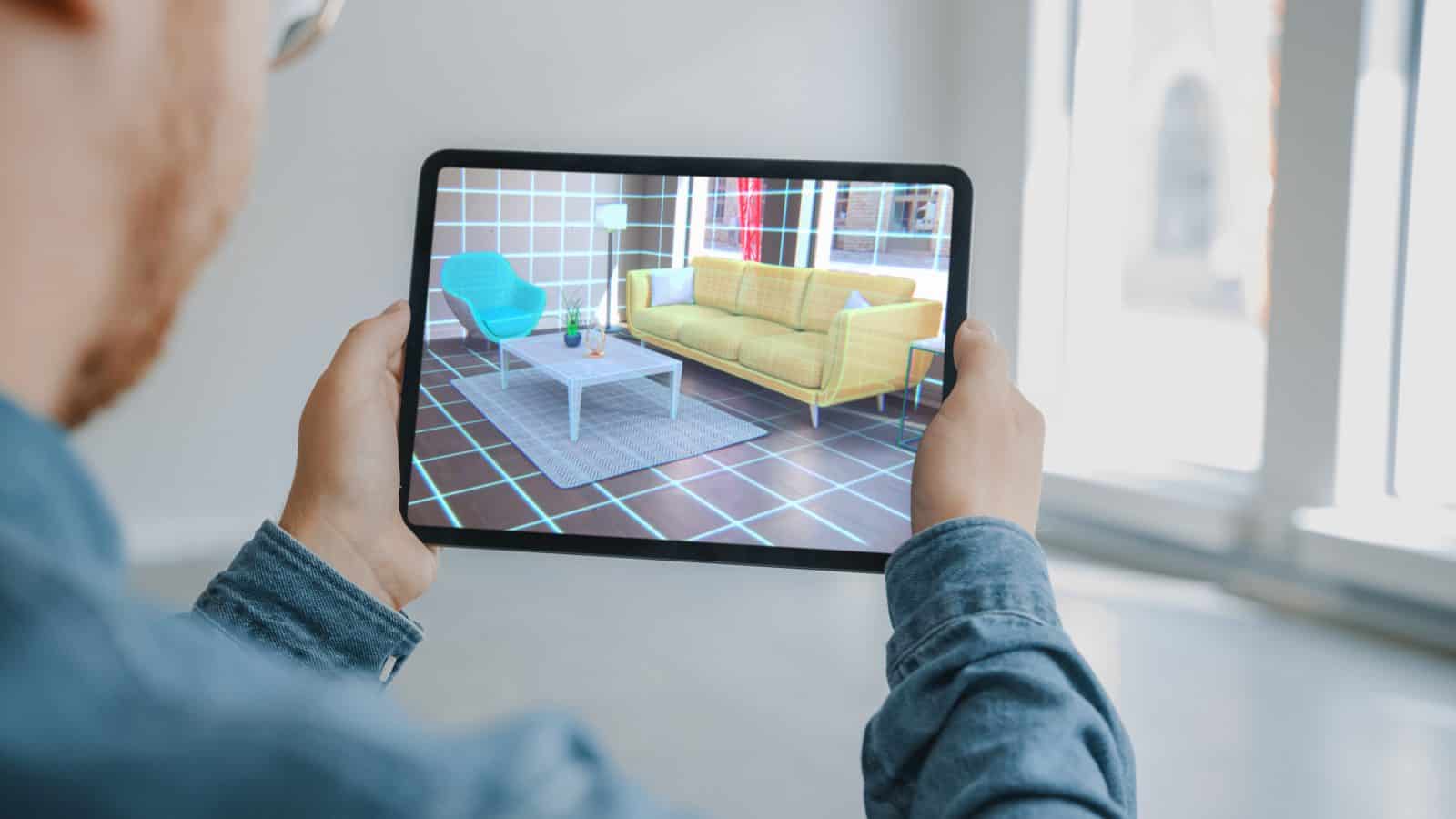
    Marketers will have to broaden their horizons and will have to think in “3D” and imagine not only the user’s in-store experience, but also a safe and efficient experience that can be enjoyed directly from the couch at home, through a VR. 

    The Metaverse, with its innovations, radically revolutionizes advertising and marketing techniques, such as the ‘day one’ for the launch of a new product on the market by a brand: promotional events could take place in virtual mode with unlimited access, within a specially constructed digital space, providing participants with some exclusive benefits linked to this experience.

    In particular, these are going to be the main changes:

    – As narrative techniques become 3D, marketing and advertising methods are also transformed: advertisers will have to respect and not interrupt the immersive and shared experience of users in the Metaverse. In order to engage and retain users, therefore, new advertising methods designed to blend fluidly into the Metaverse’s spatial dimension will be needed – completely eliminating methods such as interstitial pages that interrupt the digital experience, distracting and unnerving users. Examples of innovative forms of advertising are Nike’s virtual launch of its latest Air Jordan in Fortnite, or Gillette Venus offering different skins in Animal Crossing New Horizons.

    Gillette Venus

    – SEO will also be present in the Metaverse: just as we optimize content to be indexed in search engines, it is time to start positioning ourselves in the world of the Metaverse as well.  

    – Gamification will become an essential element of communication: interacting in a virtual three-dimensional space where users can have experiences enriched by the perception of their own and others’ presence in the shared space. The feeling of being together with other people in a digital space expands the palette of actions, reactions and ideas that can arise from interaction with others, perceived in a digital proximity implemented in the 3D space of the Metaverse.

     Gamification

    Metaverse for e-commerce?

    The answer is obviously yes. According to the report “Social Media Trends 2022” the Metaverse in e-commerce could even become a “trend” as early as next year; the growth of e-commerce in the Metaverse is a trend that will see strong growth in the coming years. The Metaverse for e-commerce could meet the needs of sellers and end consumers, allowing a virtual contact similar to the real one you can experience in the typical retail space. Above all, it responds perfectly to the needs of the new generation Z, the key target for the next 20 years, who do not perceive the barrier between offline and online. More and more brands are ready to adopt the Metaverse for ecommerce, introducing increasingly revolutionary features that will allow offline and online shopping to become a symbiosis.

    Metaverse for e-commerce

    The Metaverse will allow brands to offer shoppers a highly personalized digital experience that focuses on a seamless solution that makes it easier for customers to find exactly what they want and when they want it. It will be possible, thanks to virtual reality, to recover the concept of spatiality by being able to walk through shopping centers with the convenience of not even having to leave the house. A remotely controlled avatar will make every move for the user with the freedom to shop.

    What can companies do to get the most out of the Metaverse in Marketing? 

    Many brands are giving their marketing space in the metaverse:

    – Coca-Cola celebrated International Friendship Day on 30 July with the launch of its first collectibles in the virtual world, through a three-day auction. A friendship box containing some of the brand’s most iconic “objects”, but reinvented for the metaverse. For the occasion, Coca Cola also held an event in the decentraland metaverse;

    Coca-Cola celebrated International Friend

    – For the launch of its new model, the Nissan Juke car manufacturer decided to use customer engagement to engage and guide its users in their choice of product through various games and immersive realities. Stimulating conversion thanks to the emotional power of the video game;

    Nissan Juke car

    – Microsoft, presented Mesh for Teams that allows users to participate in video calls as avatars, providing a sense of shared presence in a meeting. You can connect from any device, without necessarily needing VR/AR viewers.

    Microsoft, presented Mesh for Teams

    The Metaverse in the marketing sector enables the merging of the physical and virtual worlds to significantly enrich consumers’ everyday experiences. 

  • Give new life to your Newspaper using AR

    Give new life to your Newspaper using AR

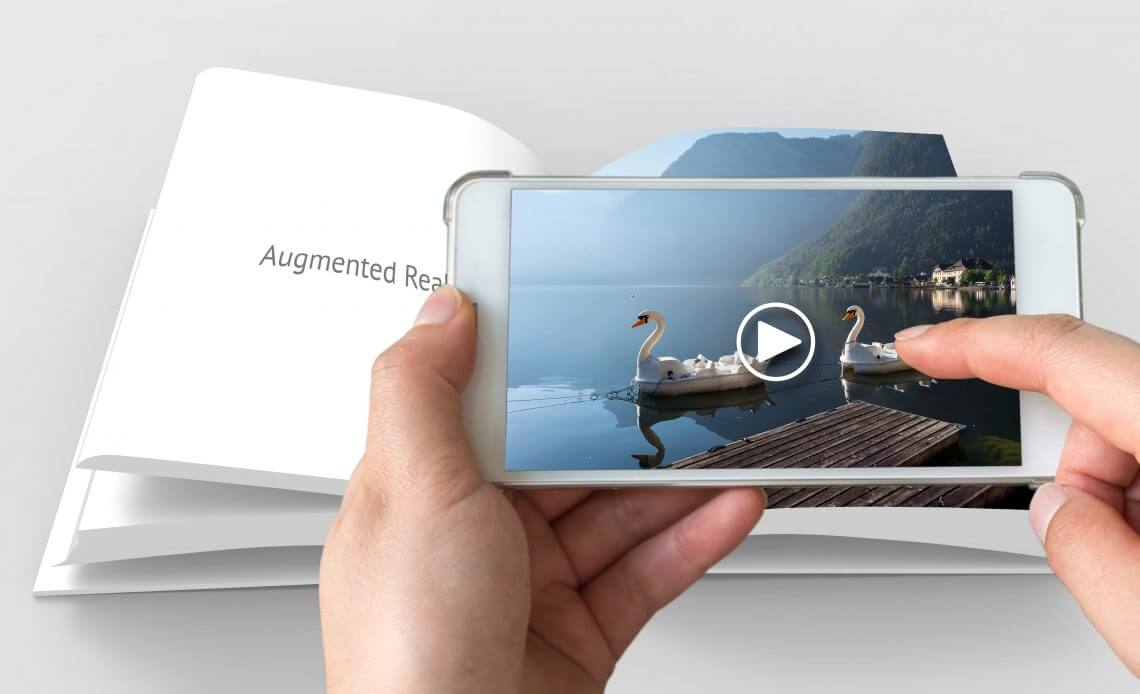
    You can give new life to your Newspapers with AR. Since we all saw the first film of Harry Potter, back in 2001, we all imagined how it could have been to have the first page of our favorite newspaper moving, having life and maybe showing you exactly what you want to see. Well, thanks to the “magic” of  Augmented Reality, this is now finally possible. 

    Of course, the AR “magic” can be activated only using a digital “wand” such as our everyday smartphone or tablet. The process itself is quite easy: using a mobile device, the AR app recognises the target image and lets you see the “magic” appear, watching the photo or the article coming to life through your device. 

    ar in newspaper Harry Potter

    Why you should give new life to your Newspaper using AR

    To increase the engagement and therefore sales

    New generations tend to use printed products less, especially newspapers, since they now grow up surrounded by technology tools in every step of their lives. Younger generations, indeed, may find printed products slower, less updated and less engaging, simply because of a lack of interactivity that digital products instead offer constantly. It is known, now, that digital is taking over print more and more every year. Using AR, though, the interactivity aspect is fully filled, giving to the readers an enhanced engagement with the content.

    To have an updated Newspaper with open information

    If printed products are well known for their static nature, the use of AR can mutate this aspect too. When a newspaper is published, the information on it cannot be changed or updated and sometimes,  when published, the news is already old. AR can resolve (or evolve) this feature by adding, for example, a link to the news to make the readers be able to stay updated about the developments of that particular news.

    The article in the newspaper could also be only a fragment of the news and by using AR, the reader could have the chance to see more about that news, with deeper investigations by way of videos, updated articles, more photos and so on… 

    To make readers “hear” the Article

    Everyone happens to be so busy that there is no time to read a full article, so think: “what if I could listen to it on my way to work?”. Well, with AR this is possible. Connecting the reader’s smartphone to the newspaper, the reader might be able to listen to the article or every other content present in the newspaper. Moreover, it is important to say that not only it is something that can help busy or lazy people, but also the ones who have sight problems and find it difficult to read a normal newspaper article.

    ar in newspaper

    To share a deeper knowledge thanks to the Three-dimensionality

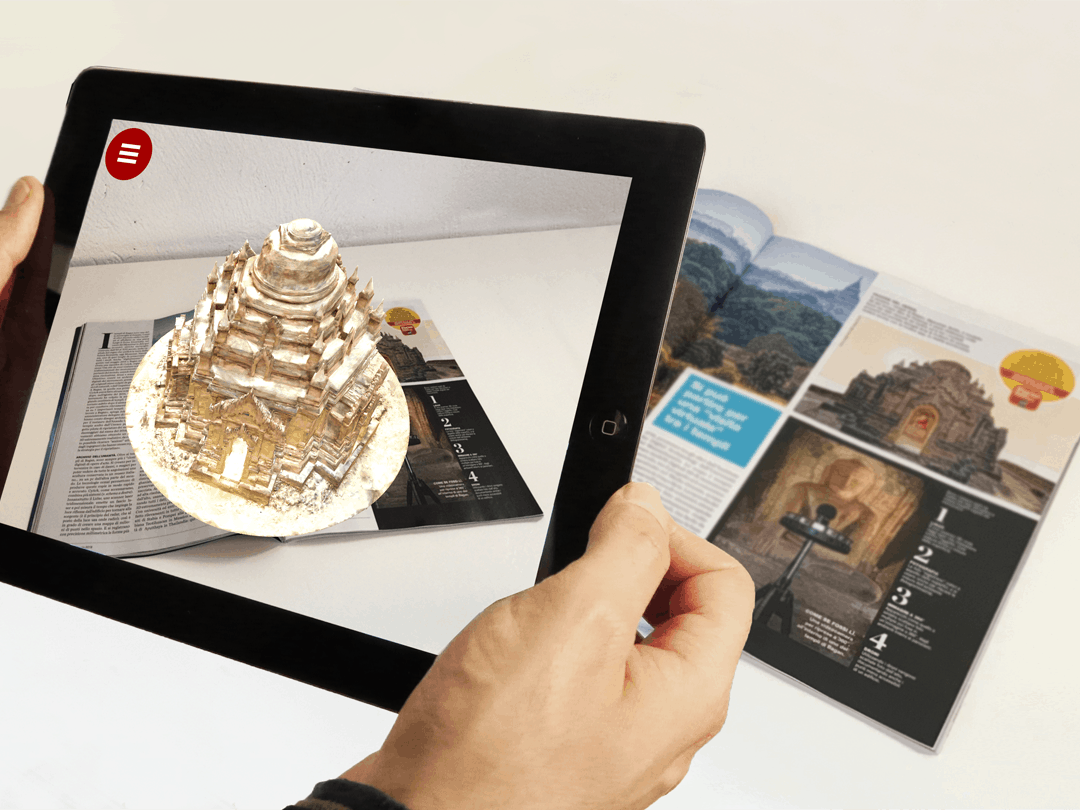
    The AR Three-dimensionality is definitely one of the main aspects that give new life to your Newspaper. The adoption of AR in newspapers can also help the reader to better understand specific graphic content thanks to the transformation of those in 3D models, perfectly seen in the mobile device. For instance, it is possible to have a full 3D view of a photo or an object present in the newspaper, by simply scanning it on the mobile device and looking at it from every angle.

    To create active readers

    Using AR in the newspaper might also mean being an active reader and making real contributions in the collection of the news. It might be possible, indeed, for the readers to add their own information, creating a sort of open source newspaper where everyone can add comments, integrate information and maybe share footage of what happened in that article. That could even help the journalists who are looking for deeper information and make the reader feel like an active helper in the newspaper and raise in him the willingness to read the next page, the next day and the day after and the day after that… 

    ar-newspaper

    The worlds of information and publishing are more and more going through a digitalization path and the adoption of AR could integrate the print product with the digital, creative a more tangible, immersive and innovative way of making information.

  • Augmented Reality in Marketing and AR use cases

    Augmented Reality in Marketing and AR use cases

    Industry experts have long known that Augmented Reality is a powerful marketing tool, while in more recent times the Pokémon Go boom has made everyone understand the huge business impact of the technology.

    There have been many businesses that have ridden the wave exploiting PokeStop and Pokémon gyms in order to attract a greater number of customers, and getting some success.

    Pokémon Go, to be honest, is not the world’s most powerful implementation of Augmented Reality, although in its simplicity it was able to achieve unprecedented success.

    Application scenarios of Augmented Reality in marketing are numerous and require a dedicated study.

    AR for print products

    Although the digital revolution has dramatically changed the way we use information, still a relevant piece of information is conveyed through paper, such as newspapers, magazines, catalogs, flyers, books, etc …

    Despite having lost ground to digital, paper products are still a powerful means of communication and this is confirmed by the McKinsey Global Media Report 2015 which basically highlights two trends: the first concerns the maturity of the print media (+ 1.7% growth from 2014 to 2019); the second a steady growth of the digital (+ 9.5% in the same period).

    This suggests that these two seemingly distant worlds, can live well together, and indeed they can also cooperate. In fact, according to research by Digimarc, 75% of consumers think that digital media is a complement to paper, rather than a replacement.

    Marketers from all sectors can think of innovative ways for presenting their products and services, combining greater clarity of the offer to a greater customer engagement. It has been demonstrated, according to the claim made by Lisa Hu, that using Augmented Reality you can get a dwell time 2.5 times higher than that of traditional media (TV, radio and newspapers).

    To date, cases of successful Augmented Reality implementations in the publishing area relate to, among others, the creation of immersive catalogs, magazines and books with AR.

    Augmented Reality for events and trade shows

    The promotional environment for excellence, for many companies, is that of fairs and events in general. These are special occasions for companies to show off theirs strengths and to try to engage visitors in order to convert them into customers or at least into leads.

    In this context, companies focus a lot on entertainment, giving visitors the opportunity to try the products and to make the time spent at the stands a memorable experience.

    The use cases of marketing actions with the support of Augmented Reality in this area are diverse, ranging from brochures and catalogs with immersive 3D visualization of the product, to the organization of contests and gaming experiences to engage and amaze visitors giving them a concrete idea of the real potential of the product.

    AR for packaging

    A sub-set of paper products, to which more and more companies turn their attention to design marketing actions with Augmented Reality, is packaging.

    What better time to engage the customer and to provide additional information on the product except when she is face to face with the package?

    There are interesting use cases of interactive packaging that put people in a position to activate additional content or mini-games that come to life from a bottle of a soft drink, rather than from the foil of the chips of a fast food and so on.

    The result is an increase in brand reputation and customer loyalty, because when customers are faced with a similar product, they tend to pick the more exciting purchase experience.

    Augmented Reality for in-store experiences

    The natural ability of Augmented Reality to expand people’s vision makes it particularly suited to design in-store marketing experiences, allowing retail companies to offer additional layers of information to the visitors.

    This category of use cases includes indoor navigation to guide people in a particular area of the store, maybe to locate special deals; the display of products and information that is not physically present in the stores because of space limitations; the possibility to sort or read the data on the origin, understand the production process, watch a promotional video, etc …

    These experiences can be enriched by the gamification of the buying process with premium and retention mechanisms.

  • Experience this vintage table radio in AR for free!

    Experience this vintage table radio in AR for free!

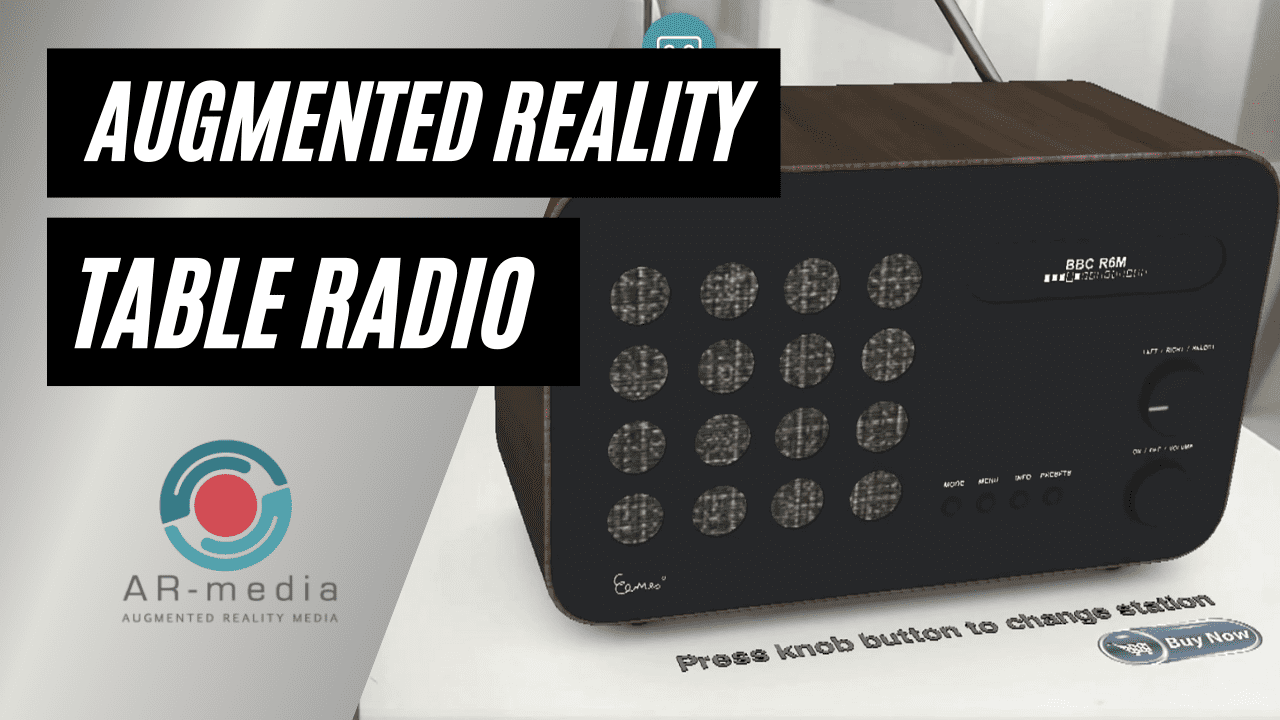
    After developing a successful method for moulding plywood in the early 1940s, Charles and Ray Eames employed the acquired know-how to create a wide range of products – including radio cabinets. By 1952, roughly 200,000 radios with cabinets designed by the Eameses had been sold by various manufacturers.

    One design, however, never went into production: an elegant table radio with a moulded plywood case, whose compact shape and austere, more technical look were unusual for the time. (Source: https://designmuseumshop.com/products/eames-radio)

    AR-media user and evangelist Daniel Nunes Kroll, CEO of the Brasilian company A Arquiteta, created a fantastic Augmented Reality experience using the Eames Radio itself, making it play music and giving the user the ability to switch from one radio station to another. 

    This is a planar experience you can try yourself for free. Download the AR-media app for iOS or Android, download and print the image trigger from the app; frame the trigger using the AR-media app and enjoy this interactive AR experience.

    How it was created using AR-media Studio

    This interactive AR experience was created using AR-media Studio, the Mixed Reality platform powered by Inglobe Technologies.

    This project was created as a planar project, meaning that the 3D content is anchored to a target image.

    The 3D radio was added inside the 3D editor and from there the interactions were created by using the AR-media Behaviours Manager, that lets you manage several types of interactions and conditions.

    AR-media Behaviours Manager

    A guide on how to create planar projects with AR-media can be found here: How to create a simple planar project – Inglobe Technologies

    Get a free AR-media account and start creating, you can rely on detailed tutorials and documentation available in the support section.

  • AR Smart Glass: why we still have to wait for mass adoption?

    AR Smart Glass: why we still have to wait for mass adoption?

    The smart glass market was valued at USD 3.89 billion in 2020 and is expected to reach USD 7.96 billion by 2026, at a CAGR of 12.66% over the forecast period 2021 – 2026 (Source: Mordor Intelligence)

    Punctually every year the analysts and observers of the AR market begin to speculate on the fact that the current one could finally be the year of the mass affirmation of smart glass, and just as punctually at the end of the year the sales volumes turn out to be quite low to be able to talk about sales success.

    What we have learned so far is that the smart glass market is certainly a very promising market, however there are still a number of obstacles that must be removed to facilitate its large-scale adoption, both in the Enterprise and the Consumer world.

    For this reason we have decided to take a look at how the players in this market are moving in an attempt to understand what direction they are taking and on what type of devices they are orientating, in order to understand, as developers and end users, what we can expect in the coming months and years.

    Microsoft

    Microsoft is one of the few companies that has approached augmented reality wearables more successfully. Since the launch of the first version of Hololens, until today, the Redmond company has been able to create a functioning ecosystem of software and hardware, which has made Hololens the reference AR device for the Enterprise , while it has never coveted to become a Consumer product.

    Microsoft Hololens 2

    We expect to see Microsoft still at work for a long time in this area and we think it can succeed where it has failed with mobile devices.

    Snap Inc.

    Snap Inc., the company that owns the Snapchat social media platform has always been among the first to experiment with Augmented Reality in different forms, first by proposing AR filters on its app, then by launching the Spectacles, smart glass equipped with cameras and designed to make it easier to upload video and photo content from the glasses directly to the Snapchat account.

    Snap Spectacles 2021

    In the recent weeks we all read the news of the acquisition, by Snap Inc., of WaveOptics, a UK startup, purchased for 500 million dollars. WaveOptics is a manufacturer of displays for smart glasse, both for the optics and projection part and it is the same technology already used by Snap in its smart glass Spectacles 2021.

    Snap’s move has the dual objective of strengthening itself in the hardware sector of Consumers Smart Glass, positioning itself among the leaders of this rapidly expanding market, but at the same time also defensive, to avoid excessive growth among its competitors.

    Apple

    For years we have been hearing rumors about a possible launch of AR Smart glass by Apple, but for the moment the Cupertino company has not yet released any device totally dedicated to Augmented Reality.

    Apple has worked a lot on the software side, in particular with ARkit, to provide a valid tool for developing immersive applications and, on the other hand, it has equipped its iPhones with technologies capable of accurately mapping the surrounding environment, such as Lidar, with the aim to provide a basis for the fruition of advanced AR experiences.

    The rumored Apple View Render

    Again, as of 2021, we just have rumors. They say Apple will finally release a Mixed Reality headset in 2022 and that it will be endowed with eye tracking capabilities, an 8K display and a 5 nanometers CPU. There are even presumed renders of such a project, but they haven?t been confirmed in any way.

    What we know for sure is that Apple is not known to launch products in a prototype state, as for example did Google with the Google Glass, rather the company launches a new product when it is certain to obtain an adequate market response.

    Facebook

    Facebook is one of the Tech Giants that has been investing more in immersive technologies for some years now, in particular with the acquisition of Oculus and the subsequent release of several successful VR devices.

    But Facebook does not seem to want to stop there and has recently created the “Facebook Reality Labs” division, within which all the company’s efforts in the area of Mixed Reality converge.

    Recent statements by CEO Mark Zuckerberg revealed that Facebook is working in partnership with the eyewear giant Luxottica on a new Mixed Reality device that will carry the RayBan brand.

    Currently not much is known about this new product, except that it will not have a display and that it could resemble Snap Inc.’s Spectacles. So as the first non-VR smart glass, Facebook could release a simple smart glass, which connects to the mobile phone, but, it seems, without offering real functionality of viewing virtual objects in the real world.

    Alleged prototype of Facebook Smart glass

    Mobile AR

    In the uncertainty of a market that struggles to find the killer device, mobile devices remain a certainty, which in recent years have served as a vehicle for Mixed Reality towards the mass market.

    Thanks to social networks, AR filters and several successful apps (e.g. Pokemon Go), Augmented Reality has landed on billions of devices, making them known all the advantages and, in some cases, the limits.

    Google Cardboard

    Mobile AR represents the compromise, the technology that already exists, affordable and accessible to all and which fills the gap left by the absence of an affordable and ergonomic AR smart glass for the masses. It is expected that the Mobile AR market will triple its value in the next three years. (Source: Statista)

    As of today it is quite difficult to find a wearable device priced like a smartphone with all of its components, a dedicated CPU, a high resolution display, wifi, GPS, compass, etc?

    Moreover smartphones can easily be adapted into wearable devices when used in combination with affordable Mobile VR headsets like the Google Cardboard or the Homido VR.

    Leveraging on the computing power and advanced features of mobiles, it is possible, today, to turn smartphones into valuable Mixed Reality Headsets that allow to deal with a growing number of needs and applications while at the same time may guarantee both scalability and quality of experience.

  • Releasing the AR-media Immersive Mode

    Releasing the AR-media Immersive Mode

    As we disclosed a few weeks ago, our development team has been working hard to implement a new visualization mode for every experience enjoyed using the AR-media Player, the Immersive Mode, an AR feature to be used in combination with your Mobile AR headset of preference, including Google Cardboard.

    Today we are glad to announce that the Immersive Mode is finally available to all AR-media users, including the ones with a Free plan.

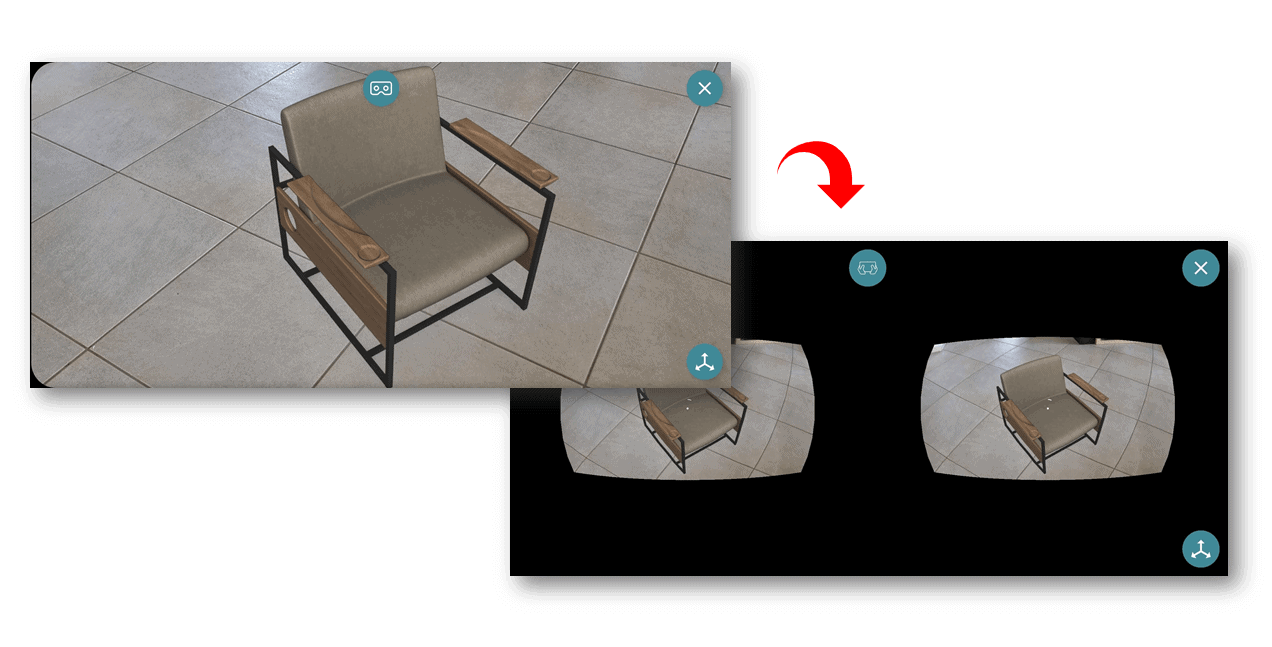
    Using the Immersive Mode is easy! You will find a new button available when you play any experience, just tap on it and your display will switch into a split mode. Then simply use your smartphone in combination with your Mobile AR headset and you’ll be ready to enjoy a truly immersive Augmented Reality experience.

    What kind of hardware do you need for Mobile AR?

    In order for you to enjoy the immersive mode, you need some kind of device that allows you to exploit the split screen functionality, typical of stereoscopic visualization.

    There are loads of products on the market, from entry level to semi-professional.

    You can start to get a Mobile AR accessory from as low as 14.99$, like in the case of the Homido product line, to higher price tags like in the case of the Merge Headset.

    A very popular Mobile AR option is the Google Cardboard, available for a few dollars from several eCommerce stores and distributors, including customizable units.

    What use cases the AR-media Immersive Mode enables?

    There are several scenarios where the AR-media Immersive Mode can prove to be useful. By their nature, certain kinds of experiences are best enjoyed with a Mobile AR headset, just think of 3D models in 1:1 scale that allow the viewer to walk inside out the object for proper exploration, or think about entertaining 360 experiences.

    In general the Immersive Mode provides a cost effective way to provide truly immersive experiences for areas such as Cultural Heritage, Architecture Engineering & Construction (AEC), Design and Prototyping and even Education.

  • Runners’ Magazine “Correre” offers AR to its Italian readers

    Runners’ Magazine “Correre” offers AR to its Italian readers

    We discussed the importance of Augmented Reality in Publishing several times, stressing the attention on the shift in preferences towards digital content from the readers worldwide, however we never cease to be amazed when a new product joins the AR club and starts offering Augmented Reality content to its readers, in order to provide a more satisfying experience.

    Sports magazines, books and other print products, being related to sport events and performances, often fall short in the attempt to provide an engaging storytelling about them, since in many cases, using just pictures, is a constraint that readers tend to overcome by consulting additional multimedia sources, like social media and digital media, that offer video content. This constraint can be finally left over by providing an augmented reading experience.

    Another sports magazine joins the Augmented Reality club

    Italian publisher “Editoriale Sport Italia” recently brought AR to its football magazine “Il Nuovo Calcio” and, starting from march 2021, also to runners’ magazine “Correre”.

    The editorial staff started adding AR content to selected pages inside the Correre magazine in order to provide additional in-depth content like interviews, highlights, training tips and more. Such content can be enjoyed by means of a mobile App that the readers can download from the iOS and Android app stores at no additional cost!

    By pointing the smartphone’s camera to those pages with the AR icon, readers can download and enable videos, animations, 360 content and other media files that bring the pages to life.

    Using the “Correre AR” app

    More and more publishers are choosing AR-media

    One of the key elements of the increasing diffusion of AR books and magazines is the accessibility of the authoring tools. The easier it is to create Augmented Reality experiences for print media, the higher is the chance of having more products like these in the publishing market.

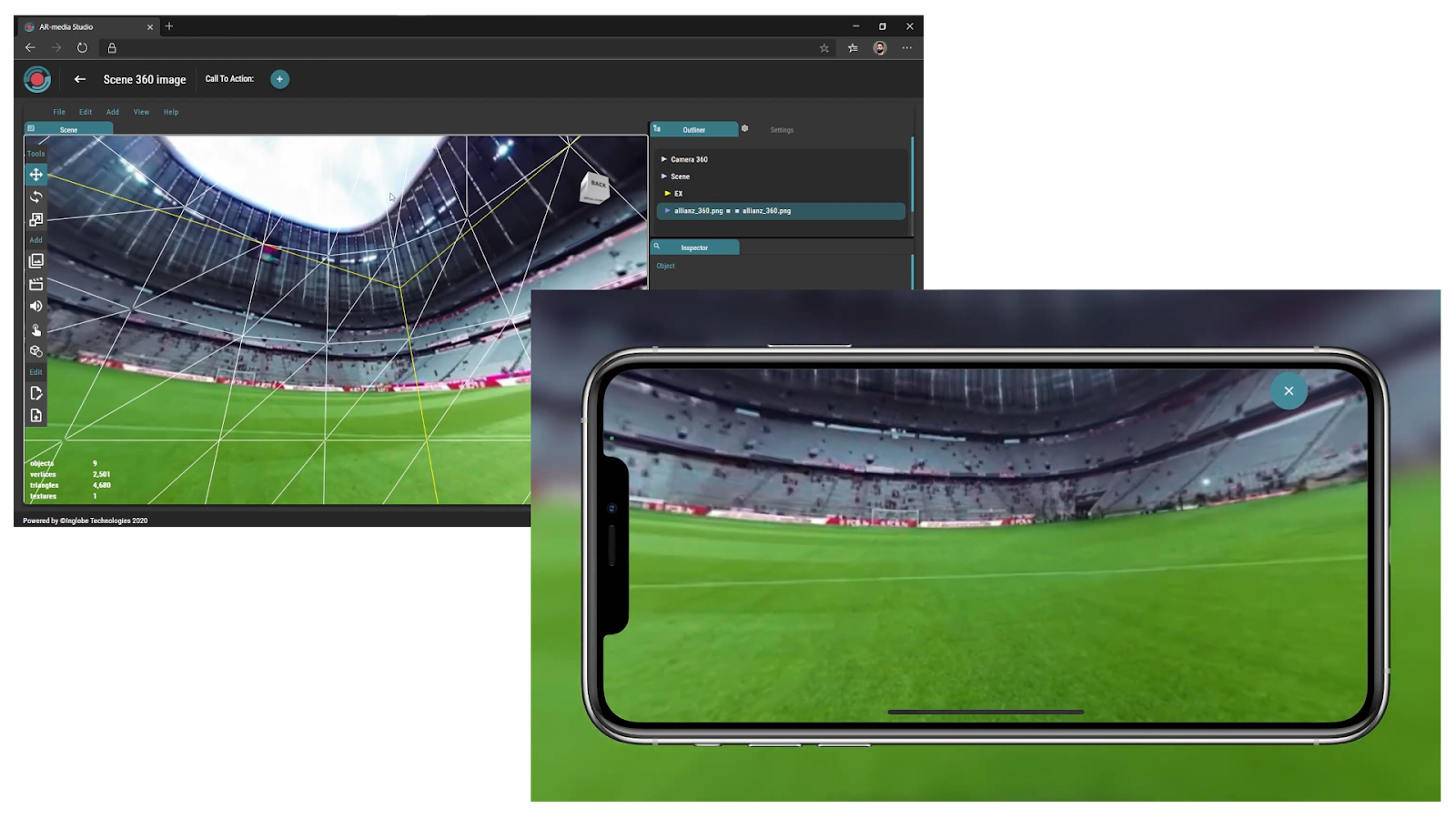
    One of such tools is AR-media, Inglobe Technologies’ Zero Coding Augmented Reality platform, a visual and easy to use tool for creators willing to quickly and effectively produce immersive content for a variety of audiences and use cases, including publishing.

    Get to know more about AR-media and get your free plan now –> https://www.inglobetechnologies.com/ar-media/

  • Il Nuovo Calcio, the first sports magazine in Italy to embrace AR

    Il Nuovo Calcio, the first sports magazine in Italy to embrace AR

    Starting from issue #336 of February 2021, the Italian sports magazine “Il Nuovo Calcio” embraces AR in order to offer additional content in conjunction with the printed magazine.

    To celebrate the magazine’s 30th anniversary, the editorial board decided to release a brand new mobile application, named “Il Nuovo Calcio AR” for iOS and Android devices, providing exclusive access to interesting and updated multimedia content that would not be possible to deliver on paper.

    With this move, Il Nuovo Calcio is the first Italian sports magazine to embed AR multimedia files into its product, confirming the trend, already underway by the major publishers, to offer a hybrid product that integrates both the traditional logic of publishing with the digital ones. The final aim is to offer a renewed and more appealing reading experience.

    As we discussed before, the publishing industry is undergoing great changes, mainly due to the rise of interest of readers towards digital products and channels, which is part of a general shift of information towards digital media. One of the ways to strengthen paper products’ appeal is by providing a mix between digital and traditional, which is a type of support to which people are still very attached to.

    What an AR sports magazine can offer?

    With the introduction of its application, Il Nuovo Calcio will be able to offer content that will enrich the reading experience, by making pages more interactive and more entertaining.

    It is easy to imagine how much a sports magazine can benefit from AR content like video interviews, highlights, tactical animations, gallery of photos and even 3D models of stadiums or other sport facilities.

    Before this hybrid model was even possible, readers used to read paper products and then they explored the topic more in depth using the internet. Often publishers themselves provide indications and website references where a topic can be studied in depth, when they haven’t the chance to embed it directly into the product.

    Finally with AR and VR, publishers have more tools to deliver their content and to provide a truly fulfilling experience.

    One of such tools is AR-media, Inglobe Technologies’ Zero Coding Augmented Reality platform, a visual and easy to use tool for creators willing to quickly and effectively produce immersive content for a variety of audiences and use cases, including publishing.

    Get to know more about AR-media and get your free account now –> AR-media – Create Augmented Reality without coding (inglobetechnologies.com)

  • How Publishers can use Augmented Reality to upgrade their business

    How Publishers can use Augmented Reality to upgrade their business

    The publishing industry has undergone a massive transformation in the last decade, with mobile and portable devices opening the door to digital content that wasn’t as easily and freely available before. E-books, online magazines and other multimedia content now abund and seriously challenge the supremacy that traditional and paper based products had before.

    PwC Global Entertainment & Media Outlook 2020-2024 CAGR by segment

    Not only digital media challenged traditional media in the adoption rate, but it is also becoming increasingly attractive for advertisers that are shifting their budgets towards digital channels year over year.

    One of the reasons behind this shift is that not only digital media attract more users, but it also allows advertisers to target their message to a better profiled audience.

    In some countries digital advertising revenues already surpassed traditional advertising and where it didn’t happen yet, it is set to happen in 2021.

    US Advertising Media Market Sizes 2020 vs 2024

    The solution to changing preferences in the Publishing Industry

    Most of the major consulting companies agree that publishers and editors should reposition their products and start mixing innovative and engaging experiences into their traditional offer.

    A lot of people are still attached to paper products and rather than completely replacing them, they’ve started making it complementary with digital products.

    US Internet User's Magazine Readership Trends

    Digital and Paper can live together as they offer profoundly different user experiences. So why not contaminate paper products with engaging content that readers typically expect to experience only on digital products? To us that is the key to rejuvenate the image of paper products and making them more attractive. There are plenty of options to achieve this goal and we believe that Augmented Reality plays a crucial role in this process.

    Augmented Reality Books

    There are certain book genres that would benefit a lot from an integration of multimedia content enjoyed in Augmented Reality. Just think about technical and scientific books with a lot of images, schemes and illustrations, they may be complemented by videos, animations, infographics and 3D models, making the reading and learning process much more effective.

    Credits: Eosliber by Ripensarte

    Augmented Reality Magazines

    Today we have quite a few examples of magazines that have embraced Augmented Reality as a part of their content offering. Telling a fact or a news with the aid of interactive media provides the reader with an experience that is a hybrid between the traditional and the digital ones.

    Just here in Italy we have quite a few examples of magazines that are offering AR content to the readers with Focus by Mondadori being the most popular one, with over 100.000 readers having downloaded the AR app to enjoy the multimedia content.

    Augmented Reality Newspapers

    Newspapers are probably the category that lost more ground in sales because of the shift of many users to digital channels to stay informed. Paper newspapers have to be printed every night and distributed in the whole country in a matter of hours, making it a continuous challenge.

    Editorial offices have to work very quickly to get the work done in time and sometimes, as the newspapers are being printed, they are already out of date because something else happened.

    Augmented Reality could help editors to provide newspapers with up to date information, since the AR content can be prepared and/or updated, even once the newspapers are out.

    Credits: AdvisionPlay

    Augmented Reality School Books

    Just like technical and scientific books, school books are often full of images, illustrations, infographics, that serve the purpose of helping students to understand more effectively what’s being taught in that book.

    Imagine students studying the solar system while pointing a device to their book and watching the animation of the planets moving around the sun in 3D, or also studying history by watching small clips taken from documentaries that provide appropriate in depth information related to those facts.

    Credits: Visible Bodies

    How AR-media can support Publishers in the transition

    Augmented Reality can support publisher transition to a hybrid model of traditional and digital media, offering paper products with additional multimedia content attached to a certain number of pages.

    With this approach readers can continue to enjoy a product they are attached to, while benefiting from the innovation of digital content like videos, 3D models, 360 photos and videos and so on.

    Moreover, with the aid of data analytics and push notifications, publishers can build and nurture a relationship with their readers and have a better understanding of their preference in terms of types of content, by analyzing which pages have been scanned the most and how long the reader spent on each one of them, that are typical tools available to online publishers.

    In this scenario AR-media is the ideal tool to build and publish Augmented Reality projects for Publishers, as it requires no coding skills and allows the user to create AR content with a visual, simple workflow. Get a free AR-media account and start creating, you can rely on detailed tutorials and documentation available in the support section.

  • What Photographers can do with Augmented Reality

    What Photographers can do with Augmented Reality

    With the AR/VR market set to touch almost 19 billion dollar in sales in 2020, including hardware and software, it is now clear that is increasingly and rapidly becoming a mass market, collecting the interest of consumers and professionals from many areas, from industry to architecture, from marketing to publishing.

    The opportunity Augmented Reality offers to content creators is to provide an engaging way to explore traditional media, turning them into live contents, rather than just still ones.

    This is especially true for Photographers: they use a lot of technology and digital tools in their work, but the final result is a static content, a picture, printed or digital.

    In an effort to identify what they could do in order to offer more dynamic and interactive products, we analyzed a number of use cases related to their work, helping them to understand how they could surprise their clients and differentiate themselves from the crowd.

    A Photographer, as well as a Video Maker, creates a lot of content, thus it is quite simple for them to create Augmented Reality products and services starting from what they already have. Some examples of what Photographers can do with the help of Augmented Reality include:

    Immersive Photo Albums with Augmented Reality

    Photographers use to create photo albums to collect all the photos of a specific event, be it a trip, a wedding party, a birthday or any other special occasion. Their photo albums are printed products that provide a traditional way of use: people browse them to look at the pictures.

    But nowadays Photographers do much more than that. They shoot professional videos and even video clips with drones, or 360° photos and videos. Unfortunately such content cannot be included in a printed photo album and must be enjoyed separately on a computer, smartphone or smart TV.

    Finally with Augmented Reality apps it is now possible to pack the entire experience into a device, typically a smartphone, enabling the visualization of slideshows, videos and 360°contents on printed photo albums. The product comes to life making the entire experience funnier and more satisfying.

    Visualization of 360° Photos and Videos

    Photographers who shoot panoramic and 360° photos and videos cannot use printed media to let their clients visualize that type of content. Of course you must use at least a smartphone in order to be able to properly view 360° content. Using an Augmented Reality platform, connected with a mobile app like AR-media Player, helps Photographers to easily create 360° content that their client can enable by simply scanning a picture they already have in their photo album or that has already been printed.

    Photo Exhibitions with Augmented Reality

    Making a photo exhibition more engaging is easy using an Augmented Reality app and platform. Each photo of the exhibition can be associated with additional multimedia content, making the visitor’s experience more entertaining and rich.

    Scanning a photo with an Augmented Reality app like AR-media Player, activates additional content like images, videos and 3D models.

    How to upgrade your Photography business with AR-media

    Augmented Reality can clearly help photography professionals to get more out of their work, bringing their photos and videos to life through a set of existing AR applications. AR provides a powerful way to surprise clients, stand out from the competition and sell higher margin services and products.

    In this scenario AR-media is the ideal tool to build and publish Augmented Reality projects for Photographers, as it requires no coding skills and allows the user to create AR content with a visual, simple workflow.

    Get a free AR-media account and start creating, you can rely on detailed tutorials and documentation available in the support section.

  • Augmented Reality in the Rail Industry: Benefits and Use Cases

    Augmented Reality in the Rail Industry: Benefits and Use Cases

    Augmented and Virtual Reality technologies are proving their impressive potential in the Rail Industry, providing a strategic leverage to the digital transformation of this vertical. It is no mystery that AR and VR can support a wide range of industrial activities and processes, but we will focus on specific Rail use cases in this article.

    We identified two main application domains for Augmented Reality in the Rail Industry:

    1) Augmented Reality Rail Use Cases for Operators

    1.1) Design and Validation of Infrastructure Projects

    One of the most interesting applications of Augmented and Virtual Reality in the Rail field is linked to the design and virtual prototyping of infrastructural assets, such as the renovation or new construction of train stations and railway lines.

    In October 2019, the British infrastructure operator Network Rail carried out a project of this type, when it created an app that allows project stakeholders to preview the replacement of the walkways in the stations. The app, called ARki, was designed to allow local communities to preview future infrastructure prior to Network Rail’s launch of a new generation of gangways.

    In general Mixed Reality applications in the Rail industry can support building and renovation of infrastructures by providing assistance for processes like Design, Building, Environmental Impact Assessment and Maintenance.

    1.2) Management and Maintenance of Railway Stations and Infrastructures

    The maintenance of stations and railway infrastructures is certainly one of the sectors in which Augmented Reality technologies can be most useful.

    Augmented Reality allows you to remotely control the status of the tracks and railway infrastructure and, when combined with other technologies, including sensors and artificial intelligence, can provide a great deal of support with predictive maintenance.

    In the Boston railway network in 2016 the smartglasses supplied to the technical staff were tested to allow them to be connected to the staff in the office and to intervene more quickly in solving problems.

    In the United Kingdom, a startup has experimented with a technology capable of predicting faults in the tracks and the infrastructure-train communication system, tracing problems in the field in real time with wearable devices. Similar trials were also carried out in Germany by another startup.

    Drones or other rail vehicles can perform a semantic segmentation of lines, vegetation and any other obstacles that could be risk factors for operations.

    Through an appropriate extension of a Facility Management platform, it is possible to enter the company’s infrastructures and assets in the registry in order to manage maintenance activities efficiently and quickly, with the aid of Augmented Reality features.
    Workers maintenance on the railway

    1.3) Safety Management of Railway Infrastructures

    The management of infrastructure safety is back in great relevance with the COVID-19 outbreak, especially in large communication HUBs, such as airports and railway stations.
    In the context of an anti-pandemic plan, Rome “Leonardo da Vinci” airport was the first airport in Europe to equip itself with a system based on Smart Helmet for real time detection of travelers’ temperatures.

    The COVID-19 pandemic has triggered a series of complications in the management of infrastructure security that AR technologies, in close combination with those of machine learning, allow to manage in an optimal way. For example:

    – Temperature control: thanks to thermal cameras or cameras installed on Smart Helmet, together with with computer vision techniques it is possible to detect the temperature of the passengers, identify and retain them for further checks

    – Social distancing: the same technologies can be used to detect the distances between people in a given space and to calculate appropriate “safety indicators” accordingly

    1.4) Management of passenger flows

    Except for the effect of the pandemic, the number of rail passengers has been on the rise worldwide, with traffic peaking near major metropolitan cities. Thanks to the new Computer Vision technologies it is possible to monitor the flow of travelers. It is in fact possible to detect and map the flows of travelers thanks to a variety of artificial vision techniques, that, combined with advanced Augmented Reality interfaces, would allow the flow of travelers to be optimally managed within the railway stations.

    In October, the Chinese city of Shanghai, plagued by the critical effects of congestion, tested AR Smart Glasses to facilitate passenger flows ahead of the China International Import Expo. Equipped with cameras that stream commuter traffic directly to a station’s control room, they can help agents quickly identify bottlenecks. The product also helps with security checks, as the glasses offer facial recognition and have built-in speech recognition systems. Following a successful application on a single event, the glasses have now been adopted in various subway systems from Shanghai to Luoyang and Gansu.

    AR technologies, in close combination with those of machine learning, make it possible to optimize passenger flows and study the patterns of passenger movements in the station spaces.

    1.5) Staff Training

    In the railway sector, just like many other sectors, AR and VR are making staff training more dynamic, engaging and efficient. The use of this technology for training purposes has increased in recent years as it helps simplify and speed up the learning process.

    In the UK, HS2, the new high-speed rail line currently under construction, is using Augmented Reality for staff training processes. During the summer of 2019, the company rolled out immersive AR technology that created a replica of its new London hub, Old Oak Common station. Prior to its opening, staff are using this solution to train on the customer experience, safety and maintenance of the station, which is set to handle 275,000 commuters per day.

    In Spain, ADIF, the government-owned company that manages the railway infrastructure, has created a modern training center in Valencia equipped with an immersive room in which the use of Augmented and Virtual Reality is used alongside with traditional training techniques.

    In a sector where by definition the staff are geographically dispersed and work in shifts, the idea of ??in-person training sessions is particularly challenging from an organizational point of view.

    With this in mind, Augmented Reality represents the ideal solution, offering the possibility of a step-by-step visual guide, as well as that of the support of a remotely connected expert who sees what the user is working on and can direct him.

    2) Augmented Reality Rail Use Cases for Passengers

    2.1) Customer Engagement

    With a user base that increasingly uses digital tools to search for entertainment and information, the railway sector today has the opportunity to use immersive technologies to set up a more modern and engaging communication: this can mean giving new life to channels that have already been tested, such as brochures or on-board magazines, but also to consider totally innovative approaches tailored to the type of clients and itinerary.

    In recent years, Mixed Reality solutions have been put in place by various players aimed directly at users of railway services in support of a series of use cases.

    Almost all companies that provide transport services offer their customers magazines to be consulted on board the vehicles with journalistic and promotional information. The contents of these magazines can be enriched with digital information that can be consulted from your mobile device. Trenitalia implemented such a solution some time ago, albeit in a very light way. 

    HyperLoop has experimented with immersive touch windows dedicated to the entertainment of travelers, allowing them to simulate an external panorama, but also to take advantage of entertainment and shopping services.

    Since a growing number of travelers say they prefer the trip itself to the final destination, as evidenced by a survey conducted by Booking.com in 2018, and since typically these lines are characterized by a theme of high historical, geographical or artistic interest, equipping travelers with a Virtual Reality viewer through which they can immerse themselves in some of the worlds linked to the journey they are making – also in consideration of the long time available to them during the itinerary – can represent a significant added value with interesting monetization possibilities.

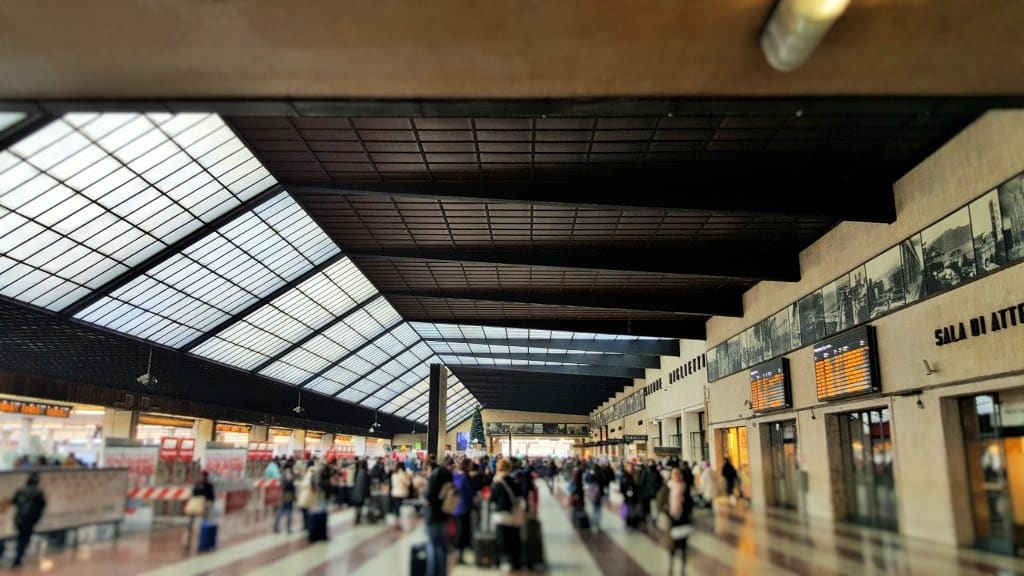
    People walking in a train station

    2.2) Wayfinding and Services

    The information relevant to a traveler is manifold and concerns that to be acquired before the trip, during the planning phase, and during the trip, when the customer is interested in entertainment services, shopping and information about the trip (eg. delays). There is also an intermediate phase, when the traveler is at the station and needs to locate their carriage, but also to use the services inside the station while waiting, such as lounge and restaurant services.

    In the UK, a private company called Trainline has implemented a signage to be activated with a mobile app to display information such as train times and routes. It is a low cost solution compared to digital display boards, therefore to be used in a complementary way.

    In 2019, Zurich’s “Z?rich Hauptbahnhof” train station launched an app dedicated to travelers with the aim of providing information on timetables and destinations starting from the station itself. The “SBB AR” app allows you to view digital content in space using environmental mapping (using Google ARCore) inside and GPS outside the structure. On Android devices alone, the application has been used by over 10,000 travelers.

    In all these cases, immersive technologies help people to retrieve relevant information in a more engaging and in some cases more useful way, see the applications for wayfinding that in complex spaces, such as in very large stations or airports, can add a lot of value for the user.

  • MSC presents the first Mixed Reality catalog

    MSC presents the first Mixed Reality catalog

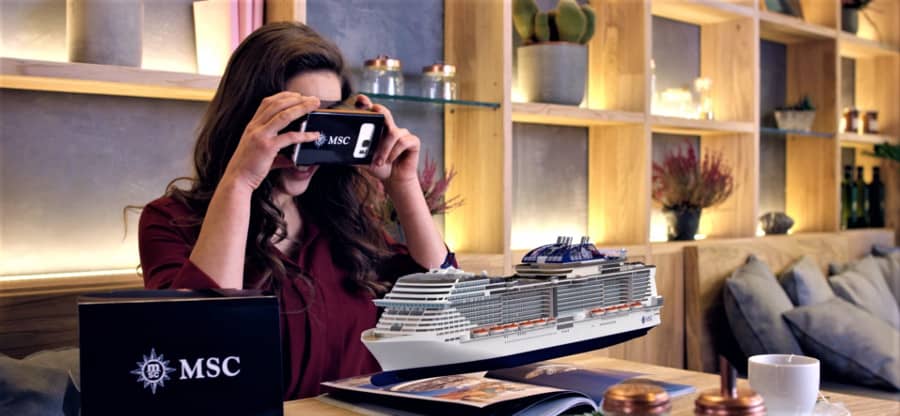
    Last year MSC Cruises, supported by Axed Group in collaboration with Inglobe Technologies, Onemore and D2B, created the first mixed reality catalog for sale of cruises through the travel agency channel. The experience consisted of displaying 360° photos and videos relative to the MSC cruise ship environments and to the locations of the various routes available. Potential customers could try to preview the cruise experience from an entirely new point of view than that offered so far by the traditional catalog.

    This year, for the 2018-2019 edition, MSC Cruises has gone further and wanted to offer an even more immersive experience by adding Augmented Reality to Virtual Reality, thus offering the first Mixed Reality catalog for cruises in the world.

    The application allows users to rely on their mobile devices to view 3D models of MSC ships, which seem to emerge from the paper catalog pages coming to life and offering an interactive perspective. In fact, you can access the panoramic views that cast people inside the environments of the ship by enabling an immersive exploration thanks to the selection of hotspots available in AR on the three-dimensional model of the ships.

    Google Cardboard visualization is also available, for an even more immersive user experience.

  • Mondadori embraces Inglobe’s Augmented Reality for its best-selling magazine

    Mondadori embraces Inglobe’s Augmented Reality for its best-selling magazine

    On december the 20th 2016 issue #291 of Focus was released on newsstands, the historical magazine published by Mondadori which explores topical themes such as science, innovation, behavior and culture, which is also the most read magazine in Italy.
    The novelty is that starting from this issue, Focus is enriched with immersive content with augmented reality, making the reading experience even more engaging and exciting.

    How does the Augmented Reality magazine works

    Focus readers with a smartphone or tablet can download from the stores the app Focus Realt? Aumentata for Android and iOS, which enables content in AR by simply framing the pages of the magazine to which are associated ?augmented? contents.
    The cover of issue #291 of Focus and several inside pages of the Augmented Reality magazine come to life by showing the reader immersive multimedia experiences related to the contents.

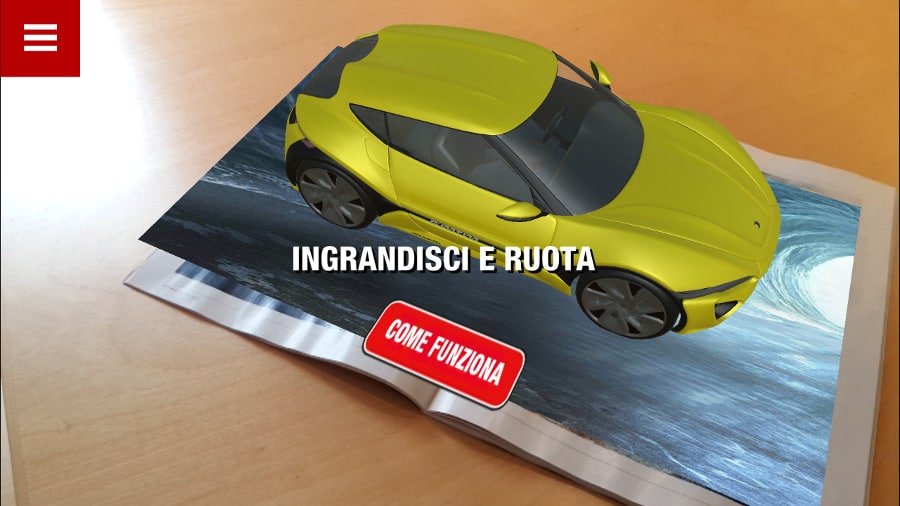
    We are talking about 3D animations, 360? videos, thematic tests, mini games and panoramic photos that add information and understanding to the text and images available to the reader, which is not limited to view only, but can interact with and activate a series of additional content according to her curiosity.

    Inglobe Technologies innovation in the solution for Mondadori

    The Augmented Reality technology is provided by Inglobe Technologies, which for ten years has been involved in the development of pioneering AR solutions. Back in 2007, when the advent of smartphones had not yet occurred, Inglobe had launched the idea of an AR book on the solar system. A few years later, in 2011, Inglobe has released a whitepaper on innovation in publishing through Augmented Reality.

    Today, almost 10 years later, thanks to the advent of the mobile and AR technologies into the mainstream, Focus Mondadori has embarked on a path of high-impact product innovation. In this context, Inglobe oversaw the entire development of the apps for Android and iOS working on contents edited by Mondadori.

    The technical features of the project include the recognition of planar images -the pages that trigger AR experiences-, gamification experiences, which allow readers to interact with contents, 360? photos and videos and a range of interactive and 3D tests.

    Augmented Reality Magazine with 3D model of Car

    Augmented Reality in Publishing and the future issues of Focus

    The path taken by Mondadori with the introduction of Augmented Reality in one of its leading editorial products highlights?two trends in the publishing industry: the first one concerns the strong need to give new life to this medium that always suffers more competition from new media and new ways of information fruition; the second one concerns the possibility of offering highly engaging content to readers thanks to the opportunities made available by the Mixed Reality. The?leading players in Publishing?are likely to move towards this direction if they want to keep an updated and attractive product for readers.

    Issue #291 of Focus’s Augmented Reality magazine is not a random experiment, but a path that will continue in the future with the regular publication of monthly issues enriched by augmented reality experiences, providing for the adoption of a technological solution specially designed for the publishing industry.
    We look forward to the next issue #292, to be published at the end of January.