Tag: maintenance

  • Augmented Reality in the Rail Industry: Benefits and Use Cases

    Augmented Reality in the Rail Industry: Benefits and Use Cases

    Augmented and Virtual Reality technologies are proving their impressive potential in the Rail Industry, providing a strategic leverage to the digital transformation of this vertical. It is no mystery that AR and VR can support a wide range of industrial activities and processes, but we will focus on specific Rail use cases in this article.

    We identified two main application domains for Augmented Reality in the Rail Industry:

    1) Augmented Reality Rail Use Cases for Operators

    1.1) Design and Validation of Infrastructure Projects

    One of the most interesting applications of Augmented and Virtual Reality in the Rail field is linked to the design and virtual prototyping of infrastructural assets, such as the renovation or new construction of train stations and railway lines.

    In October 2019, the British infrastructure operator Network Rail carried out a project of this type, when it created an app that allows project stakeholders to preview the replacement of the walkways in the stations. The app, called ARki, was designed to allow local communities to preview future infrastructure prior to Network Rail’s launch of a new generation of gangways.

    In general Mixed Reality applications in the Rail industry can support building and renovation of infrastructures by providing assistance for processes like Design, Building, Environmental Impact Assessment and Maintenance.

    1.2) Management and Maintenance of Railway Stations and Infrastructures

    The maintenance of stations and railway infrastructures is certainly one of the sectors in which Augmented Reality technologies can be most useful.

    Augmented Reality allows you to remotely control the status of the tracks and railway infrastructure and, when combined with other technologies, including sensors and artificial intelligence, can provide a great deal of support with predictive maintenance.

    In the Boston railway network in 2016 the smartglasses supplied to the technical staff were tested to allow them to be connected to the staff in the office and to intervene more quickly in solving problems.

    In the United Kingdom, a startup has experimented with a technology capable of predicting faults in the tracks and the infrastructure-train communication system, tracing problems in the field in real time with wearable devices. Similar trials were also carried out in Germany by another startup.

    Drones or other rail vehicles can perform a semantic segmentation of lines, vegetation and any other obstacles that could be risk factors for operations.

    Through an appropriate extension of a Facility Management platform, it is possible to enter the company’s infrastructures and assets in the registry in order to manage maintenance activities efficiently and quickly, with the aid of Augmented Reality features.
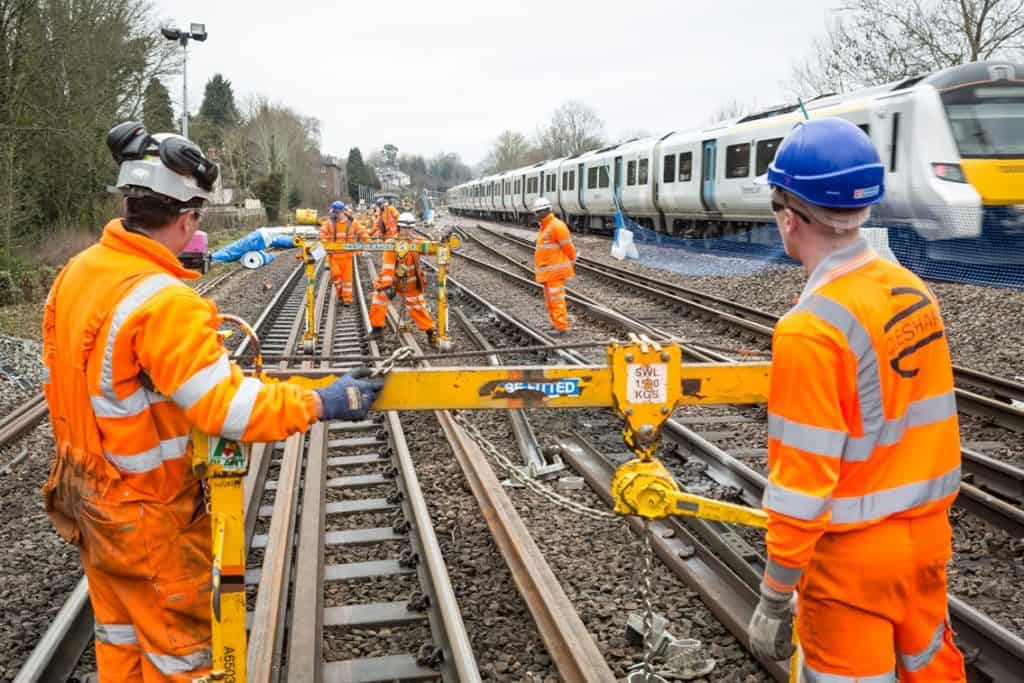
    Workers maintenance on the railway

    1.3) Safety Management of Railway Infrastructures

    The management of infrastructure safety is back in great relevance with the COVID-19 outbreak, especially in large communication HUBs, such as airports and railway stations.

    In the context of an anti-pandemic plan, Rome “Leonardo da Vinci” airport was the first airport in Europe to equip itself with a system based on Smart Helmet for real time detection of travelers’ temperatures.

    The COVID-19 pandemic has triggered a series of complications in the management of infrastructure security that AR technologies, in close combination with those of machine learning, allow to manage in an optimal way. For example:

    – Temperature control: thanks to thermal cameras or cameras installed on Smart Helmet, together with with computer vision techniques it is possible to detect the temperature of the passengers, identify and retain them for further checks

    – Social distancing: the same technologies can be used to detect the distances between people in a given space and to calculate appropriate “safety indicators” accordingly

    1.4) Management of passenger flows

    Except for the effect of the pandemic, the number of rail passengers has been on the rise worldwide, with traffic peaking near major metropolitan cities. Thanks to the new Computer Vision technologies it is possible to monitor the flow of travelers. It is in fact possible to detect and map the flows of travelers thanks to a variety of artificial vision techniques, that, combined with advanced Augmented Reality interfaces, would allow the flow of travelers to be optimally managed within the railway stations.

    In October, the Chinese city of Shanghai, plagued by the critical effects of congestion, tested AR Smart Glasses to facilitate passenger flows ahead of the China International Import Expo. Equipped with cameras that stream commuter traffic directly to a station’s control room, they can help agents quickly identify bottlenecks. The product also helps with security checks, as the glasses offer facial recognition and have built-in speech recognition systems. Following a successful application on a single event, the glasses have now been adopted in various subway systems from Shanghai to Luoyang and Gansu.

    AR technologies, in close combination with those of machine learning, make it possible to optimize passenger flows and study the patterns of passenger movements in the station spaces.

    1.5) Staff Training

    In the railway sector, just like many other sectors, AR and VR are making staff training more dynamic, engaging and efficient. The use of this technology for training purposes has increased in recent years as it helps simplify and speed up the learning process.

    In the UK, HS2, the new high-speed rail line currently under construction, is using Augmented Reality for staff training processes. During the summer of 2019, the company rolled out immersive AR technology that created a replica of its new London hub, Old Oak Common station. Prior to its opening, staff are using this solution to train on the customer experience, safety and maintenance of the station, which is set to handle 275,000 commuters per day.

    In Spain, ADIF, the government-owned company that manages the railway infrastructure, has created a modern training center in Valencia equipped with an immersive room in which the use of Augmented and Virtual Reality is used alongside with traditional training techniques.

    In a sector where by definition the staff are geographically dispersed and work in shifts, the idea of ??in-person training sessions is particularly challenging from an organizational point of view.

    With this in mind, Augmented Reality represents the ideal solution, offering the possibility of a step-by-step visual guide, as well as that of the support of a remotely connected expert who sees what the user is working on and can direct him.

    2) Augmented Reality Rail Use Cases for Passengers

    2.1) Customer Engagement

    With a user base that increasingly uses digital tools to search for entertainment and information, the railway sector today has the opportunity to use immersive technologies to set up a more modern and engaging communication: this can mean giving new life to channels that have already been tested, such as brochures or on-board magazines, but also to consider totally innovative approaches tailored to the type of clients and itinerary.

    In recent years, Mixed Reality solutions have been put in place by various players aimed directly at users of railway services in support of a series of use cases.

    Almost all companies that provide transport services offer their customers magazines to be consulted on board the vehicles with journalistic and promotional information. The contents of these magazines can be enriched with digital information that can be consulted from your mobile device. Trenitalia implemented such a solution some time ago, albeit in a very light way. 

    HyperLoop has experimented with immersive touch windows dedicated to the entertainment of travelers, allowing them to simulate an external panorama, but also to take advantage of entertainment and shopping services.

    Since a growing number of travelers say they prefer the trip itself to the final destination, as evidenced by a survey conducted by Booking.com in 2018, and since typically these lines are characterized by a theme of high historical, geographical or artistic interest, equipping travelers with a Virtual Reality viewer through which they can immerse themselves in some of the worlds linked to the journey they are making – also in consideration of the long time available to them during the itinerary – can represent a significant added value with interesting monetization possibilities.
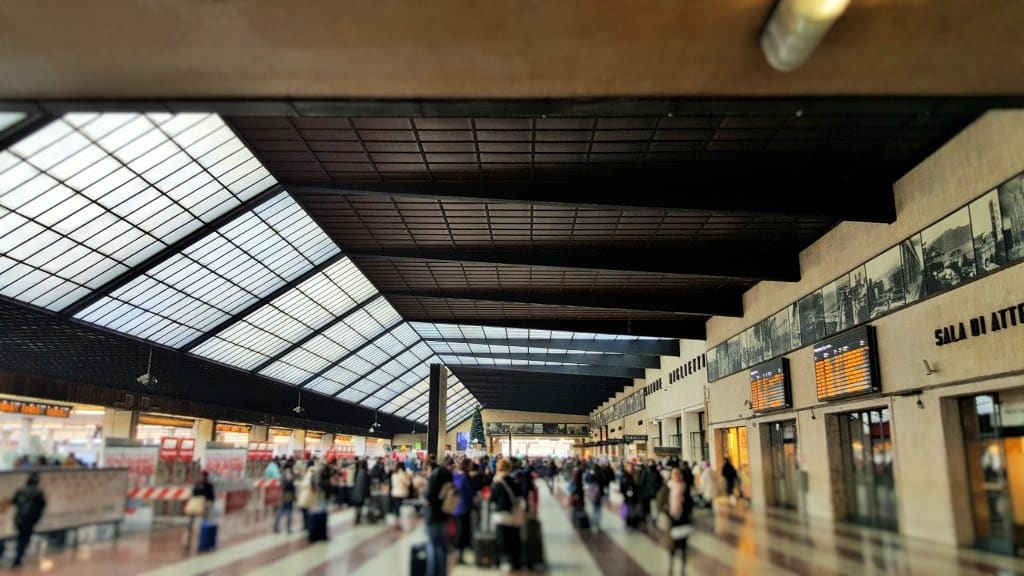
    People walking in a train station

    2.2) Wayfinding and Services

    The information relevant to a traveler is manifold and concerns that to be acquired before the trip, during the planning phase, and during the trip, when the customer is interested in entertainment services, shopping and information about the trip (eg. delays). There is also an intermediate phase, when the traveler is at the station and needs to locate their carriage, but also to use the services inside the station while waiting, such as lounge and restaurant services.

    In the UK, a private company called Trainline has implemented a signage to be activated with a mobile app to display information such as train times and routes. It is a low cost solution compared to digital display boards, therefore to be used in a complementary way.

    In 2019, Zurich’s “Z?rich Hauptbahnhof” train station launched an app dedicated to travelers with the aim of providing information on timetables and destinations starting from the station itself. The “SBB AR” app allows you to view digital content in space using environmental mapping (using Google ARCore) inside and GPS outside the structure. On Android devices alone, the application has been used by over 10,000 travelers.

    In all these cases, immersive technologies help people to retrieve relevant information in a more engaging and in some cases more useful way, see the applications for wayfinding that in complex spaces, such as in very large stations or airports, can add a lot of value for the user.

  • [Case Study] How ABB managed corrective maintenance with Augmented Reality

    [Case Study] How ABB managed corrective maintenance with Augmented Reality

    ABB is a Swiss Swedish multinational company operating in robotics, energy and automation, with a global turnover of 28 billion dollars. For some years the management has decided to start a series of projects in the Industry 4.0 field to test the most promising technological innovations for the Manufacturing sector, including an Augmented Reality project to improving how corrective maintenance was handled.

    Inglobe Technologies has been involved in an Augmented Reality project aimed at testing the usefulness of the technology in some maintenance processes, in particular corrective maintenance, to allow operators to promptly intervene on certain types of faults without involving specialized maintenance personnel and in order to reduce downtime.

    The activities carried out

    The project had three phases: one for analysis and planning of activities; one for the execution of the project; the last one to evaluate the results.

    During the planning phase, the Inglobe team and the ABB engineers of the Frosinone plant identified the most sensible use cases on which to develop the pilot project, identifying a series of equipment and technical procedures to be digitized.

    The next phase saw the actual realization of the project with the following activities:

    • Creation of 3D targets for object recognition and tracking
    • Creation of digital operating procedures with the HyperIndustry platform
    • Customization of the mobile app for mobile devices
    • Deployment and Training

    The operating procedures, organized in sequences of non-linear steps, therefore including branches, were created with the HyperIndustry industrial Augmented Reality platform, using a visual workflow, without any need for coding.

    Finally, the procedures were published and made available on the mobile application, which in this case ran on an Android tablet. ABB staff has been trained to use the mobile application autonomously.

    In the last phase of the project, ABB management carried out assessments on the main KPIs of the project in order to evaluate the quality of the technology.

    Challenges of the project

    The implementation of projects concerning new technologies, and therefore also Augmented Reality, in a factory, is almost always challenging since they introduce various new elements.

    Among the challenges of the project we can mention:

    • Choice of the most appropriate device
    • Choice of the most appropriate use case

    The choice of a device in an Augmented Reality project requires careful and thoughtful assessments as the success or otherwise of the initiative may depend on this single variable. In the case of ABB it was required that multiple operators could use the same device and it was not required that at the time of use the operator had both hands free.

    These initial requirements, and the due assessments in terms of the impact of hardware on the project costs, prompted us to opt for a mobile device rather than a smartglass, also based on the battery life compared to the duration of the work shifts.

    For the choice of the use case, ABB has assessed on which machines the stoppages were more frequent and could be solved with low complexity interventions, such as the replacement of small accessories. The choice fell on a machine that is part of the assembly process of industrial switches. The reason is that one of the most frequent causes of machine downtime was the breakage of the screwdriver insert, a component that can be easily replaced by line staff without requiring the booking of the intervention of a specialized maintenance technician.

    The results of the corrective maintenance project

    Thanks to the Augmented Reality pilot project to support maintenance, ABB has managed to provide an easy-to-use tool to its operators, allowing them to carry out a first level maintenance with the Augmented Reality app, which acts both as an instruction manual (and therefore training tool) and troubleshooting tool, supporting operators to intervene and repair the fault.

    The ABB plant in Frosinone has continued to implement Augmented Reality in its industrial processes by involving staff in this transition from paper to digital and by adopting the HyperIndustry platform to extend the technology to other production lines of the plant.

  • Huawei UPS2000 Augmented Reality installation instructions

    Huawei UPS2000 Augmented Reality installation instructions

    Huawei, China’s cellphone and connectivity technology giant, and Inglobe Technologies, the leading Italian Mixed Reality company, continue their collaboration in developing Augmented Reality solutions to make operations more efficient. The collaboration aims at providing field engineers with innovative tools meant to reduce execution time and errors.
    One of the products on which a post-installation check solution has been deployed is the SUN2000-25KTL inverter, a piece of equipment employed in large industrial photovoltaic fields.

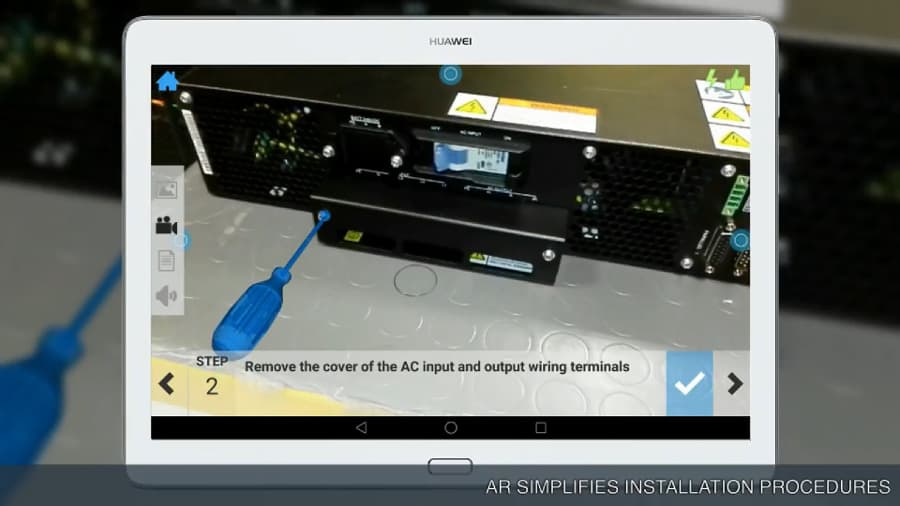
    A more recent application the Chinese manufacturer focused on regards the Huawei UPS2000-G installation procedures, used to power the network infrastructure support equipment.
    This scenario requires the technician to use step-by-step instructions with Augmented Reality graphic elements and animations to perform assembly and wiring operations, quickly and easily locating the intervention areas on the equipment and performing her technical assignments.
    During the process, the technician is supported in choosing the most suitable tools for executing individual tasks.

    The solution has been implemented by means of HyperIndustry. Hyperindustry is Inglobe Technologies’ Augmented Reality Platform for industrial enterprises. It is composed by two modules: a web-based backend that allows you to run the procedures authoring workflow; and a mobile client that can be deployed on iOS, Android, and wearable devices, allowing field technicians to receive directly assignments on their own devices and to synchronize the outcome of their activities on the platform.

    Worker using a screwdriver on a Huawei UPS

    Find out more about Inglobe’s Hyperindustry, the AR Smart Manufacturing Platform for Industry 4.0: https:/www.inglobetechnologies.com/industrial-augmented-reality

  • How Augmented Reality can support World Class Manufacturing

    How Augmented Reality can support World Class Manufacturing

    The manufacturing environment is a great source of new ideas, especially when it comes to efficiency gains. Starting from the end of the 80’s the lean thinking approach and its methodologies have changed the way factories work and perform, targeting waste and giving people the most appropriate training to give their best.

    The increasing digitalization of industrial processes has led to the formalization of the Industry 4.0 trend, which tries to group a bunch of new technologies which are capable to bring manufacturing operations to the next level.

    Among the lean methodologies, World Class Manufacturing (WCM) has conquered many leading manufacturers worldwide which implemented it in their processes and obtained consistent performance improvements.

    World Class Manufacturing Pillars impacted by Augmented Reality

    The World Class Manufacturing methodology is structured into 10 technical pillars and 10 management pillars, each one focusing on a specific aspect of the industrial organization.

    WCM Pillars

    While Augmented Reality is potentially useful to a wide range of scenarios, what we know for sure is that the technology is capable of making a great impact on the following WCM pillars:

    Autonomous Maintenance

    This pillar refers to the set of simpler maintenance tasks that can be carried out by the machine operators without a dedicated intervention from the maintenance department. It involves operations like cleaning, lubrication and inspection. Autonomous Maintenance reduces pressure on maintenance professionals and avoids the machines are run up to the breaking point.
    In this context Augmented Reality is of great help in the process of training operators to perform simple maintenance tasks they never run before.

    Professional Maintenance

    While Autonomous Maintenance is performed by machine operators, Professional Maintenance requires a higher level of specialization and a dedicated maintenance team. PM concerns taking care of machine breakdowns and more complex preventive and predictive maintenance tasks.
    Augmented Reality is particularly suited to support PM activities as a training technology as well as a step by step support in complex maintenance procedures. It is also very useful at standardizing procedures referred to same activities, but that are performed differently at different locations, something not uncommon in the case of companies with widespread operations.

    People Development

    Tightly linked to the development of human resources skills is the PD pillar. When the workforce has been involved and when training gaps have been identified, then Augmented Reality, and Virtual Reality as well, come into play. AR has proven to be an excellent technology to speed up the learning process in many fields, including industrial training. The people to be trained has the chance of learning something new directly on the field with the aid of visually presented information.

    How to implement AR into industrial processes

    Companies who understand the huge potential of Augmented Reality in industrial contexts and may want to evaluate whether the technology works as expected in their context, should take into account the following industrial roadmap we suggest.

    Industrial Augmented Reality Roadmap

    According to this approach companies should consider to start with a pilot project on a real application case inside the company in order to experiment and assess if AR delivers what expected in terms of benefits.
    After a successful pilot the company will be ready to extend the technology to other use cases in a structured manner using an appropriate software platform.

    For these purposes take a look at our HyperIndustry platform, designed to provide manufacturers with a vertical tool which enables the power of Augmented Reality to support multiple operations in the shop floor.