Author: Marianna Milano

  • The best AR Apps for your Holidays

    The best AR Apps for your Holidays

    It’s finally that time of the year where you pull out your dusty suitcase, put on your favorite sunglasses and leave the city to go towards exotic beaches, steep mountains and unexplored places. On the other hand, we know that going for holidays can be very tricky and stressful sometimes, for example when you get lost in the middle of the Sahara desert where all you see is sand, or when you can’t find your way out from the depths of the jungle with that tiger staring at you…. Ok, perhaps we are going a bit extreme, but your struggle during your holidays may be very real. 

    Luckily, we have some Augmented Reality tips that can help you relax a little bit more and enjoy your holiday the way you deserve. Whether your dream place is the highest peak of a mountain or the flattest wave of the ocean, we got you covered. Let’s discover now the best AR apps for your holidays.

    ar holidays

    The best AR Apps for your Holidays into the Wild

    Peakvisor

    If you love trekking and exploring new mountains this AR App is a must have. Peakvisor allows you to instantly see the names of the mountains in front of you, so that you immediately identintificate where you are and your surroundings. By pointing your smartphone in front of you, little banners with the names of the mountains will appear together with the high. Moreover, Peakvisor also has a 3D map program incorporated so that you can do your research before going exploring. Being an App for explorers, it can also work offline, you just have to remember to download your trails before your hiking.

    iNaturalist

    While hiking, we happen to meet unseen gems like particular flowers or rare trees and unfortunately we might not know what kind of plant/tree is. With iNaturalist, by scanning the image in front of you with the camera of your smartphone, you are able to see the name and some information about the plant you are looking at. Of course you might encounter some inaccuracies. For example if the quality of the image is not very high, the system might not be able to recognize the right species, or if the element you want to know about is too rare you might not find it at all inside of the app. This App, indeed, is managed by experts and a community, that is why it can happen not to find the exact match.

    iOverlander

    iOverlander is one of the best Apps for campings. Using GPS recognition, it allows you to find the perfect camping spot WORLDWIDE. It also gives you information about the condition of the campsite, where to find water, food, wi-fi and nearby points of interest. The beauty of iOverlander is its community: you will find lots of people just like you that give tips and precious advice in order to give you the best camping experience.

    peak ar app holidays

    The best AR Apps for your Holidays in a famous City

    Are you thinking about going to visit a new city and feeling afraid not to make the best of it? Well, it all depends on which city you are going to. There are some tourist places now that have implemented AR in their touring guides in order to give to the tourists more immersive experiences of their City and a fuller and deeper involvement in the exploring aspect. 

    For instance, if you are planning to spend your holidays in the north of Italy, you should definitely have on your smartphone AR Apps like TabUI. TabUI is an Italian App that allows you to gather information about the places you are visiting by simply pointing your smartphone at your point of interest. For now, though, it only works in some areas of North Italy. While, if you are keen to visit Italian Architecture Monuments among the cities of Turin and Rome, you don’t want to miss trying Arch.i, an AR App that works by pointing your smartphone at basically any monument of architectural work to instantly have the chance to know everything you want about it. Moreover, if you are planning to stay in the Italian Capital a little bit more, we suggest using another AR app that can guide you through the ancient streets of Rome and tell you everything secret of the Roman Empire: Charta Roma. 


    Other numerous Apps that help you visit a place in a deeper and more immersive way might be “Santorini AR”, focused on the greek city of Santorini and “National Parks by Chimani”, an amazing Augmented Reality Guide that will let you explore the American National Parks in way you have never imagined.

    best ar apps for your holidays

    Your must have AR Apps for every Holiday

    Virtlo

    Virtlo is an Augmented Reality App only available for IOS for now, able to tell you all the points of interest nearby, such as restaurants, hotels, museums, parks and even stations by using your smartphone. You can also see the distance from where you are so you can explore the city in the best way possible. The app is completely free and it’s open source, which means that everyone can add some tip or point of interest and help the others.

    ar app

    Google Translate

    How not to mention Google Translate when it comes to travel and technology? Google Translate allows you to instantly translate every written word to every language by putting your phone’s camera on the word you want to translate. Google will do all the rest. This means that if during a trip you want to know what is written on a street signal, in a restaurant menu or a contract, you can instantly translate it by using your phone. Of course, you need to be careful because not every translation is accurate and the chances of a misunderstanding are quite high, but for basic sentences it will work just fine. 

    All you have to do now is just pack and enjoy your holidays, wherever you are going!

  • Augmented Reality in Medicine: new frontiers of Healthcare

    Augmented Reality in Medicine: new frontiers of Healthcare

    “When using augmented reality in the operating room, it’s like having a GPS navigator in front of your eyes in a natural way so you don’t have to look at a separate screen to see your patient’s CT scan”, said Dr. Timothy Witham, professor of neurosurgery at the Johns Hopkins University School of Medicine. And this is only one of numerous benefits that the adoption of augmented reality in medicine field has generated. Augmented reality (AR), as we know, is the technology that allows digital contents (such as images, video, objects, animation ecc..) to take place in the real world. It’s a technology that is changing the way we live, we think and most of all it’s shaping the future, leading us towards new innovative, smarter and improved lifestyles. 

    In the medicine aerea, AR is creating new ways of helping people and saving lives like never before. It allows doctors to have more accuracy, more focus, more information and, of course, a better outcome and diagnosis. Including virtual objects and tools in the real world, doctors can see things right in front of them and in terms of accuracy this is a huge step forward. Also, timing speaking, it cuts all the waiting, looking, searching moments, increasingly reducing time of operations.

    ar in medicine
    electronic medical record concept. medical technology.

    How Augmented Reality in medicine works

    In order to integrate the Augmented Reality in medicine we need to define some technical practical aspects that allow us to use it properly. 

    • Among the main actions in using AR in medicine, the camera calibration is one of the most important one. In this process, the camera needs to “understand” the environment that will host the Augmented Reality object. 
    • In the medicine AR, the crucial action to take is the patient registration. A computed tomography (CT) or magnetic resonance imaging (MRI) provides a view of the internal anatomy of the patient and also the target points in case of surgery operations. 
    • Another essential component is object tracking which is essential in order to calculate the exact position that it will be necessary to operate.
    augmented reality in medicine field

    Why Augmented Reality in medicine is so important

    AR can let us know if there are defibrillators nearby

    It could happen all the time, while walking in a street, that you might see someone who suddenly collapsed and of course the first thing you’ll do is to call an ambulance. Now, though, there are some apps that, using AR, can also tell you if there are defibrillators nearby, so that you might be able to give additional help in the meantime. There could also be other applications that thanks to the AR localization can be crucial in saving lives, giving essential information to the individuals.

    AR can teach us about the human body

    Augmented reality is every year more used also in the education field, especially when talking about medicine. It is studied that studying (or teaching) by welcoming the help of Augmented reality can help students to learn better, faster and especially to understand in a deeper way difficult concepts. Being able to see and try in a more 3dimensional and immersive way, rather than reading a book, allows students to remember more and assimilate better. In fact, it is known that learning using other senses rather than just reading enhances the chances to remember, internalize and  elaborate harder and more articulated topics. 

    AR can be very appreciated both for kids who are willing to learn more about the human body in a funnier, immersive way and for medicine students at the University that can learn faster, better and though become better doctors. For instance, during a lecture it could be possible to show a certain part of the body such as a heart or a bone and have the chance to study it by watching it on your tablet or phone in 3D.

    ar medical education
    Doctor uses augmented reality goggles and human skeleton for teaching student

    It’s marking the new frontiers of the surgery

    Everyone knows that when it comes to surgery, precision is the crucial element for the outcome of an intervention and here it is where AR can really show all its potential. Augmented Reality in medicine allows surgeons to be more precise ( Studies affirmed that AR gives the 98% of the accuracy, which makes it at the same level or even higher of other methods). 

    In June 2020, for instance, for the first time at Johns Hopkins a spinal surgery has been made using AR technology in living patient , and one of the first sentences that came out from the surgeon when talking whether to use AR or not he says “I feel more comfortable when I use it”.

    This was the first AR surgery and it was a spinal surgery on a living patient, but, as we have seen,  AR surgery is expanding very fast and also more complicated operations have been conducted with success. For example, AR surgery can involve cardiac operations, such as the removal or alterations of heart parts, and also bone tumor resection, allowing doctors to be more accurate and precise and that make patients feel safer and calmer.

    augmented reality in medicine

    AR in medicine might also detect mental illnesses

    Did you know that when talking, humans send unconscious messages through their facial movements, the position of the body and also their tone of voice and that they have nothing to do with what they are saying? Well, a lot of us already knew that by analyzing a person’s gesture and expressions, or the way he/she talks, for instance, it is possible to understand if that person seems attracted or interested to us, but, did you know that it is also possible to understand if that person might suffer from depression, anxiety or other mental conditions? Well, Augmented Reality can help with that too. 

    Through the scanning of a human body in movement, AR can detect if some gesture or expression might mean something serious and thus give us more awareness about our conditions. The other innovative part is that you might do the scanning on your own, or with the help of a familiar person, and only after your personal diagnosis, you can go to the doctor. In this way you could spare time trying to do a personal diagnosis and/or help the doctor with a better and deeper diagnosis since you are able to give him more information about your condition.

    biopsy ar

    Our Augmented Reality in medicine expertise

    Inglobe Technologies is a well known company in AR medical field with projects that involve techniques such as Rehabilitative Robotic Platform and Risk Management. On March 25, 2015, Inglobe Technologies and Tecres joined forces to create one of the first immersive experiences in the medical field: the Tecres interactive Mirror and App. In this experience, we created a set of tools that make the communication of advanced orthopedic technology not only effective but also amusing. The system recognizes humans in the interaction area that are scanned in the metaphorical X-ray Mirror, where an X-ray skeleton, controlled by the user, interacts with the products.

  • Create your AR Business Card: dare to be different!

    Create your AR Business Card: dare to be different!

    If you want to stand out at introducing your brand, the first necessary aspect that you need to consider is delivering a business card that differs from all the others, in order to be remembered and to awaken more interest. Well, the ultimate value that can make a huge difference in your business card is the Augmented Reality (AR) element. 

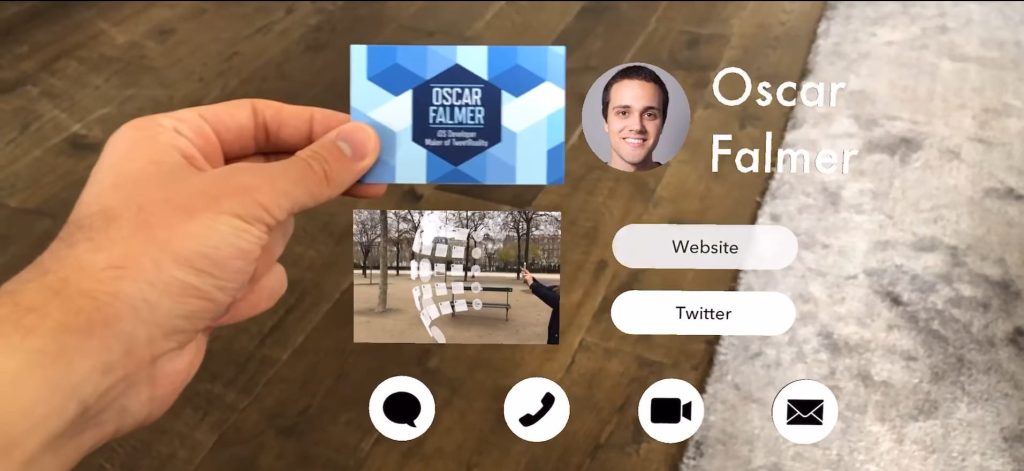
    An AR Business card makes you stand out from all the other “regular” business cards especially because of its “wow” effect that allows you to produce more appealing results compared to the other large amount of business cards that always (let’s be honest) end up resting in the most hidden and forgotten part of our wallet. 

    Thanks to an Augmented Reality business card you can also show more about you than you would do on a normal business card. By simply pointing the smartphone on your AR business card, it is possible to add several actions to your card so that the user can live a definitely more appealing knowledge experience and this allows you to stand out more among the others and instantly give an additional sense of professionality and will to emerge.

    ar business card example

    Some of the advantages of an AR business card 

    The advantages of using an AR business card compared to a “regular” business card are limitless. By presenting an AR business card you definitely have more chances to:

    • increase engagement: it is known that printed products that have implemented the AR element create more engagement and more curiosity to the people who are seeing it for the first time (increasing the chances to see it for a second, third and fourth time…);
    • show that you keep up with modern times: we all know that business cards will always be important in the business/marketing field, but showing that you have been able to give them a new updated and technological life will definitely give you an aura of modernity and originality that it will be impossible not to consider in the working field;
    • increase ROI: whether your AR business card will help you get that job or not, it will for sure contribute to generate clicks and interactions on your website and portals, helping you achieving higher numbers in terms of engagement, clicks and visits;
    • be more respectful with the environment: yes, business cards are made in paper and so are AR business cards, but thanks to the AR technology, a single business card can contain a large amount of information otherwise impossible to enclose in a little piece of paper. This means less use of paper and more information given at the same time. 

    Endless possibilities to stand out with an AR business card

    Through your AR business card, you can show more about yourself and your work. For instance, you can add your social pages in it, so that with only one click others can see immediately your profile pages and immediately have a “virtual” perception of you. Same with your website and/or your email address and phone number. 

    Moreover, you could also show an original video presentation, where you present your work, your vision and a bit about yourself, or if you feel like it, you could also create an avatar of you that explains your work for you as soon as people click on it. 

    You can create animations, put links to your works and socials, add images, videos and even games if you want to add a major sense of amusement.

    ar business cards

    The technology behind the AR business card

    In order to create an AR business card, Augmented Reality technology uses marker-based recognition, that means that you need a marker to activate the augmentation. By scanning the image marker with your smartphone, you will activate the experience and start seeing your augmented business card in a way you couldn’t believe possible. 

    The marker you need in order to activate the augmentation can basically be activated in two different modes. There is the easier one, which is by using Web based AR: in this case, you only need to implement an 2D image marker, which usually is a QR code on your card and by scanning the QR code and clicking the link given, the magic will appear. 

    Otherwise, there are AR business cards that can be activated using a mobile app. This can appear a little more tricky and, even though the “wow effect” will totally be worth the downloading, lazier people can find the use of additional apps more difficult and this could generate the hated proposition “I will look at it later” that we must avoid at all costs.

    Now see the magic happens

    Our platform AR-media allows you to create impressive AR business cards, able to stand out among all the others. With simple steps you can bring your business card to another level, doing something more original and worth-remembering.

    Here’s a quick tutorial on how to start creating an experience with AR-media. Start creating your own AR business card.

  • WebAR: the benefits of AR without using an app

    WebAR: the benefits of AR without using an app

    If you are among those who’s asking how far WebAR has come in the development of experiences, like we are, and want to know more about its r-evolution, then you’ve landed in the right place (plus, we have a demo for you at the end of the page).

    What is web ar?

    “Augmented Reality is the enrichment of the perception of the context around us with digital data, created by technologies that allow the overlay of contents seen as part of the environment in which the subject finds itself”. In order to make this concept true, we usually need to download a specific app on our device and see the magic happen. WebAR breaks off from the tied-in-a-app definition, bringing Augmented Reality on the internet browser, freeing developers from the management of the apps and stores and allowing users to have access more easily and more rapidly to immersive experiences. 

    The r-evolution of WebAR happens exactly when the virtual object needs to be put into the environment: no special software or app is needed, only a smartphone or tablet and its camera, and an internet connection of course. Indeed, in order to have a positive result, the camera of the device plays the most important role. The information about the environment is detected by the phone camera, and through it the environment is scanned and analyzed and data is transferred from the camera to the Web environment.

    Web AR

    The features of Web AR basically remain the same as application-based ones:

    • Image tracking: by scanning a specific 2D image with the camera of your device (such as flyers, pictures, artworks and books), the Augmented Reality object will appear in your device (whether can be a video, a 3D model, another picture, an animation..), allowing you to live a deeper experience of that 2D image and giving you a more complete and more sensorial involvement;
    • Marker tracking: basically the same as the image tracking but the scanning process takes place with a specific object or defined symbols, rather than 2D images;
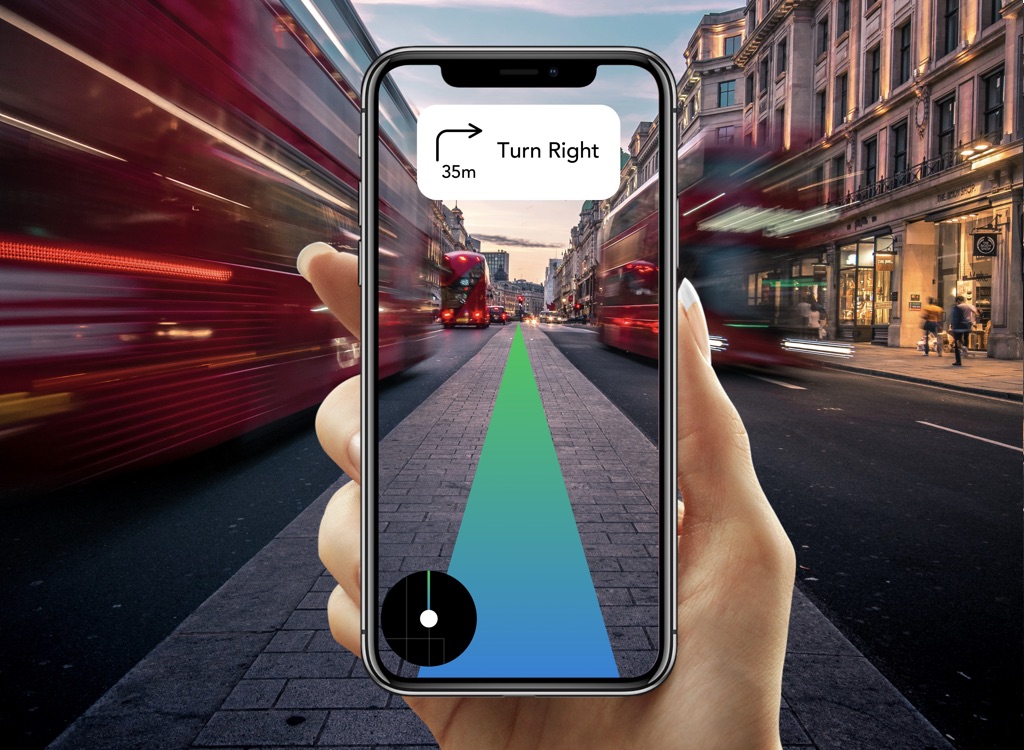
    • Location based AR: for instance virtual tours and maps support. Users, while moving freely in the environment, can have access to adding info about the place where they are, receiving help in finding certain places or knowing more about a specific monument or city.

    It is necessary to remember, though, that even though Web AR does not require special apps, sometimes it might require specific adjustments in terms of softwares and tools in the devices, such as ARkit for iOS and ARCore for Android. Generally, WebAR nowadays is available for all the latest smartphone devices above iOS 11. Ergo, Web AR might still have some weaknesses that need to be improved and/or revised, and the battle between Web AR and app AR is still far from declaring a winner. Let’s see more specifically what are the main differences between them and what are their hardest limitations. 

    web ar revolution

    Web AR VS App-based AR: differences and limits

    Why WebAR is the r-evolution we were all waiting for

    • Well, as mentioned above, the first and most relevant difference between Application-based AR and Web AR is the “place” where they are released: application-based AR is only available using an app whether Web AR is accessible online without downloading other apps. The web aspect makes the whole access process way easier since you only need a URL link, a QR code or an NFC tag in order to live the experience. 
    • There are many advantages especially for developers. In fact, WebAR is able to significantly reduce time and cost of an app-based experience. First of all you don’t need app store providers’ validation, hence the market process is a lot quicker; you can give support and fix bugs immediately; you can release all the updates that you want potentially in no time. 
    • Why Web AR seems to become a revolution is for a simple, yet crucial reason: people like immediacy. Researchers have shown that when people need to download in order to use an experience, 50% of them are more keen to drop off and refuse to try the experience than to “waste” time on downloading an app that they will probably use just once. Hence the immediacy of the Web AR is undoubtedly its biggest asset. 

    Immediacy, easiness and ready-to-usability are central aspects in the innovation of Web AR that cannot be undervalued from agencies and companies whose aim is to compel the client through new innovative ways. For agencies, Web AR might definitely represent a new level of marketing and appeal to new followers and clients, giving to the users a brand new type of client experience.

    smartphone WebAR r-evolution

    But there are still weaknesses in the development of the experiences

    • Being WebAR browser-based, it might happen to go towards a low performance. In terms of information transferring, WebAR spends more time and memory to transfer the digital object because of its lack of the resources that otherwise are present in the app-based and this can mean a lower quality of the digital object both in terms of image and animation. In order to live a better experience, the best solution would be the creation of “simpler” experiences, with less interactions
    • Having good internet connection is the number one requirement in order not to occur in low-quality experiences or impossible-to-see experiences, that is why Wi-fi is preferable. App based AR can give you the ability to download the experiences in advance and use them at any time, even in the absence of an internet connection.
    • Another restriction of the WebAR is the limited battery capability. Using applications, indeed, smartphones and other devices usually last longer because the app uses the functionalities already present in the device, whereas, in Web AR, browsers need access to the camera sensors, analysis and other resources and this can significantly reduce the last of the battery.
    AR-media no coding Augmented Reality platform

    However, predictions about the future of the Web AR are more than positive that is why we talk about a r-evolution. Just think about three or four years ago and how long AR and Web AR have gone up to now. Of course there are features to optimize, tools to fix and aspects to refine, but as for other technologies that have been changing and improving with time, there is no doubt that the development of the Web AR and its experiences will follow the same destiny. 

    Anyway, we know you can’t wait to try our Web AR. So if you want to have a taste, wait no longer and try it now by scanning the QR code or by clicking below.

    qr code WebAR
  • How to improve your lifestyle with AR

    How to improve your lifestyle with AR

    You don’t have any more excuses to be lazy nowadays, by starting to improve your lifestyle using Augmented Reality. New technologies have always been seen as enemies of the healthy lifestyle, since they’ve always been perceived as something static, impossibile to use if not sat still on a chair or a sofa, in front of a computer, a laptop or a smartphone. Well, things have changed by now. Today, new technologies have learned to live among the most active men and women, moreover, they help them stay fit, active and improve their general mental and physical health. Researchers have now stated that this relationship between fitness/wellbeing and technology is to be considered more possible thanks to immersive technologies, which have the potential to add more value, sense of experience and motivation to the standard ways of keeping a healthy lifestyle.

    What do we mean by improve one’s lifestyle with AR?

    Following a healthy lifestyle is not alway as easy as we think. The common conception of “healthy lifestyle” means trying to be less sedentary as you can, avoiding junk food and fats, practicing mindfulness or some kind of meditation and, well, taking time to relax and enjoy life.

    Using Augmented Reality, some (if not all) of these aspects can result in easier to follow, more accessible and even more convenient. Moreover, thanks to new technologies, you appear to have more control over your work on having a healthy lifestyle, because there is anyone else than you checking on your improvements, appointments, meals and so on… everything is manageable following your personal timing and schedules.

    Staying fit with AR

    Your gym wherever you go

    In order to have a healthy lifestyle, being able to have a fitness routine is something almost mandatory. Sometimes though, keeping a fitness routine might appear more difficult than we think. For instance, as we know, a lot of jobs require several hours a day to sit on a chair, so that after 8 hours of work,  we might not feel exactly in the mood for going to the gym. And here’s the part where Augmented Reality comes to save your day: what if you don’t need to “go” to the gym, but all you need is AR/VR equipment that brings the gym to you? This might be the first and one of the most important aspects of AR helping you improve your lifestyle . 

    The variety of sports and ways to do it using AR is impressive and it is totally up to you. By using smart equipment, headsets, or smartphones, doing sports has never been easier and funnier. By buying an AR device, you can recreate the environment of a gym at your own place, you could also have your personal trainer, and sometimes even talk with other people “in the same gym” so that the relational part of the gym remains existent. Moreover, having your gym at home means that you don’t need to respect your gym time-schedule, so that if you want to do your workout at midnight, you are more than free to do it (only make sure not to be too loud and let your neighbors sleep). Your personal trainer will be there, at any time, waiting for you, in your virtual gym.

    Improve your lifestyle with AR

    Real-time data

    While the gym might be virtual, your results are definitely real. With the help of an AR device in the daily fitness routine, people can perfectly track all the activities. These devices take track of everything from what distance you cover when jogging or cycling, to the calories consumed. Thanks to this data, users can make critical decisions about their future workouts, like whether to increase or reduce intensity, helping you not overstress while monitoring the activity and allowing you to see your improvements at the same time. 

    AR/VR technology is able to give you real-time insight on your activity. It can suggest the workout that works best for you, based on your weight, height, precedent activities and possible results, allowing you to have the best workout outcome.

    AR can keep you more motivated and bring fun to your workout session

    It is known that motivation is the most critical factor affecting your fitness routine, and staying motivated all the time is almost impossible. AR fitness technology can help with that. AR apps can choose the perfect workout for you, starting from the basics and intensify the exercises with your timing and possibilities. This improves your motivation, since you are more able to see the first results in terms of strength, change of the exercises and your saved history. As we saw earlier, it is all tracked, and seeing your results clearly will definitely help you stay motivated. 

    AR can also bring a more gaming experience, especially when using specific apps like “Zombie, run” where you find yourself running from zombies or “run social”, a virtual experience where you can choose the perfect place for your jogging session like a beach, a wood, Central Park and many more. This generates amusement in the user together with motivation and the simple workout can become an innovative and inspiring experience.

    AR running

    Improve your eating habits with AR

    Improving your lifestyle is hard work that goes beyond just caring about the fitness aspect. It is something that involves several positions. One important aspect to be considered for instance is our personal diet. Having a healthy lifestyle means also conducting a healthy diet, eating healthy food and not too much. In this case too, AR can come to rescue you!

    The first and the biggest innovation that AR can bring to your food habits is raising awareness and understandability on what you are eating, giving you information about the type of food, the calories, the quantity suggested to consume and other. Researchers are now studying AR glasses that record in real time what is in your plate, giving you all the info necessary. The best part is that the info given changes while you’re eating, monitoring every step of the feeding process, from the whole plate to its emptiness, so that you know exactly what you are eating and how.
    Another app called Habit.at uses AR to change the perception that people have toward specific kinds of food. How it works: it basically changes the environment around the plate, with the aim of  dissuading from bad eating habits, so that healthy foods will be surrounded by a more positive and funnier environment, in order to stimulate on keeping eating those foods.

    eating habits with ar

    AR can help you improve your mental health

    Reducing anxiety with AR

    Sometimes, all we need to feel like our lifestyle seems improved is a little break: a break from our everyday life and our daily routines. And sometimes, only 10 deep minutes are enough to re-energize us. Augmented reality can help with that too! There are, indeed, amazing little experiences that one can use to reduce anxiety, feeling less stressed or just to have 10 minutes of calm fun. In those experiences you can immerse yourself in amazing landscapes and places using the right device, that otherwise would have been impossible to go to, such as the most breathtaking beach of the Maldives, the calm woods of Norway, beautiful Italian flowers field etc. and stay there the exact amount of time that you need to rebalance yourself. For an even more relaxing experience, also SPAs are starting to introduce virtual experiences like that in their services, combining existing treatments with virtual surroundings, to have a full, mind blowing, relaxing experience.

    improve lifestyle with AR

    Starting your meditation journey has never been easier

    Another importa aspect of improving your lifestyle with AR and VR is meditating. Numerous AR apps now can help you guide your first steps toward meditation. With guided voices and virtual tours, it is possible to feel immersed deep in one’s mind, facilitating the process of focusing on oneself and accelerating the learning process of meditation discipline. The most known apps are Psious, Clevr and Guided Meditation.

    AR meditation

    Medically speaking, besides surgery and general healthcare, AR is now used in mental health in psychology, helping patients to overcome their phobias, traumas and other issues. Anyway, we feel ready to try improving our lifestyle using AR and see how the results will be. Are you joining us, too?

  • Celebrate May 4th with the best AR/VR Star Wars experiences

    Celebrate May 4th with the best AR/VR Star Wars experiences

    “May AR be with you”: Yes, we have decided to celebrate Star Wars day with the best AR/VR immersive experiences. We know, this may not be the original quote from the legendary, stellar movie Star Wars, but this gets straight to the point, right? In order to celebrate the Star Wars day, which happens to be, of course, May the 4th,  there are no excuses not to relive the most captivating stories and the best images, recalling the most sensational immersive experiences based on the outstanding movie series. The following are the best picks in the manner of games, virtual and augmented reality experiences, virtual production and, why not, even metaverse where Star Wars has come into our very homes.

    Celebrate Star Wars day with the best AR/VR immersive experiences

    Celebrate with “Star Wars, Trials on Tatooine”  and “Star Wars Pinball VR”

    In order to celebrate Star Wars day with the best AR/VR immersive experiences, in terms of games, “Star Wars, Trials on Tatooine” is a must. Even if it is not the newest Star Wars game, since it was born in 2016, it definitely represents one of the “must try” SW virtual experiences of all time. The game takes place in a galaxy far away from Star Wars, right after the events of the Return of the Jedi, called Tatooine, where you can actually wield a lightsaber and be transported into the desert of Tatooine and defend the droid R2-D2 from the stormtroopers. Technically speaking, the game requires a powerful computer since its photo-realistic approach and it uses a single controller. It can be downloaded for free on SteamVR.

    Star Wars day ToT

    Have you ever heard about a Star Wars-themed Pinball experience? Well, it is not exactly like any other Pinball games, but if you want to Celebrate Star Wars day with the best AR/VR immersive experiences, you should definitely try it. In fact, “Star Wars – Pinball VR” is a Pinball VR experience and this is what makes it extremely original and curious. In the game, not only can you play the “traditional” Pinball game with a virtual Pinball machine, but, moreover, there are items and tools in the game itself which enhance your gaming experience like never before.

    In the game there are different Pinball machines, and every Pinball machine represents a different story of the Star Wars saga, including The Mandalorian, the newest Star Wars TV series. The Pinball game itself is definitely one of a kind Pinball game. In fact, it is not everyday that you see 3D astronauts, shooting and explosions taking life in a Pinball game. To enhance your VR experience even more, you can also find yourself fighting against one of the main characters and playing numerous additional mini games. In the game, you find your Pinball machine in a personal playroom, called “the fan cave”, and to make it even more captivating, you can become your very own room designer and customize it the way you prefer, putting your hero statue, winning your Pinball trophies and much more. Star Wars Pinball VR is available on Oculus Quest, SteamVR, and PlayStation VR headsets.

    Star Wars Pinball experience

    Immerse yourself in AR/VR “Star Wars: Jedi Challenges” experience

    Released by Disney, this is one of the best Star Wars AR (Augmented Reality) Video Games with equipment, and this is by far the best way to celebrate Star Wars day. Created in collaboration with Lenovo. With a headset, a lightsaber handle, a LED motion tracking, and your smartphone, you have the chance to bring Star Wars into reality!

    Star Wars: Jedi Challenges involves three games in it. The first is Lightsaber Battles, where, once wielded your lightsaber handle, you need to fight against your enemies who will appear in your room, choosing among different types of game, like defeating waves of enemy troops across all eras in Assault Mode, facing off in 1-on-1 duels against Kylo Ren, Darth Vader and others, using Force powers to strategically defeat your enemies.

    The second experience available in the game is Strategic Combat. In a large-scale war ground, you can train yourself in military strategies by commanding armies in order to defeat the enemies, win against the forces of the Darkside or/and recreate epic battles. Improving your skills, you can also unlock new levels and go on in the game.

    The third Star Wars experience is Holochess. With Holochess, you can also train your concentration and strategy in chess ground with monsters and aliens based on the movie Star Wars IV – A new Hope. In the game you need to collect eight different creatures with different strengths and weaknesses and win against the enemy.

    Star Wars Jedi challenges

    Celebrate Star Wars day rewatching “The Mandalorian”

    You can celebrate Star Wars day also by rewatching the best SW movies, celebrating the innovative production processes. Indeed, the production process of The Mandalorian is extremely innovative in terms of technologies used for visual effects, where the actors directly interact with the virtual objects and the surroundings. This is called Virtual Production. That means that the crew can change from scene to scene, in the same location, without interruptions. Using this type of technology you don’t even need to go to specific locations to create your work. In the Mandalorian, indeed, it is impossible to recognise whether a scene has been created with Virtual Production or not.

    Star Wars AR/VR immersive experiences the mandalorian

    The ultimate Star Wars immersive experience: Reborn, the Metaverse

    Being claimed as the “most anticipated Metaverse game of 2022”, Star Wars: Reborn seems to be the Metaverse game we were all waiting for. 

    As seen from British Weekly, according to the creator, Reborn should be composed of more than 1000 planets, where every player cooperates to build one and asset it, or even build new ones. The highest hype is all around one of the planets, which should represent the Hollywood planet and where lots of celebrities are expected to participate.

    Celebrate Star Wars day with the best AR/VR immersive experiences

    These are our favorite picks to celebrate Star Wars day with the best AR/VR immersive experiences. So, now that you have loads of options on how to celebrate Star Wars day, have you decided your favorite “galaxy” where to pull out your lightsaber yet?

  • What is Virtual Production?

    What is Virtual Production?

    The use of Virtual Production sets a revolution in the field of content production. As we all know, the pandemic marked the end and the beginning of a new era. Together with numerous problems and insecurities, it brought significant technological resolutions and innovations, in order to make life easier and (why not) cheaper and allowing a lot of things to be more accessible remotely. Even if it was born before the pandemic, Virtual Production definitely got a significant boost ?thanks to it?.


    Virtual Production is the touchpoint where the live action world and the digital one meet, removing the barriers between live production and visual effects, so that it becomes feasable to make them work together simultaneously. By using VP, the chances to make a high quality content with less effort and lower budgets are limitless and the only limit to your creativity is basically your mind. With Virtual Production, every place can be transformed to another: an empty desert can become a crowded city and basically every scenario can be digitized and created by simply using digital interactive sets or LED walls without the necessary and long use of the post-production.

    This kind of technology is possible thanks to certain platforms and suites, such as Unreal Engine and Unity, that allow the creation of games, movies, any 3D content or even a metaverse, the new internet revolution where we live as virtual avatars in virtual worlds. In the Virtual Production context,  the actors directly interact with the virtual objects and the surroundings. But this is only the tip of the iceberg, let?s take a closer look at what Virtual Production is and why it appears to be a great revolution.

    Virtual production

    The differences between Virtual Production and traditional VFX

    VP begins from the pre-production stage

    Compared to the traditional Visual Effects (VFX), Virtual Production presents several aspects that make it completely different, starting from the very beginning. The process of using VP, indeed, starts in the pre-production phase, where you can have an initial look of what your content should look like. Using traditional VFX such as green screen and chroma key, this process is basically impossible to make. With Virtual Production you don?t need to go to certain places, spend time finding the right image and hope and guess that the final look will be the same as you thought. You can have a plain view even before starting.

    Real-time production makes the process quicker and without the necessary use of post-production

    Virtual Production allows you to create amazing high quality experiences cutting the long process of post-production that has always been necessary in order to realize the image intended to be created. In fact, the real-time aspect makes the whole experience quicker, since possible changes become applicable on set at that moment. The real-time aspect allows the production to also make live experiences whether it can be the newest way to make weather forecasts or whole music concerts creating incredible images otherwise impossible until not so long ago.

    It is the case of Madison Beer immersive concert experience, made by Sony and Unreal Engine, gone live on Tik Tok during the pandemic and now available on Youtube, where Madison Beer played an entire concert in real time virtual production, showing worldly what Virtual Production and creativity can do.

     Madison Beer concert

    With Virtual Production you don?t necessarely need to use Green Screen or LED Walls

    One of the biggest revolutions of Virtual Production, as said, is its quicker process. This is due to the fact that for some kinds of productions, the use of Green Screens or LED Walls may not be necessary, since all the creations are made virtually. Using a virtual environment, in fact, the crew can change from scene to scene, in the same location, without interruptions.

    Not using the green screen means more accuracy of the image realism and also less stress over the guessing of the right lighting, colors, ideas of how it should be and the sense of disconnection that may come. 

    This also benefits the actors, who have the possibility to see in real-time how the environment is and thus, the acting process seems to be easier and more engaging. Moreover, it is more empathetic to the audience, creating in the actors the so-called ?sense of presence?. 

    If you are a Star Wars fan, you have probably heard about the The Mandalorian Series. Well, season two is entirely made with Virtual Production in collaboration with Unreal Engine. It is now famous for its unbelievable high quality and revolutionary making process.

    virtual production the mandalorian

    Leveraging on the same assets for multiple productions (Cinema, Videogames)

    With the tools dedicated to creating Virtual Productions becoming more and more sofisticated, with an attainable quality level close to photorealism, production houses are turning more and more to VP because it allows them to make use of 3D assets for multiple purposes, for example they can do both a Movie and a Videogame with the same environment and that’s certainly a cost-effective solution. A recent case of Virtual Production of this kind is The Matrix Awakens, where they used the same 3D assets (e.g. the city) for both the Movie and the Videogame.

    Virtual Production means high quality with lower budgets 

    The need of finding the right places, of moving to certain areas in order to make particular scenes, or the need of a numerous crew is no longer a burden that the productions need to carry thanks to Virtual Production. With 3D technologies and virtual production, the workload is a lot lightened and thus the budgets become significantly reduced, that’s mostly possible because a less hardware-intensive approach can be used. You don?t need Hollywood’s budgets, but just a little studio where you can burst your creativity. 

    This is a substantial revolutionary aspect, since the lower costs increase the number of the companies who can take advantage of using Virtual Production. This means that even smaller companies can experiment with the improvements and the conveniences of Virtual Production and aim to have high quality final products. The lower budget also allows companies from different backgrounds such as marketing, communication agencies and so on, to experiment with these new technologies and create brand new high quality content. 

    VP

    In the end, Virtual Production can actually ?save you?. It helps you save time, it helps you save money and it helps you save a lot of stress, all of that guaranteeing the most effective high quality product.

  • How AR artists can bring art to a new level

    How AR artists can bring art to a new level

    Using AR, artists can bring art to a new level. We all know that every time a new technology or a new tool takes life in our world, the artists are among the first ones to try it, experiment it and eventually make it more commercial. The truth is that they can actually be the pioneers of a new way of seeing life, with their vision of combining creativity and technology and sometimes they really do their part in changing things and make the world a little brighter. This is the case of Augmented Reality.

    Why use AR in art

    According to some of the artists that are using it, Augmented Reality (AR) can bring the art world to a new level. They could have the chance to express themselves in ways they couldn’t believe possible and most of all, every piece of art can become a new different kind of experience. 

    An AR artwork can appear more immersive, adding more value to the experience of the public. Art is creating emotions, feelings, deep thoughts on the person who is looking; art is sharing terrifying secrets and revolutions while creating beauty. Augmented Reality can enhance all that, not only for Art Galleries and Museums, but also for Freelance Artists.

    AR artists in the art scene

    Numerous artists are now involving in their works the AR component as means to create more immersive experiences and generate stronger emotions. Here are the ones who impressed us more. 

    The company Adrien M and Claire B

    The company Adrien M and Claire B is a french artist company that combines digital and living arts, creating unique performances full of beauty and poetry. Using technological tools to enhance their living art performances, they “transcend the spatial boundaries of stage and the time limits of performance, […] creating an art of movement to set the human body in resonance with graphic and digital arts. The result is a poetic visual language blending imaginary, real and virtual dimensions while bearing unlimited opportunities for artistic exploration.” With ‘Acqua Alta – crossing the mirror’, the company created an immersive AR experience where “ink drawings and white folded paper come together to reveal the virtual life of dancing miniature beings and their dive into the imaginary realms of water”. 

    AR artists Acqua Alta - crossing the mirror

    Esoulito

    Esoulito is a brazilian artist based in Sao Paulo, who combines Augmented Reality with street art and murals, creating a brand new way of making street art. You can have access to all his works on his IG profile or have a look at his website, where it is possible to admire most of his works and collection and eventually buy them. He creates old classic portraits like the Birth of Venus or ancient statues modified in street art. To all that, he adds the AR element, to make them move, live, and send further messages. Our favorite is definitely the AR Monnalisa in street art! 

    Sianfan

    Another AR and VR artist that is worth mentioning is Sianfan. The peculiarity of Sianfan is her ability to merge the digital world with nature and with her own body, creating beautiful experiences full of poetry and intensity. In her work “Partial Bodies”, she presented a meditation between the natural and the virtual world and their relationship, analyzing the female body and nature in a digital environment. Her work can be described as “undeniably digital, yet innately organic, the entangled bodies present fragmented forms that reflect the uneasy relationship between the natural and the virtual.”

    AR artists_Sianfan Partial bodies

    Marc o matic

    If you love steampunk style and technology, you cannot but love Marc o Matic. He is famous for merging traditional art and technical animation and immersive tech, with a retro steampunk style all in it. Using mobile devices, viewers are able to see the work of art in a much deeper way. When hovering your phone over an artwork, the AR element brings the artwork to life through animation and sound, revealing more detail to the story behind the work. Needless to say, the result is simply amazing! He defines himself a “creative technologist”, indeed, he also creates virtual reality art works and 2D and 3D animations. 

    AR artists Marc o metic

    Creating art with AR-media

    Basically all the artists mentioned above need to use an app in order to make the viewer see the AR element in their works. For instance, to give life to your works, you can use AR-media. With AR-media you can design, implement and share your creations without coding, creating all the immersive experiences you want and taking art to a new level. 

    It doesn’t matter if you, as an AR Artist, want to create immersive content associated to a painting or a graffiti, or if you want to visualize a 3D model in the environment. AR-media lets you create both Planar and Spatial Augmented Reality experiences.

    Using Augmented Reality in the art field can be a new and innovative way to take art to a new level. AR artists can enhance and grow their already existing artworks, but also experiment to create brand new ones, allowing them to express themselves in ways they couldn’t imagine being possible. They now have the potential to unlock new forms of storytelling and self-expression, bringing the viewers to live deeper experiences and thus enhance feelings in the spectators. What are you waiting for?

  • 2022: the rise or the fall of NFTs?

    2022: the rise or the fall of NFTs?

    In the past year, NFTs became one of the most talked-about topics in the crypto-world, marking their biggest rise since their creation in 2014. So, if 2021 marked an incredible increase of NFT, what can we expect from NFTs in 2022? Will 2022 be the rise or the fall of NFTs?

    Well, before making any predictions about the future, let us take a step back and analise what we are really talking about. What is an NFT? 

    What is an NFT?

    Before discovering wether 2022 will be the rise or the fall of NFTs, let’s start understanding what they really are. NFT is the acronym of “Non-fungible-token”. It is “fungible” anything that can be exchanged or replaced with something identical, whereas “non-fungible” is everything that cannot be replaced, something unique. For example, it is possible to change/exchange any kind of banknote, that means that it is “fungible”, but it is impossible to change an NFT with another since it is not interchangeable. Each NFT has unique properties and is not worth the same amount as another one.

    The biggest characteristic of the NFT is its “digital exclusive”, in the sense that an NFT can only be anything digital: a drawing, music, game-item, a video… everything that can be put in the digital world (so basically everything) and that can be traded with cryptocurrency (the most used in this field is Ethereum, but there are many more). Anyone has probably heard about the NFT of the first tweet in history, created by the Founder of Twitter Jack Dorsey, sold for over $2.9 million. Curious to know more about it, now?

    Dorsey nft tweet

    Create and sell an NFT

    Non-Fungible-Tokens can be bought and sold, exactly like other cryptocurrencies, on specialised platforms. One of the biggest NFTs platforms is OpenSea. OpenSea is a marketplace specialised in the buying-and-selling of crypto currencies and digital assets. It’s based on the Ethereum Blockchain (one of the most known cryptocurrency at the moment after BitCoin). The reason why OpenSea is gaining popularity day by day is its extreme simplicity. In fact, it is very intuitive and easy to use. All you have to do is create an account on the platform, connect an Ethereum wallet and upload the digital contents you want to sell. 

    open sea website

    How NFTs can change the art market 

    Needless to say, the art market, above all the others, is the one that, maybe, compose the biggest part of the NFTs, indeed, one of the most appreciated aspects of the NFTs is exactly its use for the digital art market. Until now, digital artists have always struggled with the economic and recognition part of their work since this idea of “an easy-to-replicate” kind of art and therefore the tendency of being less considered. With the “non-fungible” aspect, NFTs can totally reverse this factor and digital art creations, making every NFT unique. In this way, finally, the digital art world might have the recognition it deserves and be “treated” exactly like any other tangible artistic work. Apparently, the rise of the NFT in the art field is due not only to the possibility of seeing your artwork recognised, but also to the possible and appealing amount of money that an artist could do with its art, because of the tendency of taking as example some of the “ones who made it”, for example the Digital artist Beeple who sold “Everydays — the First 5000 Days” for $69.3 million or the famous CryptoPunk NFT sold for $1.8 million. 

    NFTs monkey

    NFTs are not just related to art…

    It must be said that Non-fungible-tokens are not only applicable in the Art area. As said, everything that can be digital can be transformed into an NFT, thus, you can now have access to certain events only by buying a special NFT ticket. The ultimate news makes it known to the world that in 2023 we will also be able to see the first NFT Restaurant directly from New York, where, by owning a Restaurant NFT you will somehow receive a membership that allows you to enter and hopefully dine in the Restaurant. 

    nft restaurant

    AR NFTs, the new frontier 

    2021 was the year of NFTs. Well, they actually existed since 2014, but this past year they experienced a real massive explosion and, whether you are an expert in the subject or not,  you have probably heard this word at least once by now. 

    Thus, for 2022, the NFT world is beginning to speak about AR NFTs (Augmented Reality Non-Fungible-Tokens) as the new frontier of the NFTs. For the first time, NFTs which have always been restricted in the bidimensional world, could now have access to the three dimensional world. In other words, including the AR element in the creation of an NFT you add the ability to visualise it in your physical surroundings by using a specific app or a website. 

    Moreover, the use of AR NFTs could add the “scarcity aspect” even more. Indeed, especially for the tourism sector, it could be interesting adding some AR content only available with NFTs, such as a particular AR guide in a museum, 3D access to exclusive parts of the gallery or even the chance to see a work of art such as a paint or a sculpture in a deeper and more accurate way. 

    As we have seen so far, creating an NFT is quite simple and intuitive (especially using well known platforms). What could seem a little bit more challenging is creating an AR NFT, since it might require the addition of tools and platforms that allow the visualisation in the environment. The biggest advantage, though, is exactly this one: in a world where NFTs are created with an extreme simplicity, having the possibility to create a different work could make the creator stand out among the others, creating immersive and outstanding experiences.

    ar nfts art

    Why NFTs could fall 

    According to a large part of the web, though, Non-Fungible-Tokens are going towards a slow fall, especially due to the several damages that they might be responsible for. Thus, it would be irresponsible to not mention the risks and disadvantages that occur in selling and buying NFTs. 

    Owning an NFT does not mean you can use it

    The first incomprehension that seems to appear all the time is actually around the very definition of NFTs. Indeed, buying and “owning” a specific NFT does not mean being able to do everything you want with it, like copy it or using it for other purposes. You just own it. That might generate concerning thoughts about the very reason why you should buy an NFT in the first place, if basically it might be something that can be seen/listened/viewed anytime from any screen. 

    “Different” points of view about NFT art really is

    Another concerning aspect of NFTs involves the art market. Apparently, the large amount of “artistic creations” in the NFT world may actually damage the NFT art market, because of the speculative aims that non-artists can have. That is why considering art something like code-made lions or monkeys for many users can appear difficult and people start asking if creations that do not seem very “artistic” (maybe because of a lack of emotions, soul and passion put into the creation of them) might not be worth buying and therefore create mistrust.

    The risk of getting scammed

    Despite its large popularity, NFTs world does not have legal guarantees yet that protect buyers and sellers, thus the chance of being scammed seem to be quite high. The buyer can never really know if the NFT bought refers to something created by the seller or if it is something taken from other parts. Something even worse could occur, like selling NFTs that are not even present in the digital world. 

    The negative impact on the environment

    Another aspect that needs to be discussed is the environmental one. The super strong computers that generate NFTs consume an enormous amount of energy. These computers need very high capacity in order to work with the Ethereum Blockchain and guarantee proof-of-work (sort of security system that oversees transactions in the cryptocurrency world). In fact, when selling and buying an NFT, there is the so-called “gas fee” which is exactly a fee that needs to be paid for having used a large amount of energy. There are websites, such as cryptoart.wtf where it is possible to see the amount of emission that NFTs are making. According to cryptoart, the footprint of the NFT Space Cat seems to be not so far from the electricity usage for two months of an EU citizen. 

    NFT environment

    At the end, it is quite impossibile to declare wether 2022 will be the rise or the fall of NFTs. What we can say is that despite all the risks and the disadvantages of selling/buying NFTs, it must be said that the predictions are quite positive. Apparently, the NFT market is going to change, improve and surely become bigger. There are already movements towards an NFT market greener replacing proof-of-work with proof-of-stake. According to the crypto experts, something about the safety of buying/selling NFTs will be made soon. About NFTs creators, instead, it appears that  Augmented Reality will play a very significant role in the renewal of the 2022NFTs.

  • Give new life to your Newspaper using AR

    Give new life to your Newspaper using AR

    You can give new life to your Newspapers with AR. Since we all saw the first film of Harry Potter, back in 2001, we all imagined how it could have been to have the first page of our favorite newspaper moving, having life and maybe showing you exactly what you want to see. Well, thanks to the “magic” of  Augmented Reality, this is now finally possible. 

    Of course, the AR “magic” can be activated only using a digital “wand” such as our everyday smartphone or tablet. The process itself is quite easy: using a mobile device, the AR app recognises the target image and lets you see the “magic” appear, watching the photo or the article coming to life through your device. 

    ar in newspaper Harry Potter

    Why you should give new life to your Newspaper using AR

    To increase the engagement and therefore sales

    New generations tend to use printed products less, especially newspapers, since they now grow up surrounded by technology tools in every step of their lives. Younger generations, indeed, may find printed products slower, less updated and less engaging, simply because of a lack of interactivity that digital products instead offer constantly. It is known, now, that digital is taking over print more and more every year. Using AR, though, the interactivity aspect is fully filled, giving to the readers an enhanced engagement with the content.

    To have an updated Newspaper with open information

    If printed products are well known for their static nature, the use of AR can mutate this aspect too. When a newspaper is published, the information on it cannot be changed or updated and sometimes,  when published, the news is already old. AR can resolve (or evolve) this feature by adding, for example, a link to the news to make the readers be able to stay updated about the developments of that particular news.

    The article in the newspaper could also be only a fragment of the news and by using AR, the reader could have the chance to see more about that news, with deeper investigations by way of videos, updated articles, more photos and so on… 

    To make readers “hear” the Article

    Everyone happens to be so busy that there is no time to read a full article, so think: “what if I could listen to it on my way to work?”. Well, with AR this is possible. Connecting the reader’s smartphone to the newspaper, the reader might be able to listen to the article or every other content present in the newspaper. Moreover, it is important to say that not only it is something that can help busy or lazy people, but also the ones who have sight problems and find it difficult to read a normal newspaper article.

    ar in newspaper

    To share a deeper knowledge thanks to the Three-dimensionality

    The AR Three-dimensionality is definitely one of the main aspects that give new life to your Newspaper. The adoption of AR in newspapers can also help the reader to better understand specific graphic content thanks to the transformation of those in 3D models, perfectly seen in the mobile device. For instance, it is possible to have a full 3D view of a photo or an object present in the newspaper, by simply scanning it on the mobile device and looking at it from every angle.

    To create active readers

    Using AR in the newspaper might also mean being an active reader and making real contributions in the collection of the news. It might be possible, indeed, for the readers to add their own information, creating a sort of open source newspaper where everyone can add comments, integrate information and maybe share footage of what happened in that article. That could even help the journalists who are looking for deeper information and make the reader feel like an active helper in the newspaper and raise in him the willingness to read the next page, the next day and the day after and the day after that… 

    ar-newspaper

    The worlds of information and publishing are more and more going through a digitalization path and the adoption of AR could integrate the print product with the digital, creative a more tangible, immersive and innovative way of making information.

  • 6 ways VR & AR help you fight Climate Change

    6 ways VR & AR help you fight Climate Change

    If someone is still concerned whether the use of technology in our daily lives could be right or wrong, it needs to chill immediately. It has been revealed now that, not only technology does exactly what it has been created for, which is helping humans in their everyday tasks, but especially new technologies like VR and AR play an important role in fighting climate change. It’s true there is no Planet B, but there is Planet A(R).

    Augmented reality has been revealed to be a relevant hi-tech tool in the environmental sector, thanks to its ability both to raise awareness about the topic and to make concrete acts that allow people to have a lower impact on the environment. The contributions that come from the use of AR in the environmental sector are numerous and very effective, let’s observe some of them.

    Raising awareness with Augmented and Virtual Reality to fight Climate change

    The power of the “sense of presence”

    One of the biggest powers of Augmented Reality is its immersive experience that generates in people what psychologists call “the sense of presence”. In fact, with the ability to recreate objects, people and entire environments around a person, Augmented reality can easily create experiences that make the user feel like she is “living the moment”. This sense of presence can be used also when talking about Climate Change, for example with the creation of projects like “This is Climate Change”, by the MIT, where users experience the effects of climate change in most affected areas of the world by visualizing a series of short 360° VR films titled Fire, Famine, Feast, and Melting Ice. Studies revealed that, once one experiences an event on its very hand, she would be more likely to understand the effects and thus, become more sensitive to it.

    VR and AR play an important role in fighting Climate Change_this is climate change project

    The chance to see the unseen

    What if you could reach the most unreachable parts of the world, like the deepest waters of the ocean or the coldest lands of the Antarctic and see what actually is going on there? Well, professor Jeremy Bailenson, from Stanford University, made it possible with his VR game that takes you to the heart of the oceans, letting you see the whole ocean acidification process. 

    Other projects where VR and AR play an important role in fighting Climate change could be transporting the user in the merge of plastic present in the oceans and making him see how difficult it is to live in those situations for fishes and marine ecosystems. Seeing what is actually happening in certain lands that otherwise would be impossible to see, makes the observer understand the reality and the gravity of the situation, creating a higher probability of generating awareness and the willingness to act differently.

    fighting Climate Change_Bailenson Ocean VR project

    Changing the world while having fun

    VR and AR play an important role in fighting Climate change starting from schools too. School is the principal way through which the new generation’s minds are shaped, that is why raising awareness among the younger is such an important mission. The Italian project “Immaginaria 360°” knows it well. A VR project created for schools that takes the students to the most polluted area of the world, showing them how the hand of man can destroy our beloved world. The purpose of this project is not only to show the effect of the pollution in some areas of the world, but mostly to teach the right actions we need to take in order to minimize their effects and improve the sustainability in our daily lives.

    Augmented & Virtual Reality examples to fight Climate change

    Planting a tree in the real world by planting it in the virtual one

    In 2017, WWF in collaboration with Lenovo and Google gave life to an amazing project that combines virtual and real world with the aims of both raising awareness and pushing people to do concrete actions. With its VR game “Into the Wild”, in fact, WWF gave the chance to the gamers to take real actions also outside the game: gamers for example can plant trees in the game and for every tree planted, a real one can be planted in the real world. 

    VR and AR play an important role in fighting Climate Change_WWF Into the Wild VR project

    Controlling our impact with Augmented Reality 

    Augmented Reality can be used also to see the impact we are making in a specific moment. By using, for instance, an app, it could be easy to have access to a series of information that could allow users to be instantly aware of their carbon footprint, the amount of pollution in the environment and what they could do to reduce it. They could also have access to information about air quality in determined cities with designated detectors connected with specific apps that could show real-time pollution data in those specific areas of the city. In this way users can both me aware of the pollution levels in their area and take better decisions to protect their health (e.g. not exercising outdoors when the air quality is too bad).

    monitoring Air quality with AR

    Reducing the need of moving with transports

    Augmented Reality can also contribute to minimizing transport gas emissions. During the pandemic we have seen how much we can actually do without going out of our house especially in terms of entertainment experiences, such as going to the cinema or theatres. Augmented reality could not only avoid the need of getting in the car/bus and going to the theatre, but also boost the viewer experience by using new appetizing technologies. The same argument can be used for some kinds of travel experiences, simulating trips and places and, last but not least, in the working field. 

    Man using VR

    New technologies such as VR and AR play an important role in fighting Climate change. As seen, they can help us to take the right actions and make the right decisions in order to make our part in making the world a better place to live in.

  • Augmented Reality is changing the furniture Industry

    Augmented Reality is changing the furniture Industry

    Apparently Augmented Reality is changing the furniture industry. Because of the pandemic and lockdowns that forced people to stay inside their homes, consumers finally started to get more into online sales, almost preferring them offline ones. With the online selling process, comes the need for consumers to experience it in a more accurate way, gaining more awareness on the product they are going to buy.

    That is why Augmented Reality has become the first ally to the re-rise of the furniture industry and apparently, more than 40% of consumers would prefer spending more money and having the chance to try the product in AR rather than just trust the photos. Indeed, even though we might think that Augmented Reality is used notably for games, technological stuff and maybe clothing, things have changed by now. Research shows that more than 60% of AR items belong to the furniture category, followed by clothing and groceries, making it the most popular AR user.

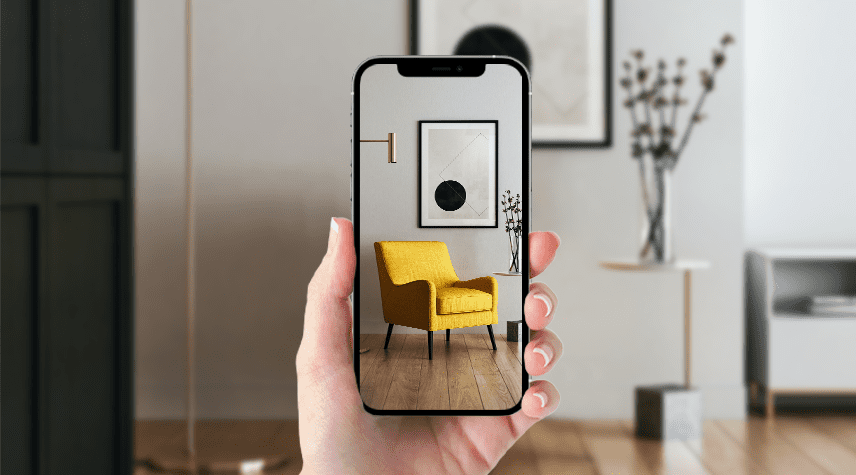
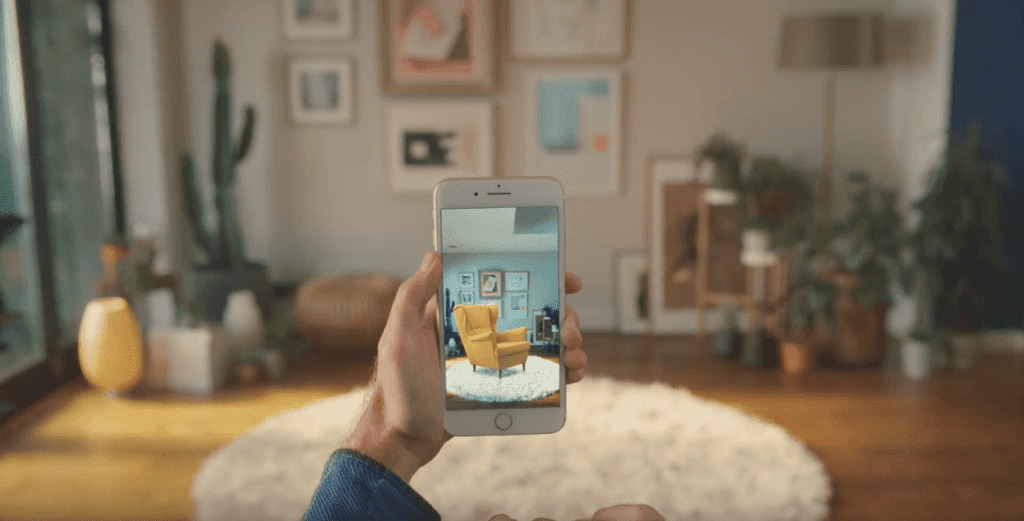
    Armchair AR visualization with furniture app

    Is Augmented Reality giving new life to the furniture industry? 

    The answer is definitely yes! Thanks to the use of AR technology, while scrolling our favorite furniture app on our smartphones, we can now have a taste of how an item looks in our home, simply by “placing” a realistic 3D version of the item in the space with our smartphone. This gives an amazing try-before-you-buy shopping experience. We can try any kind of item: a chair, a bed, a lamp, even tile and parquet, comfortably sitting on our (very material) sofa. This is for sure the first reason why Augmented Reality is giving new life to the furniture industry. 

    Why using an AR App in Furniture

    1) To try before you buy

    As said, one of the biggest advantages of the Apps using AR in furniture is that you don’t need to buy first and then see how your item fits in your space, but you can try any item from your smartphone and decide whether it is worth buying it or not. Furniture stores like IKEA know it well. With its app “IKEA Place” it has been one of the pioneers of using this immersive technology to enhance the consumer experience.

    Moreover, it has now released an update where it is possible to try not just one, but several items all together. In fact, it has been studied that the use of AR technology helps retailers too, because the consumer has the chance to try a large number of items and she might be persuaded to buy more than one. Besides, this significantly reduces returns. The opportunity to try the product, without actually buying it, makes the selling process easier and turns the app into a great marketing tool.

    Armchair AR visualization with furniture app

    2) To reach more people than the physical store

    Another reason why Augmented Reality is changing the furniture industry is that people can turn their smartphones into an extension of the furniture stores. Indeed, it allows the store to be known from a larger number of people also far from the physical store. Potential customers can try the products from far away without having to visit the stores in person and that can create a new fidelization process, where even people who live on the other side of the country can buy from the store and become regular customers.

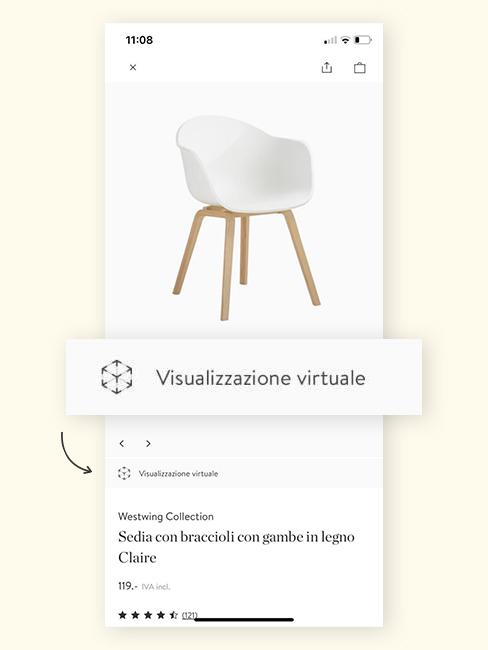
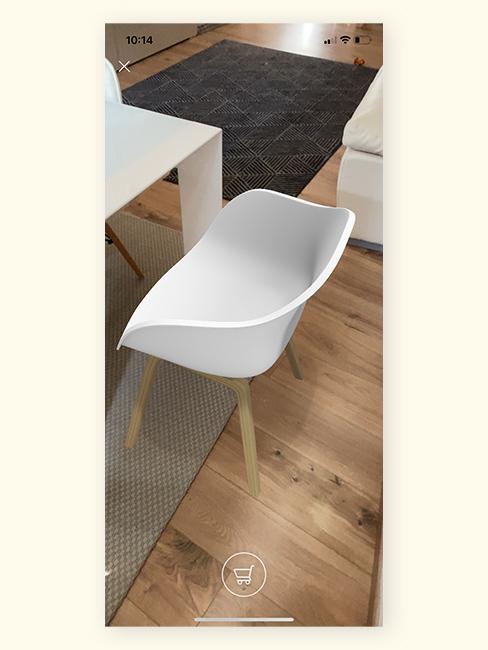
    Obviously, there are furniture stores who solely choose to be present online. It is the case of Westwing, where dozens of items are available to be tried in AR mode. The process is quite simple: you need to choose an item, click on “virtual visualisation” and open your smartphone’s camera. Then, you need to point your smartphone on a surface (even your floor will be fine, especially if it is a table or a chair) and move it until your item appears.

    Chair AR visualization with furniture app
    Chair AR visualization with furniture app

    3) To speed up the furniture selling process thanks to the customization

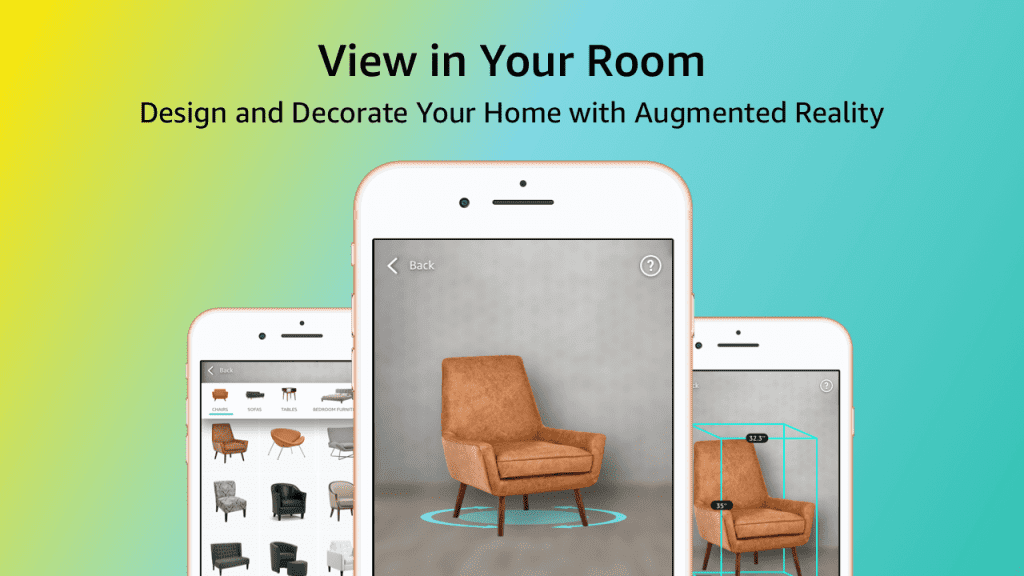
    Big brands like Amazon, for instance, know that buying online is the new way of buying and they understand the power of AR to help the consumer experience. In fact, Amazon introduced on its existing app the “visualise it in your room” button. Then, you must accept its access to your smartphone’s camera and click on the green square. It is also possible to take photos and screenshots of the moment so that you can share it with everyone you want. Moreover, Amazon gives you the ability to save them, to try more than one together and it also gives you style advice and recommendations for your designs.

    The use of tools such AR views creates a more personalised experience for the customer. The ways a product can be customized are numerous. Indeed, it is possible to change colors, textures, materials and much more, taking the consumer to have a major trusted sensation about buying the product, speeding up the whole selling process.

    AR app for Furniture visualization

    4) To have fun

    Yes, Augmented Reality is changing to the furniture industry, but it is worth saying that it is not only about selling. The customer, in fact, while trying the items with the app, gets a sense of amusement, as if it was a game in which she can play. Hence, the customers are attracted to use this immersive technology and to play with it. For the most creative ones, it is also a way to enhance their creativity and find themselves becoming interior designers (at least for a while!).

    The AR-media furniture’s experiences

    Among the categories available in our AR-media App there is the one related to the furniture experiences, where you can try items that other creators made. Moreover, with AR-media, you can create your own furniture experience, elaborating and creating an item, bringing it to life and watching it with the App. If you want to try one of the already existing items in the AR-media App, you just need to go to the furniture section, click on the one you want to try and open it. Then, you need to move your smartphone allowing the App to map the environment and then click to see the experience. Here is a demo video of how it looks like.

    With its easy, creative and different approach, AR in the furniture industry is really giving new life to the way we have always thought about furniture sales. With its opportunity to boost sales, create more engagement and make sensational experiences, we can definitely say that Augmented Reality is changing the Furniture Industry.

  • The transformative power of AR in Real Estate: the take of an industry expert

    The transformative power of AR in Real Estate: the take of an industry expert

    A new AR product has been recently released in collaboration with Bruce Kulpaca, principal broker at Commercial Venture Group (CVG). Bruce felt the need of enhancing the selling experience in his industry, transforming it into something more efficient for both the seller and the buyer by using AR in Real Estate. 

    His will to explore the transformative power of AR in Real Estate led him to us, and we worked together to develop a pilot project and to launch the Ding Dang app about a Real Estate property located in Springville (Utah), named Springpointe. Once again, a new project where the Real Estate Industry and AR-media converged together to create a magnified and transformative experience. 

    Keep discovering this project by reading the whole interview with Bruce Kulpaca below.

    Interviewing Bruce Kulpaca on how Ding Dang uses Augmented Reality in Real Estate

    Q: Hello Bruce, you started your Real Estate career in 1996, tell us something about the beginnings.

    A. Well, as you noted, I started my career in commercial real estate in 1996. At that time, I worked in commercial development; primarily retail in Florida. I was based out of Tampa. It was an exciting time. Drug stores were moving out out in-line space and pushing hard for stand alone sites and grocery anchored projects featuring local space; outparcels were very much in demand. The commercial real estate was redefining retail in the context of intersections and population centers.

    Q. The advent of the Internet in the 1990s was a great revolution for its impact on commercial real estate. What kind of practical impact did it have on you and your clients?

    A. It was evolutionary. The Internet changed how real estate is marketed. If you go back in time and think of how commercial real estate was marketed before the internet, it was very much of an “in market” approach. That is, a tenant or developer spent a great deal of time in the market…driving the streets, going on-site to look at locations, taking pictures from different angles, drawing rings on paper maps and annotating with sticky notes.

    During the pre-internet era even taking aerial pictures required a great effort. Once I rented a plane, since I had my private pilot’s license, and my colleague snapped photos. It may seem ridiculous now, using a drone in 20 minutes, for pennies, you can do the same job and even more. Today property ownership information is readily available, zoning is readily available. Also, the reach of our market has really expanded.

    Q. What do you mean the market reach has expanded?

    A. I used to spend a great deal of time putting together marketing packages that were then physically mailed out. It was a really slow process and depended on a somewhat limited mailing list. Now, we can quickly approach our market through websites and email campaigns. Not only that but social media allows others seeking our product to find us. It’s a significant change; a lot of market inefficiencies have been removed.

    Q. Market inefficiencies… How does that relate to commercial real estate?

    A. In my view, market inefficiencies are removed as more buyers and sellers become aware of each other. It’s my job to seek out as many buyers and sellers; through this process the best price discovery is achieved for my client or project. I want to take every opportunity to make sure buyers and sellers are given the best information that technology can provide. You never really know what little piece of information will turn a prospect into a buyer.

    Even today, much of the marketing is limited to photographs, flyers and renderings. These tools leave a lot to the imagination and can be subject to a whole range of subjective influences….maybe the rendering is not quite as good as another project, maybe the site plan is unclear, maybe the flyer is unclear. If our goal is to eliminate market inefficiencies, then the tools we use should be aboutpresenting the project with minimal subjective influences.

    Q. After the Internet revolution, the next one in real estate will be related to 3D and Augmented Reality. You recently founded a real estate app called Ding Dang. Can you explain your vision with respect to these technologies?

    A. Well, it’s part of the evolutionary process we discussed. It is the next step in making projects real for our customers and removing subjective influences. For example, we are beginning to see more and more use of 3D technology in commercial real estate. This is a big step beyond renderings and site plans. The goal of Ding Dang is to take the evolutionary step even further with augmented reality. Ding and Dang are Utah slot canyons. The name reflects my love of the outdoors and experiencing, in my view, the sublime power of nature. Hopefully, I can express through the app a sublime experience of architecture. In my view, augmented reality is the next step past 3D. Like 3D, it operates on multiple perspectives or planes.

    Augmented reality takes the next step by placing the project in your environment. You are not looking at a movie which is how 3D tends to be presented. Rather, you have an image in front of you in your environment and this image can be engaged with by the viewer. The audience can actively participate. I think anytime you can engage the audience, challenge the audience to participate, the project has a better chance of avoiding the subjective pitfalls of that are prone with non-participating marketing tools like flyers, movies and renderings.

    Q. The Ding Dang app has three visualization modes: On-Site; Site Plan and Anywhere Anytime. Can you explain how they differ?

    A. Sure. Let’s take the first approach: On-site. Here were are dealing with basically an onsite experience. We can project the proposed building onto the site via an iPhone. The site is viewed on a 1:1 scale. The advantage of this approach over a site project sign is obvious. When you can walk around the site and actually see how it will be sited, the customer is an active participant and is able to view the building as it will actually be built. It is even possible to create an experience where the customer can walk up to the building and even go inside. With community projects, this opens the possibility of having the community give its input on a project before it is ever built.

    With site plan, we can project the architecture onto a flat site plan. This approach allows the viewer to experience the project in multiple dimension and how the architecture relates to the site. The last approach, Anywhere Anytime, allows the project to be projected onto any flat surface and can then be viewed from any angle. The viewer can walk around the project or the viewer can remain stationary and use the viewer tools to move the project.

    Q. You say project…what does that mean? How is the architecture projected?

    A. There needs to a means to view the projection. Currently, the architecture viewed either through the screen on the iPhone or the user can enable the viewer tool and use an inexpensive viewing device such as the Homido Grab for a more immersive experience.

    Q. Why did you choose to use an App for this technology?

    A. In my opinion, the smartphone is the one device we all carry with us at all times. The app is superior because it is easily accessible. One only needs to open the app, click on the appropriate project and the experience can begin. If the experience is downloaded onto the phone, there isn’t any need for internet. I was demonstrating this technology to a seat mate on a flight recently, We were flying so my phone was on airplane mode. However, I was able to call up the project on my phone and show my seat mate the project.

    Q. Where do you see this technology going?

    A. As companies develop smart glass, the experience will become more and more immersive. I think within the next 5 years we will be able to put on a pair of smart glasses, call up any project through the app and not only experience the architecture but have access to a host of other important marketing materials such as spread sheets, rent rolls, permitting schedules etc. All of this accessible via the same app and tied together on a project by project basis. As this develops, those that are part of the technology will be part of an ever more efficient marketplace.

    Well, thank you Bruce and we certainly look forward to finding out how this technology develops…

  • AR beauty filters and their (not so beauty) reality

    AR beauty filters and their (not so beauty) reality

    “In a world full of Kardashians be… yourself” says one of the popular ‘memes’ on the internet. What does it actually mean? Well, all you need to do is scrolling your Instagram/Facebook/Snapchat/Tik Tok feed for about five minutes to figure it out: in no time, you will be overwhelmed by the distorted-almost-unrecognisable faces of your friends, changed by the ultimate face or AR beauty filters found on a Social Media.

    What is a face filter? An AR face filter is a sort of mask created with Augmented Reality that can add virtual objects, images, sounds and any kind of make-up to your face by simply framing it with your smartphone camera, whereas an AR beauty filter, besides adding make-up and changing the color of your hair, can also distort (or beautify) your entire face and body, making your eyes look bigger, your lips fuller, your nose thinner, your waist smaller than Dita Von Tees’s and so on… causing a large number of critics, psychological issues, especially among younger people, and self-esteem doubts!

    The pioneer of the face filters is Snapchat, when years ago it had the idea of putting facial filters to its stories in order to add amusement and fun to the regular photos. The response was huge! Within months all the other Social Platforms had to update and add different kinds of filters to keep up with it. Nowadays, more than 600 million people use AR filters to their stories and posts across Instagram and Facebook and more than 75% of Snapchat users create content using filters everyday. 

    AR beauty filters are not just trouble-maker

    It is fair to say, though, that thanks to the introduction of AR beauty filters on Social Media, especially during these past two years of pandemic, both people and companies had the opportunity to “live their lives” in a more standard environment. Considering the Beauty Industry, for instance, Augmented Reality is changing the way some brands approach their customers, creating a more personalised experience for them. Hence, the women and men who wanted to try on new products or see how they look like with different hair were able to have a taste of how they could look like without leaving the house and the companies which encouraged the realisation of such filters, on their side, were more than glad to offer the tool and help them finding their favourite product that they would buy right after.

    This is a considerable improvement in the beauty industry, allowing the companies to predict which product can have more success, facilitating the visual merchandising and also the inventory. Moreover, it has been studied that people who use AR beauty filters help the companies to improve the quality of their products and set higher standards thanks to the availability of monitoring a million different kinds of facial features.

    In addition, it is necessary to say that augmented reality AR beauty filters can also be a new digital tool for all the make-up artists that want to share their art with the world. They can create their digital make-up and make users try it and if they like it, they will be (obviously) more keen to reproduce it on their very face!

    But the reality is way more complicated

    As Spiderman once said: “with great power comes great responsibility” and the impact of augmented reality AR beauty filters in terms of psychology and education on people’s minds is far from being optimistic. Studies revealed that the spasmodic use of AR beauty filters especially in young girls may cause a significant increase of negative self-perceptions, encouraging young girls towards the use of cosmetic surgery, with the aim of becoming exactly like the beauty filter they use everyday. Apparently, though, this is only the tip of the iceberg. In fact, it is not only about cosmetic surgery, but it is the whole way in which a person sees herself or himself that is concerning.

    The Augmented Reality sector put these filters under the category of “deformations” and “face distortion” and if it is not enough to make us think about the disturbing effect that this may cause us, it seems that the “deformation” happens even beyond the physical aspect, going straight to the psychological one, “deforming” our way of thinking about ourselves and how we should look like. Hence, some women now refuse to be seen without AR beauty filters as if they somewhat think they look that way, so now it is common to see photos where girls wear inhumanely long lashes artistically designed and an amazing silk skin beautifully coloured, forgetting how they looked in the first place. 

    There are plenty of these filters and you can recognise them just by their name. On Instagram, for instance, in the story filters section, you just need to choose the “selfie” category and you will find dozens of AR beauty filters usually named something like: SilkLashes, BeautyFace, CuteFace, FoxyEyes, PrettyFace, PerfectEyes etc…

    Finally some changes are being made in the AR beauty filters sector

    Seeing the concerning amount of anxiety, depression, and suicidal thoughts among girls, apparently caused by the negative way they perceive themselves outside the “filtered reality”, some companies and countries decided to do something about it: Facebook banned face-distortion filters in 2019 (reintroducing them again after a few months), countries like Norway and UK forbad AR beauty filters and photos where the image of the body appeared too far from reality, unless clearly declared in the caption and lots of influencers campaigns touch the topic too, encouraging people to post their natural face by using referred hashtags like #filterdrop and #naturalbeauty.

    Undoubtedly, this is only one first small step towards a better awareness on the subject and a lot of work still needs to be done. Especially among the young people, educational awareness on how some technological tools work and their impact on their mental behaviours are necessary. The world of Augmented Reality and new technologies is still a mix of wonder and mystery and it is our duty to recognise the real beauty of it and use it to improve our daily reality.