Investment in the Metaverse and the sectors most affected
In the first months of 2022, $120 billion was invested in the ‘wide field’ of the Metaverse (more than twice as much as in 2021).Â
Investors in the Metaverse fall into three categories: large technology companies (Meta, Microsoft, Nvidia, Apple, Alphabet), venture capitalists and brands pioneering innovative projects.
The sectors that show real interest and investment in the Metaverse are: energy (18%), automotive (17%), hi-tech (17%), tourism (15%) and entertainment (15%).Â
According to a McKensey survey of 3,400 people worldwide, already 59% of respondents prefer to have a digital experience as an alternative to a physical one. In particular, shopping, attending events or games, fitness, dating and education are mentioned.
Ever since Facebook became Meta, there has been a lot of talk about terms such as: Metaverse, Virtual Reality, Visors, Avatars. This article will discuss Avatars, when they were created, what they are and their function in the Metaverse.
Avatars were created and designed to be a kind of personalized representation. But what exactly is an Avatar in the Metaverse?
What is the meaning of the word Avatar?
The word Avatar has the meaning of ‘incarnation’ and was first used by Neal Stephenson in the 1992 science fiction novel ‘Snow Crash’.
Avatars, for instance, are the images chosen to indicate who we are in virtual communities, social networks and online video games. In recent years they have taken various forms with precise declinations depending on the contexts in which they are used. For example, according to the social platform, users upload photos for their profile or create a 2D or 3D model of themselves. In simple words, an Avatar is an online representation of a user that is used by the latter within the web to present him/herself to others and can have either the real characteristics of its creator or be a figment of his/her imagination. The emoji created by Apple in 2017 are the first successful case in point.
How to use an Avatar in the Metaverse?
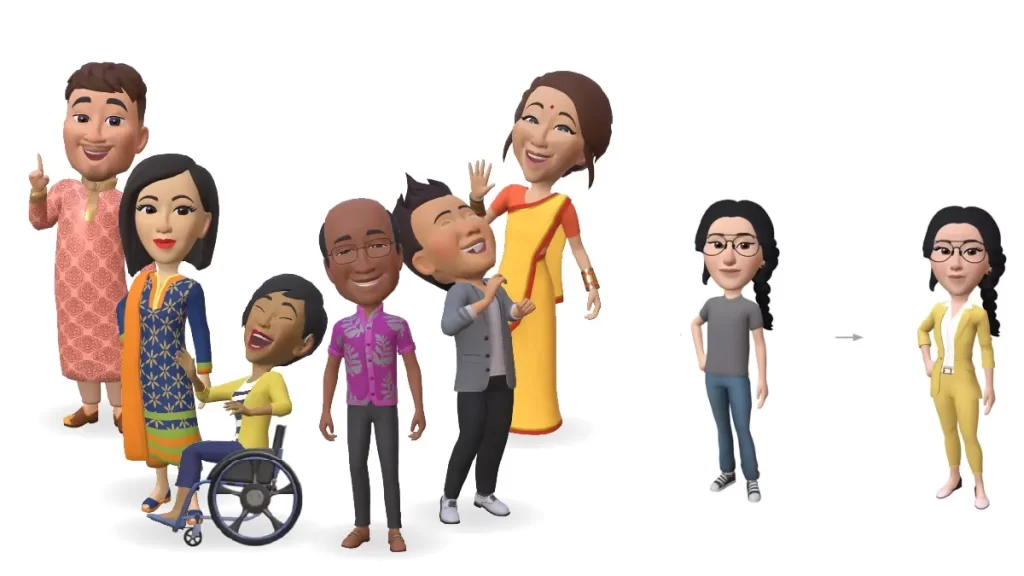
The Avatar in the Metaverse is defined as our digital version occupying a three-dimensional space in the virtual world. The first step to be able to enter the Metaverse is to create an avatar: a very important moment for users, not only from a technical point of view but also from a psychological one, because they have the possibility to freely choose their digital identity.
In fact, the Metaverse represents a new means of communication that radically evolves social interactions between users, overcoming the limitations of 2D technology and thus offering the possibility of relating in a totally innovative and immersive way. The avatar creates the first impression others have of us, so we choose how to present ourselves.
In the world of the Metaverse, the user has ‘carte blanche’ to create an avatar: it is the user himself who chooses who and how he wants to be, and this is precisely one of the main reasons why he captures and attracts the attention and curiosity of users.
When Metaverse was announced, the highlights were new and improved. An Avatar in the Metaverse is essentially based on the same principle as other online avatars, just like the 2D avatars on other platforms: the user will be able to create and use an avatar in the Metaverse at will and through an avatar will be able to traverse different experiences within the virtual world.
The avatar then becomes the official identity in the Metaverse, replicating exactly the person as he or she is in the real world, body movements, facial expressions to give the user the feeling of really being there.
The most important advantage of creating an avatar in the Metaverse is that the user can change his or her avatar at any time. For example, we can create one version for social relations and one for business relations. Or, a different version for each activity we perform or person we meet. Moreover, depending on the platform we want to inhabit, our avatars will have different characteristics. The psychological aspects of each individual definitely play a key role in the creation of one’s avatar: the choice of the virtual character conveys personality traits and can immediately suggest something about the person behind the avatar. In the construction of an avatar, some personality traits of the individual may emerge, while others may remain hidden or difficult to understand.
How to create your own Avatar in the Metaverse?
Versatility is what characterizes avatars. There are many ways to create an avatar: on some platforms, such as the one used by Meta Presence, it is possible to upload a photograph into the system from which the corresponding avatar is generated, or, with imagination and fantasy, one can create an unedited and original version of one’s personality.
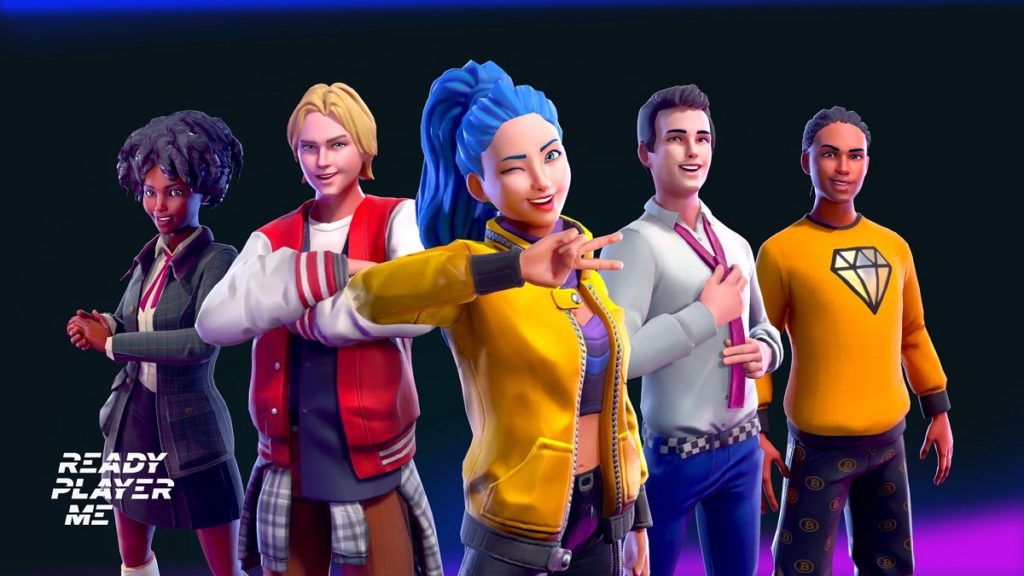
Another popular platform is Ready Player Me. What makes this app unique is that Ready Player Me avatars can be used on over 1,500 metaverse apps, which means that the same avatar can exist on different metaverse platforms. You can explore virtual worlds in VRChat, participate in meetings in MeetinVR, or live stream with fans using LIV – all with your own personal avatar representing you in the virtual worlds. Any developer can integrate Ready Player Me into their app or game using our free SDK (Software Development Kit) for avatars that is compatible with Unity and Unreal Engine and works seamlessly on web, mobile and desktop platforms.
The user can choose in total freedom whether to create a realistic or caricatured avatar; close to his or her real style or like the hero of a fantasy video game; to choose a human or non-human form; a full-body avatar or one with only head and hands; with realistic or unrealistic movements. Of course, these are only a few elements that can be changed in one’s avatar. The Metaverse, in fact, opens up a range of possibilities, from colors to style, a true art.
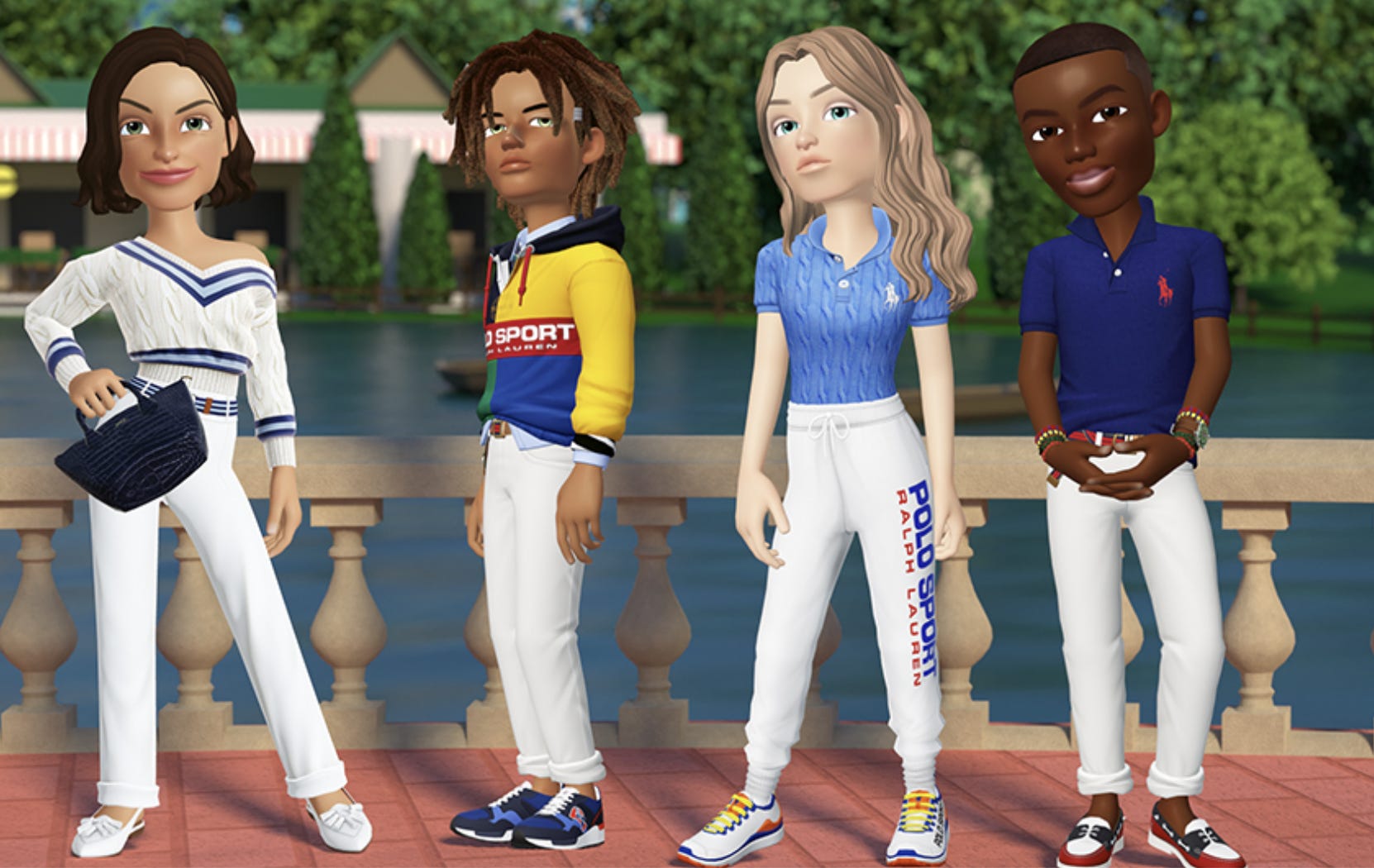
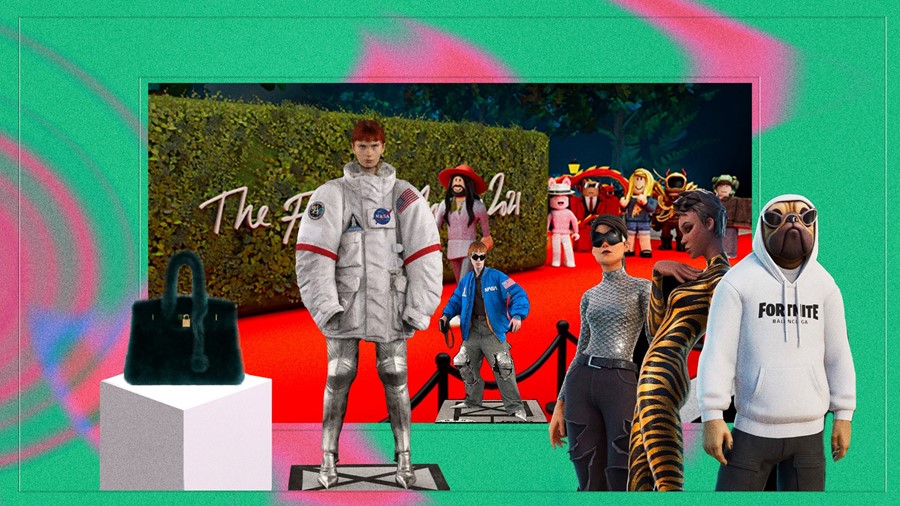
Many companies have set up the first digital designer clothing shops ‘The Meta Avatars Store’ on Instagram, Facebook and Messenger, where one can buy digital clothes to model and dress avatars. The first brands on this platform are Balenciaga, Prada and Thom Browne! Digital goods will, in the future, be an important way to express oneself in the Metaverse and a major driver of the creative economy.
What are the main apps for creating an Avatar in the Metaverse?
To create your Avatar in the Metaverse, you can choose from these important apps, which are very easy to use and perfect for downloading to iOS and Android mobile devices.
1. Face Avatar Maker – Creator: This is a very easy-to-use application. Available on Android devices, it is the most effective way to create a perfect manga-style avatar in just a few minutes. You can choose the shape of the face, the shape of the eyes, the hair and other fun accessories so that you can customize your image 100%;
2. Mirror-avatar, gif stickers, sticker and emoji: ideal application for those who are looking for a quick and easy way to share funny cartoon images of themselves with friends and family;
3. Avatoon- Avatar Creator: Avatoon’s app can easily create a custom avatar, true to the real image, in a matter of seconds. Furthermore, once the avatar is created, facial expressions, pose and background can be inserted and changed;
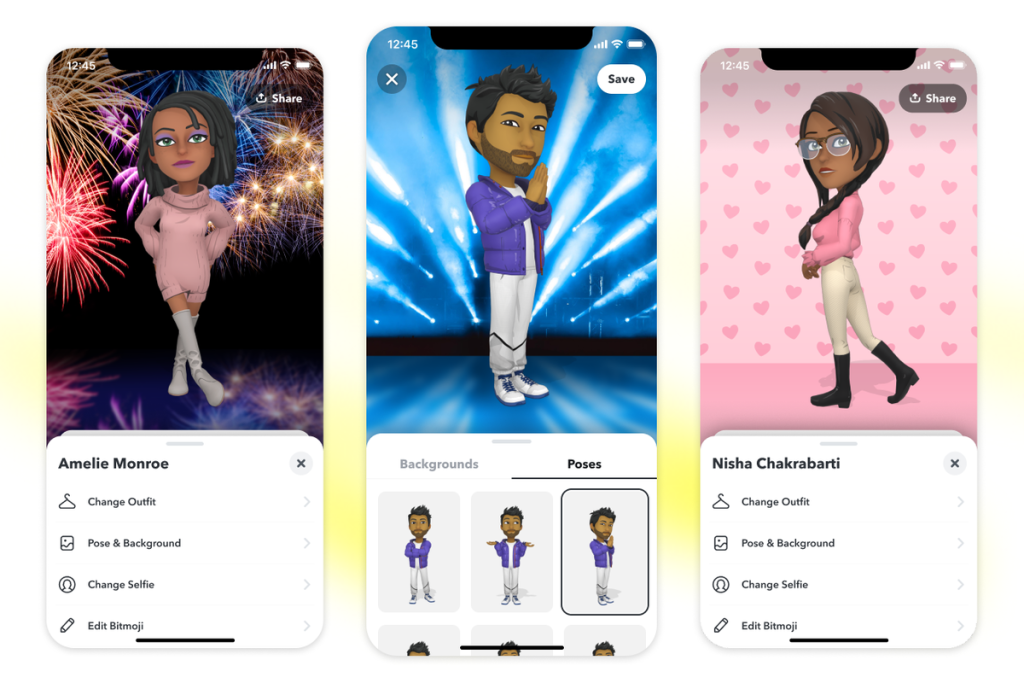
4. Bitmoji: This is one of the most comprehensive apps. With this app you can reproduce the face in simple moves, insert funny cartoons or other characters within a specific location, an original and fun way to recreate real situations. You can use the Bitmoji app on Snapchat and in any other chat. By simply taking a selfie, the app will be able to faithfully reproduce the features and bring the custom avatar to life. After creating the virtual character, the Bitmoji app will show it in different situations and poses.
With AR & VR in E-commerce we have officially entered the phase of E-commerce 3.0: brands have changed the way they propose and sell their products and services, on the other hand the purchasing process by users has completely evolved. Today’s consumer expects to have a real, personalised, multi-channel browsing and buying experience, wherever they are and whenever they want. Therefore, it is crucial to be able to build a very strong and lasting connection with the customer, so that they continue to choose the brand and encourage other users to do so as well.
E-commerce 3.0 is characterized and differentiated from the past by being flexible and highly customisable. It must be able to accompany the user on the path of choice and purchase, recommending products and services that meet the user’s individual needs and make them feel at the center of interest. Every single product or service must be accompanied by photos, videos, reviews and detailed descriptions and, in case of need, the customer must be able to count on a competent and helpful support service, able to resolve any problems or requests in a short time.
Why use AR&VR in E-commerce?
Thanks to Augmented Reality and Virtual Reality, E-commerce is evolving and transforming into virtual shops that look like the real ones, where online shopping is more and more engaging, able to keep the user on the website, simulating a real shopping experience as if you were in the physical shop.
AR & VR in E-commerce allow breaking the barrier between physical and virtual space through increasingly immersive mediated reality experiences, which are very useful for consumers. These technologies can change the way reality is perceived by the user and the possible applications are many. The use of virtual and augmented reality in e-commerce is a differentiating element in the optimisation of the shopping experience, going so far as to make this action a moment of entertainment and fun.
With augmented and virtual reality, it is not only possible to replace products’ 2D images with 3D models, text, additional information and assistance, but it is also possible to create a real virtual avatar that has the same physical characteristics as the user and can wear clothes as in real life. It is not only in fashion, however, that we see change, but also in different sectors. Augmented reality can make an important contribution to decision-making.
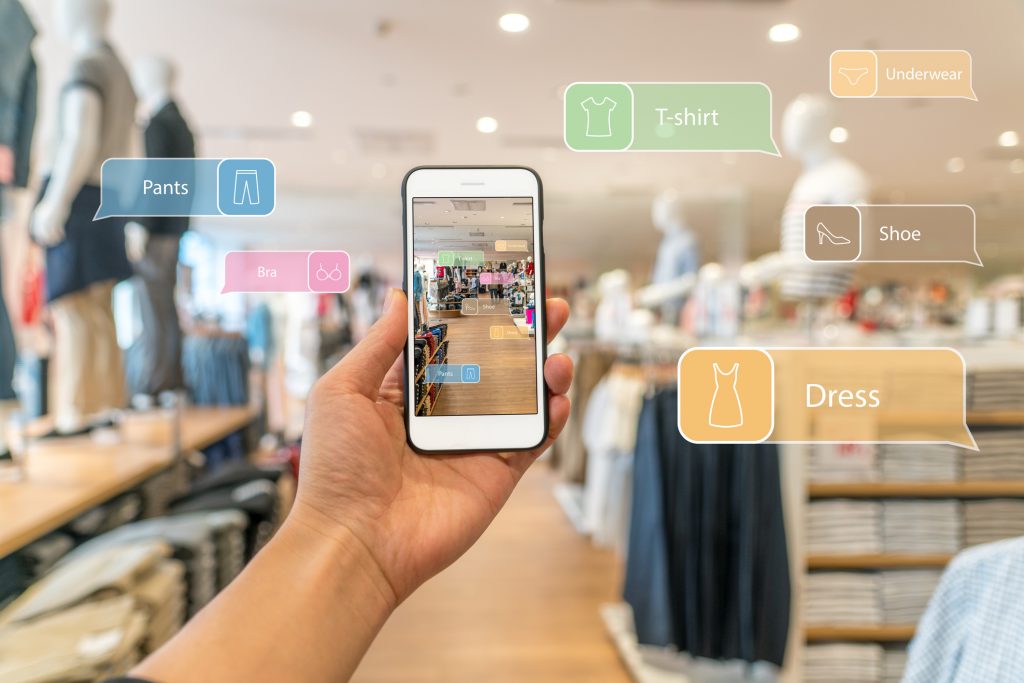
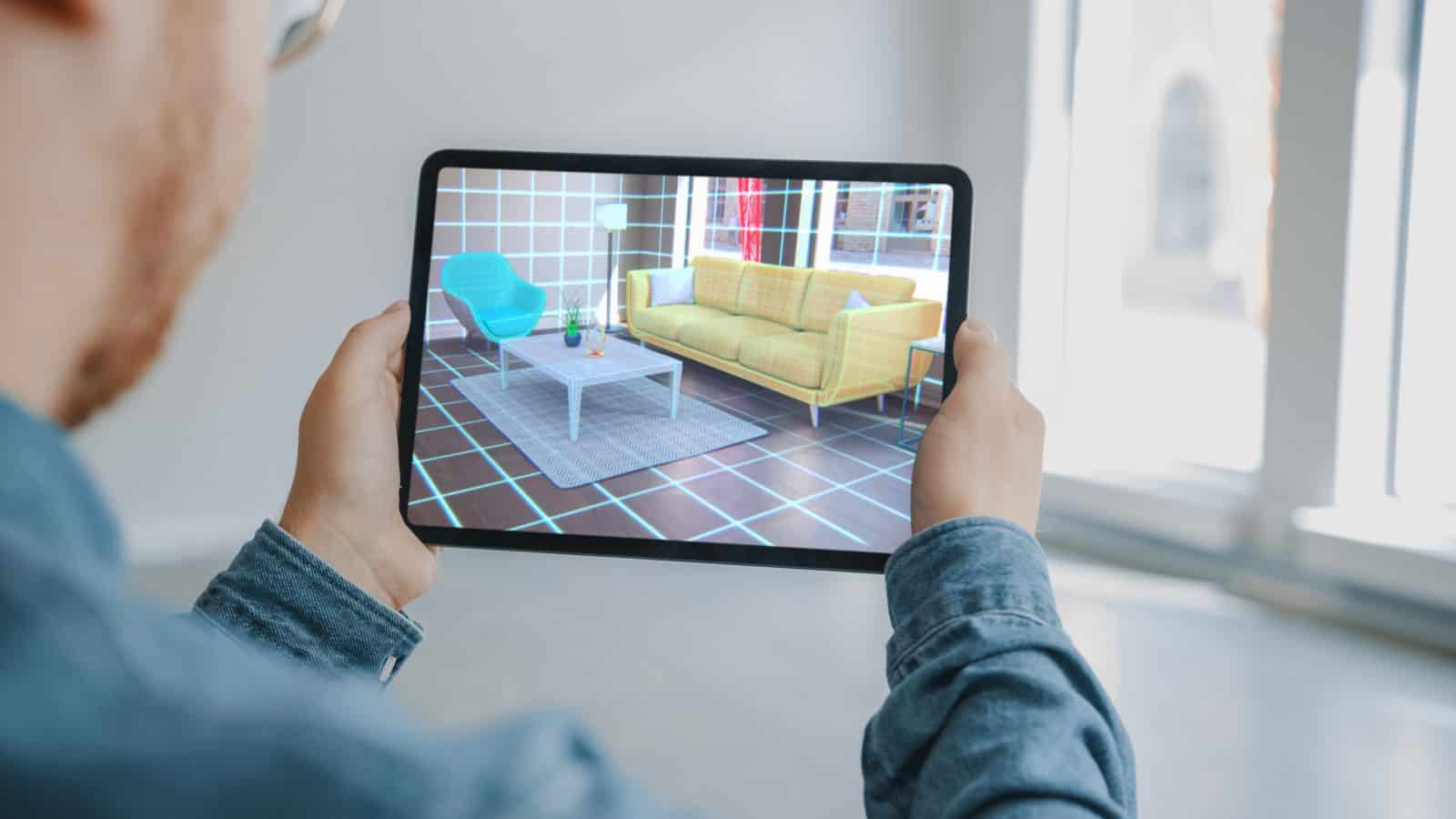
Indeed, this technology allows the user to see objects in different contexts of use before purchase, reducing possible returns and making it easier to choose the product and its characteristics. All this is possible simply by using a smartphone: by pointing the mobile phone’s camera where you want the chosen product to appear, and then view it from different perspectives.
What are the benefits of AR&VR in E-commerce?
The main advantages of AR & VR applied within an E-commerce site are:
– Improved online shopping and choice experience because it is more interactive, immersive and personalized;
– Faster choice process resulting in more sales in a shorter time frame;
– Online experience as close as possible to the real one with real virtual stores and touch-points;
– More conscious shopping, less margin of error in consumer choices, less number of returns;
– Possibility of simulating the virtual version of the product being worn, such as: clothing, make-up or in one’s own home environment, as in the case of furniture, visualizing even the smallest details from possible different angles.
Why are brands moving closer and closer to AR & VR?
Snapchat has carried out a study called ‘The Future of Shopping’, conducted by Foresight Factory in twelve countries globally, to provide an extensive picture of the shopping landscape at this point in time. According to the Snapchat report, the use of augmented reality in E-commerce will increase by 2025 and as a consequence it will also directly support sales. From the analysis of the 2021 data, it is predicted that in less than 5 years there will be a 27% increase in the proportion of Generation Z shoppers who will use augmented reality before purchasing a product, leading to a scenario in which almost 3 out of 10 Generation Z will shop using augmented reality.
Specifically, among the main motivations for consumers to use AR & VR in E-commerce is:
– the possibility to see how products might really look (37%)
– seeing them in 360° (34%) and understanding their exact size (34%)
-in the case of furnishings, the possibility of visualizing the products within the chosen environment (28%).
The different brands that integrated AR & VR into their E-commerce had several benefits such as:
– increasing brand awareness;
– differentiating themselves among competitors;
– perfectly meet the needs of the new generation Z
– collect more consumer data.
Examples of brands that have integrated AR & VR into their E-commerce
Many brands are giving their space to augmented and virtual reality:
– Nike is experimenting with augmented reality by creating ‘Nike Fit’. Nike Fit is a new feature that will be integrated into the brand’s official app which, by scanning your foot, shows you the most suitable size of the shoe you wish to buy. According to Nike, more than 60 percent of people wear shoes of the wrong size. The company hopes to solve the problem using a combination of computer vision (which recreates an approximate model of reality), scientific data and artificial intelligence algorithms. The process of identifying the right fit will be carried out in augmented reality directly from the smartphone. All with extreme simplicity.
– Burberry has launched a new augmented reality shopping tool that allows users to get a better idea of a product’s features before buying it. By searching for the Burberry Black Tb bag or Arthur Check trainers on a smartphone, shoppers will be able to see a digital image of the product at scale in comparison with objects in their own reality.
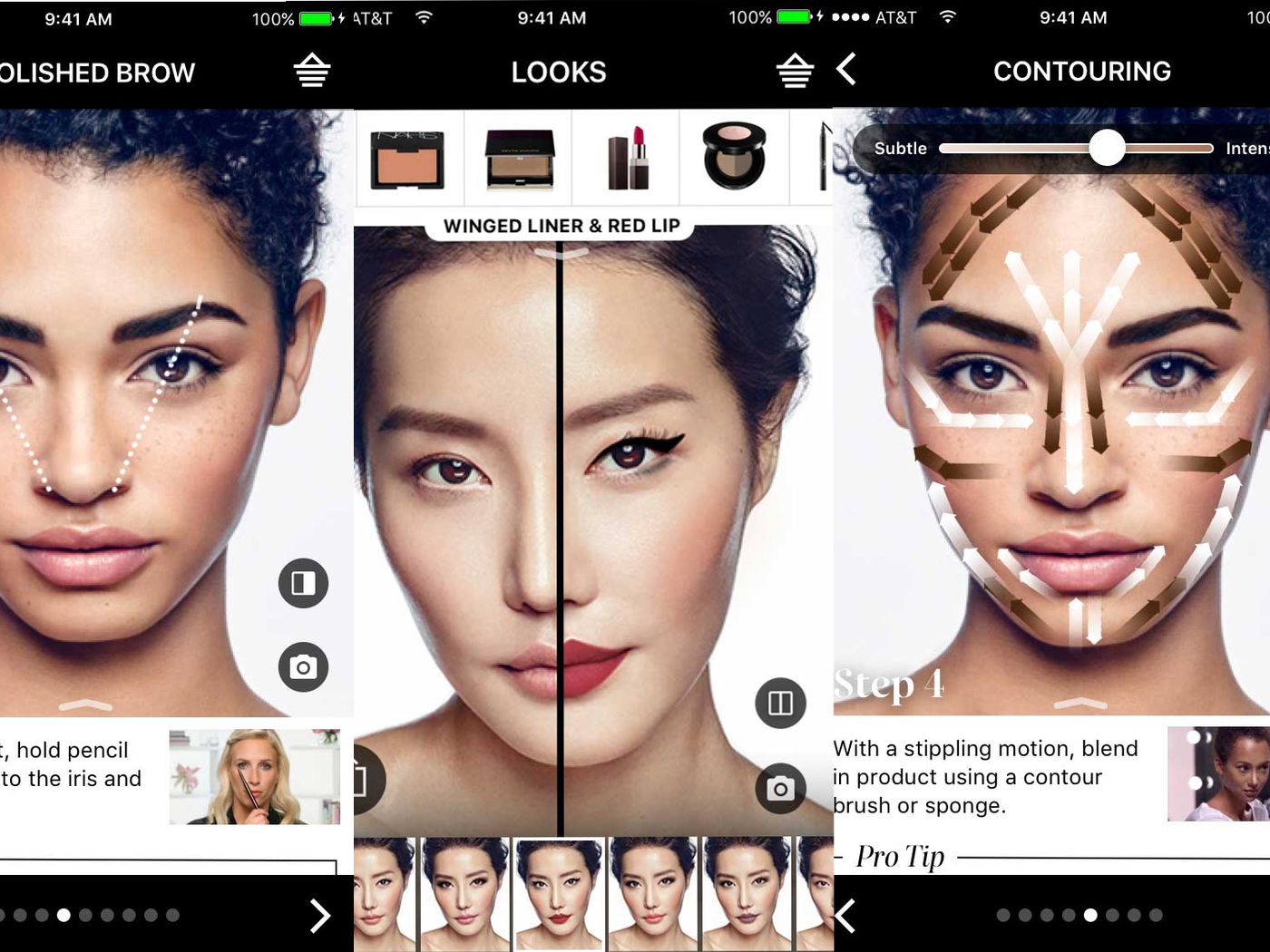
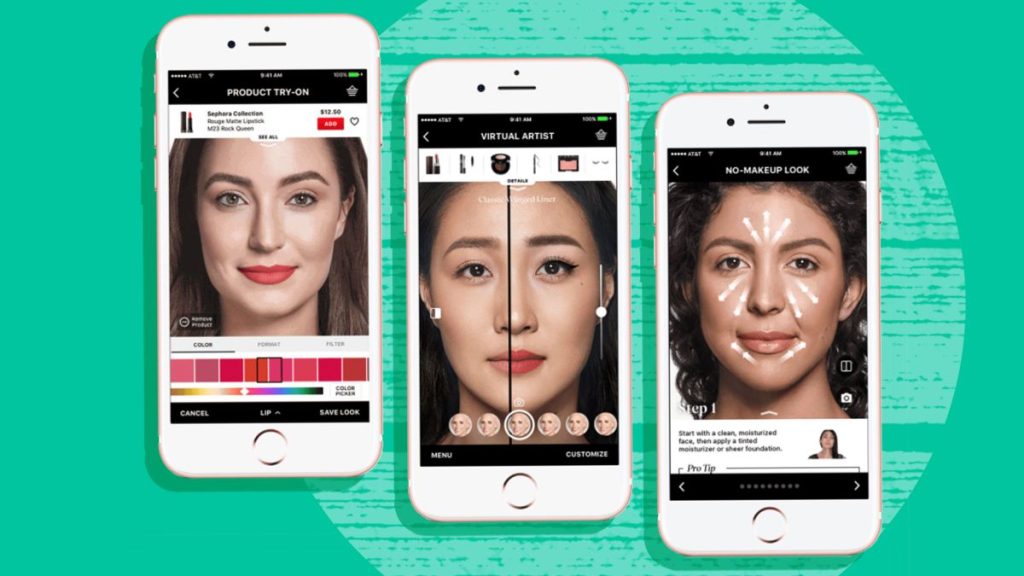
– Sephora has introduced the ‘live 3D with facial recognition service’ in its ‘Virtual Artist’ app, one of the retail sector’s first experiments in augmented reality. Virtual Artist allows users to upload their own selfie onto the app and “virtually” try out various Sephora products, all by editing the uploaded photograph. The new version, which has been a huge success with the public, allows you to see yourself, as in a mirror, in real time and in motion, observing the effects of cosmetic products from different angles, greatly improving the effectiveness of the tool. Thanks to the development of this new function, Sephora now differentiates itself in the market by being able to show the virtual image in motion and in real time.
Virtual Reality and Augmented Reality will forever change the way we interact with technologies and the reality in which we are embedded. This is an important process that every company will have to use to keep up with the times.
The word ‘Lidar’ is made up of: Light and Radar. Lidar (Light Detection And Ranging) identifies the technology that measures the distance to an object by illuminating it with laser light and, at the same time, is able to return high-resolution three-dimensional information about the surrounding environment. Lidar works similarly to a radar, but uses laser technology to measure distances and depth. This is crucial for augmented reality (AR)-based apps and photography.
A Lidar typically uses several components: lasers, photo detectors and readout integrated circuits (ROICs) with time-of-flight (TOF) capability to measure distance by illuminating a target and analyzing reflected light. The operation of Lidar technology is based on an ‘immediate’ principle and is referred to as ‘Time of Flight’ (T0F) or time of flight. Time of flight can be obtained by sending a pulsed signal via a laser, but also by measuring the phase and frequency of the reflected light signal against a reference signal.
What are the advantages of Lidar technology?
The use of Lidar technology has several advantages:
– Allows fast and accurate measurement;
– Wide resolution;
– Simplicity and ease of use
Due to its simplicity of application and use, Lidar technology is defined as a ‘Transverse’ technology and is most widely used in several markets:
1) Construction: Lidar is used in the construction/building sector as it helps to reproduce the reality of construction in a very easy and highly reliable manner;
2) Mapping: in recent years, this technology has been increasingly used in everything related to morphology mapping/precision remote sensing: it helps to establish the differences in elevation between terrains with a particular eye on the morphology of a given area (even potentially coarse). In this way, Lidar operators can create numerous Digital Terrain Models (also using drones), the accuracy of which will be very high and the margin of error very small;
3) eCommerce: sellers can easily create a 3D version of their products for sale, simply by using an iPhone and helping potential customers better understand what the products look like. Many eCommerce shops already offer a 3D visualization of the product in addition to photos.
4) Automotive: Lidar sensors used as a ‘visual’ tool to build self-driving vehicles. In this context, Lidar systems are used to detect obstacles, such as other vehicles or pedestrians, or the environment surrounding the vehicle.
Lidar: a step forward by Apple in Augmented Reality
Appleintroduced a Lidar sensor in its smartphones for the first time and made Lidar available to everyone. Lidar may be the greatest creative and professional innovation ever to come to the camera section of a smartphone. The iPhone 12 Pro’s Lidar is based on ARKit, Apple’s framework for augmented reality.
With iOS 14 came ARKit 4, which added several new features: it increases resolution, allows multiple faces to be tracked simultaneously, enables motion capture, and better handles occlusion, that is, the possibility of virtual objects being covered in the scene by a real person. In addition to position tracking, which allows virtual objects to be linked to physical points.
The Lidar used by Apple is a module consisting of two elements, a transmitting and a receiving element. The transmitting element is based on an array of VCSELs, vertical cavity surface-emitting lasers, an acronym that will mean nothing to many but which is the same technology used by optical mice today.
Digital twin: what is it and how does the digital twin model work?
Digital Twin is a virtual representation of an object, connected to it throughout its life cycle.
The Digital Twin is updated in real time by data collected from sensors connected to the physical asset and uses simulation programmes, machine learning and reasoning to provide useful information about the asset and to develop predictive models of the object’s future performance and reactions to certain conditions. With the advancement of digital technologies, the Digital Twin allows for more efficient management of systems, saving costs and time.
The market for digital twins is growing rapidly and this fact indicates that their demand will continue to grow in the future. In 2020, the market for digital twins has been valued at $3.1 billion. Some industry analysts speculate that it could continue to grow rapidly until at least 2026, reaching an estimated $48.2 billion.
What are the benefits of using Digital Twins?
– Improved research and development: the use of digital twins enables more efficient product research and design by creating a lot of data on possible performance outcomes. This information can lead to insights that help companies apply the necessary refinements to products before they go into production.
– Increased efficiency: even after a new product has gone into production, digital twins can help reflect and monitor production systems, paying particular attention to achieving and maintaining maximum efficiency throughout the production process.
– Product end-of-life: Digital twins can also help manufacturers decide what to do with products that reach the end of their life cycle and need to receive final treatment, through recycling or other measures. Using digital twins, they can determine which product materials can be recovered.
The markets that use digital twins with great success are those dealing with large-scale products or projects such as:
– Engineering (systems)
– Automobile manufacturing
– Aircraft manufacturing
– Railway car design
– Building construction
– Manufacturing industry
– Energy companies
How can digital twins be used to experience augmented reality?
Digital twins and AR are one of the most interesting digital representations of recent times. Based on an incredible technological variety and complexity, digital twins constitute a true connector between the physical world and its infinite virtual instances, with which the full simulative power of the digital can be harnessed. The constant flow of data generated between the physical and digital twin enables the interaction of various enabling technologies of Industry 4.0, such as artificial intelligence and augmented reality. Users can, through digital twins and AR, make use of simulations and predictive analysis to prevent problems before they occur, explore new opportunities and support new projects in a more informed and objective way than would be possible with traditional methods.
Compared to ‘simple’ virtual simulations focused on a single event or phenomenon, digital twins involve the entire life cycle of physical twins. The real-time data flow is processed to extract information value that is useful for generating knowledge to support complex decisions and the continuous improvement of processes or products themselves.
Today’s virtual worlds lack a very important aspect: the connection between reality and the metaverse, i.e. the virtual reality shared via the Internet, where one is represented in three dimensions through one’s desired avatar. And this is where the digital twins come into action, with the IOT once again creating the sensory links needed to interface the real and the virtual.
Digital twins and AR are about to enable companies to visualize key information about their operational technologies. The ability to visualize physical and virtual environments is an untapped advantage for industries such as manufacturing, transportation and energy, where heavy machinery and other physical equipment are often at the heart of business operations.
It is becoming increasingly imperative and necessary to combine these physical assets into applications and IT infrastructure to improve operations, customer service and produce business-critical insights that help companies gain a competitive advantage. This is where digital twins and AR each have a role to play in helping companies achieve full Industry 4.0 transformation and automation.
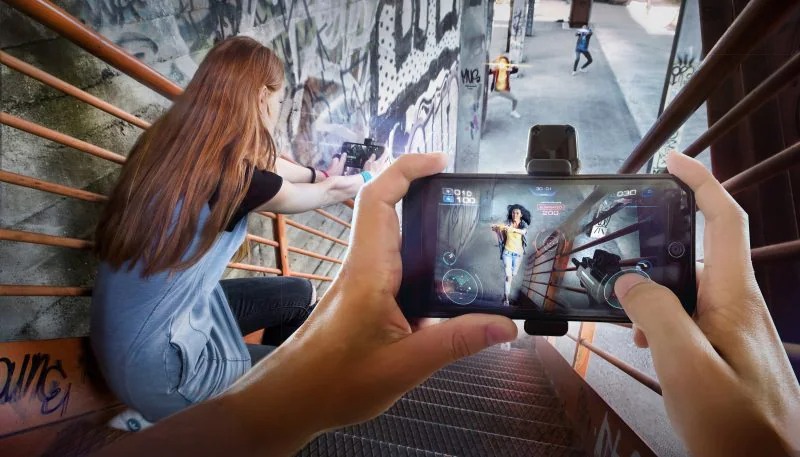
Augmented Reality has brought a revolution to the world, especially to the games industry. The video game sector is the main consumer branch for AR technology, as they are now within everyone’s reach, without the need to buy expensive headsets, and they are really immersive thanks to the possibility of being able to explore the world by generating a feeling of adventure.?
Augmented Reality games create a realistic image together with sounds and other sensations to offer imaginary experiences that stimulate the player’s physical presence in the environment. As the user becomes more demanding and looks for ever more immersive gaming adventures, they will discover through AR a complete virtual world that replaces the real one, controlled by body movements. This is, therefore, an extraordinary beginning of AR technology. In recent years, the online games industry has evolved tremendously, reaching a record of $175 billion in revenues with more than 2.7 billion gamers worldwide, and is expected to grow even more in the future.
The relationship between AR and the games industry is one that is destined to grow more and more; according to Newzoo‘s new report, an interesting fact emerges: 69% of PC gamers engage in mobile gaming at least once a week. But that’s not all: since 2016, mobile has accounted for the largest share of the gaming market. And it will continue to grow faster than PC and console, driven by an increase in average spend and the fact that more and more consumers will have access to smartphones in the future.
?For the past three years, this is a trend that has evolved to the point where it is setting record after record. Seventy-nine per cent of the users surveyed said they had tried AR when playing video games in the past six months. Among gamers, 81% of respondents have used AR several times, 67% of those who enjoy AR more than once a month have played Pokemon Go, which remains undoubtedly the most successful and downloaded game of all time. Since its launch (July 2016) it has earned almost $2 trillion in total between iOS and Android platforms ($748 million on Apple and $1.2 trillion on Android).?
How will AR bring revolutionary changes to the world of games?
Augmented Reality games have reached a level of sophistication that truly engages players. Manufacturers in the gaming industry have introduced innovation beyond imagination to offer users a smooth and immersive experience.
The benefits are numerous:
– Real-time interaction: AR technology is known to unite the real and the virtual, creating a dreamlike journey for users. Real-time interaction will enhance the perception of players around the world and encourage the creation of more immersive levels;
– Changing lifestyles: Gaming is not only entertainment, but the evolution of augmented reality has also made its way into lifestyles. Sectors such as medicine, tourism, education and entertainment have turned towards AR interactions to increase user engagement;
– Creative content: AR is only distinguished by their ultimate experience, but also by their versatile and engaging content, well coded by game developers. To better cater to the target market, developers offer superior custom content.
What is Gamification?? What is it for?
Gamification is the process of using game mechanics and game thinking to engage users and to solve problems. It is used to apply game elements in non-game contexts with the aim of influencing user behavior, increasing motivation and encouraging participation.?
There are many fields where Gamification can be applied. The most significant ones are education, in-company training and marketing.?
In the field of education, Gamification enables innovative teaching methods on the part of teachers and learning methods on the part of students. Gamification mechanisms stimulate participation, even in the absence of specific rewards, just to challenge oneself or others and have an engaging learning experience.? Thanks to Gamification, subjects are transformed from passive observers to active participants. In fact, when participants in a game face a challenge and fail to overcome it, their self-esteem, unlike in a normal situation, is not undermined, rather they are stimulated to try again.?
In companies, ‘Workplace Gamification’ is used to create work environments, processes and tasks that stimulate and inspire employees, but also to create systems for their training. In the field of marketing, the integration of gamification logic in advertising campaigns and ‘lead generation’ allows potential buyers to be more engaged with the product and thus increase the conversion rate.
Gamification has the ability to keep the user’s attention high and to constantly challenge him/her.?This mechanism, thus, forces everyone involved, be they students, company employees or workers, to think transversally in order to find a solution, and it has been proven that this enables them to acquire new knowledge, develop new skills and, in some cases, change their behavior.?
What are the best Augmented Reality games on iOS and Android?
Like ‘normal’ video games, Augmented Reality games also fall into different genres. Adventure games are the most popular genre in the world of AR games: thanks to geolocation, the user’s location in the real world becomes the game environment, combining a unique storyline, fantastic creatures and incredible quests. With a GPS-enabled smartphone, the player can move around the real world carrying out the most incredible missions. Even fans of sports games will be able, thanks to the use of AR, to play basketball or go hiking simply by using their smartphone.?
1. The Walking Dead: Our World – Best Augmented Reality games on iOS and Android
?The concept of The Walking Dead: Our World is similar to Pok?mon GO. Based on the popular TV show and comic series, this AR survival game will take the player out and explore to accumulate supplies, discover valuables and rescue survivors. New characters can be unlocked throughout the game, each with different abilities and characteristics. In addition, you can team up with friends for co-operative challenges. The Walking Dead: Our World also allows you to record mission highlights and share them on social media.
2. My Tamagotchi Forever
This game revives a fad from the past: the Tamagotchi, the world-famous virtual egg, reintroduced in a completely new form. Colorful to look at, with iconic stylised graphics, and extremely easy to understand.? The objective is to keep the pet alive and happy by feeding it, washing it, and putting it to sleep at the right times. This game is simple and really suitable for everyone.?
3. Harry Potter: Wizards
Also created by Niantic, this is the newest game based on the Harry Potter series, and allows everyone to feel a bit like a wizard or witch. The game has only been available for a very short time but already has millions of downloads on Android and iOS. The camera on your phone will bring wizards, magical objects, creatures and more into your life. As you advance in levels, you can earn rewards that will help you level up and strengthen your wand. In addition, the player can meet his favorite Harry Potter characters in AR.?
With the speed of development of AR technologies for smartphones, there will be many surprises, with new categories of games.
An exciting future for gaming that will touch and exceed its limits.
Since the 1960s, Augmented Reality has evolved to become an increasingly present technology in both private and commercial life. Millions of people want to use AR with their smartphones, thus enriching the immersive experience, seeing what they could not see with the naked eye or perceiving sounds they could never hear without technological support.
Smartphones are still a very important and significant driver of AR growth due to their convenience. The smartphone, as opposed to other devices, is the most appropriate medium to popularize the mass adoption of AR for two reasons: because it is present in every person’s life and it has the necessary hardware (CPU, GPU, sensors) that this technology requires.
Why are Smartphones the most popular device for Augmented Reality?
Globally, 5.9 million people own and use a smartphone while 171 million people own a VR headset.
According to a survey conducted by NielsenI86 % of people come into contact with augmented reality for the first time thanks to their smartphone; the latter ranks higher than other devices.
The use of AR with the smartphone, in e-commerce, has a significant influence on customer engagement, customer behavior and therefore, on sales.
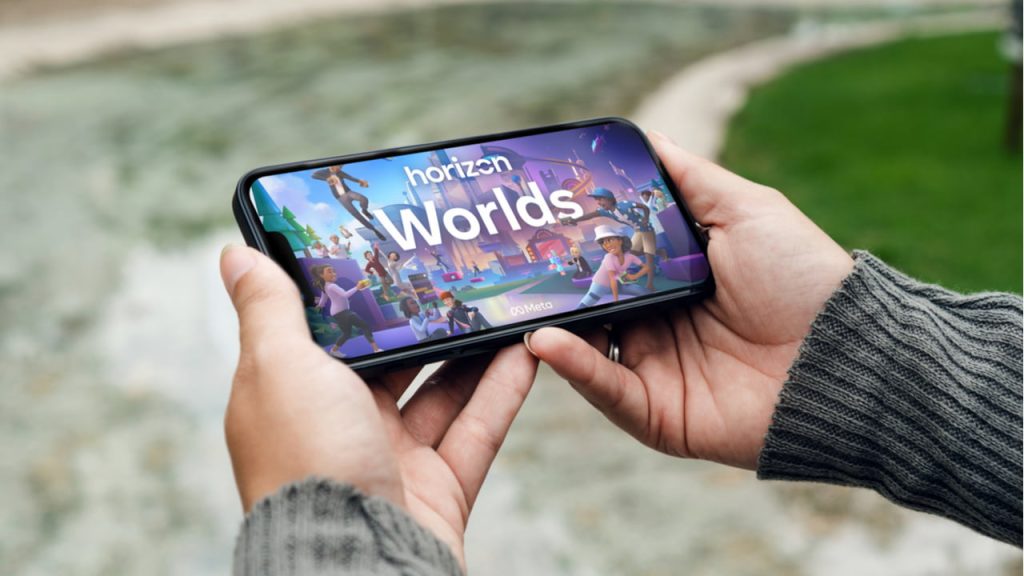
The importance of the smartphone in the world of AR was further confirmed by Meta, stating that it will be possible to interact with its metaverse Horizon Worlds even without a 3D visor. Meta is working on a web version (thus also available from smartphones) of its social virtual reality platform, Horizon Worlds.
The expansion would allow users to experience Horizon Worlds without having to use Quest VR visors, which are currently the only way to access the virtual world on which Meta is building its metaverse. Meta’s goal in launching web and mobile versions of its virtual world is to convince more people to enterHorizon Worlds, avoiding the need to purchase a Quest VR visor.
The smartphone also allows us to overcome certain barriers related to augmented reality devices:
– the battery life;
– mobile connectivity;
– the development of other apps (hence the creation of an ecosystem to be enjoyed with dedicated glasses and visors).
How to view Augmented Reality with a smartphone?
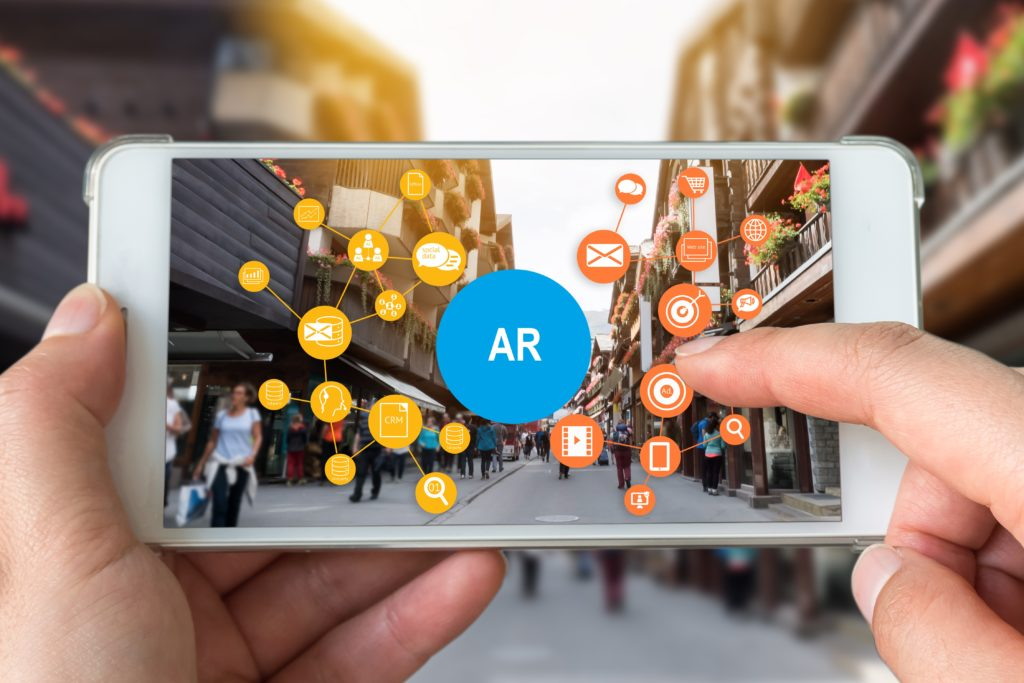
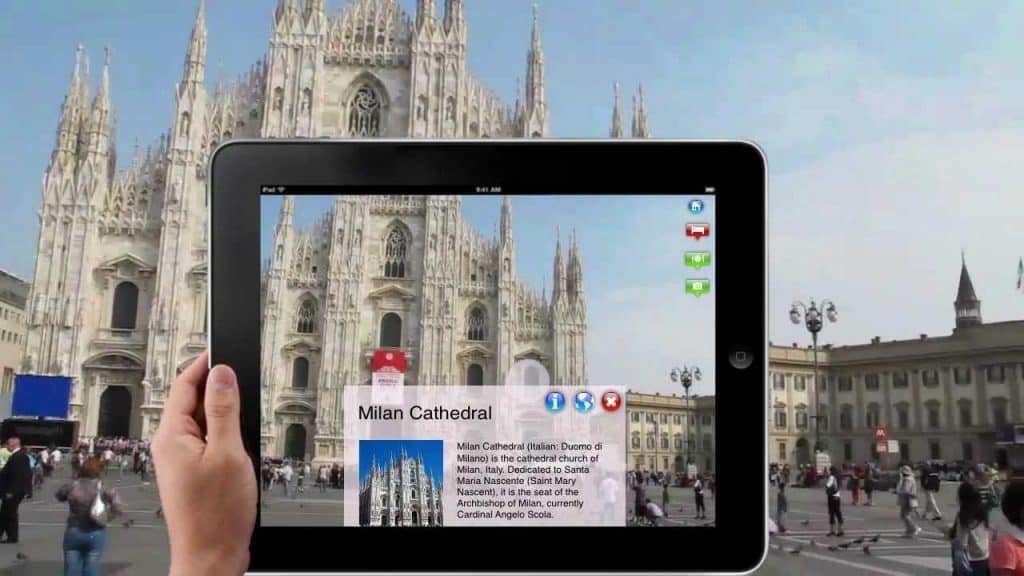
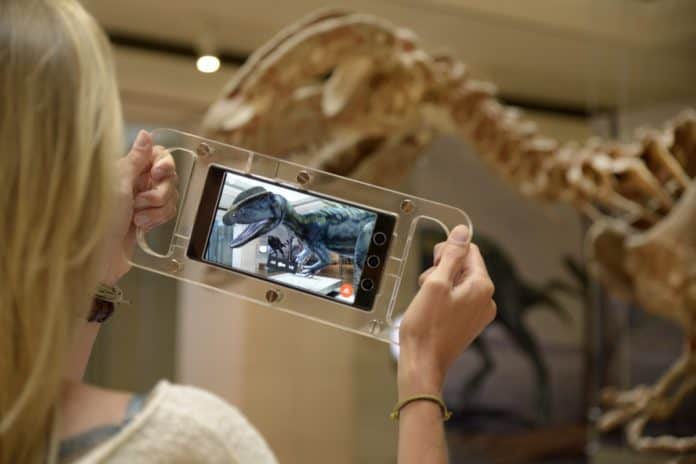
Smartphone technology with AR enables people not only to view virtual images immersed in real-world contexts, but also to connect with these images and objects, to interact with them, and to exponentiallyenhance the experience, simply by using the camera on their device. This is possible thanks to tracking systems that recognise real-world objects and create virtual reference planes with which to anchor the digital content projected by the applications. The device’s cameras capture real-world images and the application processes the 3D content that is coherently projected. The result of this fusion is redirected to the display of the mobile device, with which the user can interact thanks to the touchscreen interface.
However, in addition to the advantages, there are also limitations, such as: during use, the AR environment is limited by the size of the smartphone screen, unlike, for example, the 360-degree field of view that glasses can offer.
What experiences can the user have using the smartphone with AR?
There are many ways in which AR enabled smartphones can add value, such as:
Want to paint your house and not sure what colour you’ve chosen? No need to try it on or paint a part of the wall, just use your smartphone with Augmented Reality. Using it is very simple, you open the camera and you can see the walls in a different colour.
Through your smartphone you can see the furniture before you buy it, visualize it in different rooms of the house so that you know, in advance, whether you like it or not, whether it is worth putting it in one room or another and in what position. An example is the Ikea Place app, where all the company’s furniture is available to be projected inside your home.
With your smartphone and AR you can also learn and study. In the field of education and training, it helps improve the teaching-learning process by making it more connected to the surrounding environment; learning can become a more collaborative journey through the creation of interactive spaces that can encourage greater student engagement.
– Entertainment and Videogames:
The entertainment industry represents one of the main areas of deployment for augmented reality on mobile devices, thanks to the possibility of developing ad hoc applications to generate audience engagement towards a product or event.
Industry 4.0 sees augmented reality as one of the new enabling technologies, especially for training and remote assistance. Through the use of smartphones, it is possible both to guide the operator in direct contact with the plants and manufactured articles on the factory floor and to carry out remote assistance, where highly specialized technicians, by means of voice prompts and instructions via app, can follow the operator in real time to solve problems occurring on the plants.
– Hybrid working and Unified communication:
The spread of smart working has caused the spread of unified communication applications, such as Microsoft Teams, Cisco Webex, Zoom, Google Meet and many others. These platforms have already seen, or will soon see, the implementation of virtual reality and augmented reality modules to make moments of communion with colleagues and content sharing increasingly immersive. The environment of collaboration platforms becomes capable of going beyond the simple video shot on a display, configuring itself as a metaverse that is hybrid by nature, in which each person can intervene in a traditional manner or through an avatar, depending on the technological interfaces at their disposal.
Augmented reality technologies make it possible to use smartphones to try on products such as make-up, clothes, watches, etc. Thanks to the use of smartphones with AR, brands are able to engage their audience by making them interact virtually with products wherever they are. Among the many examples we could cite are interactive shop windows, thanks to which customers can ‘play’ with the product in various ways, or virtual mirrors, mirrors that exploit real-time tracking functions and augmented reality to act as real virtual fitting rooms.
The numerous augmented reality functions with smartphones allow extending the social experience with new features, such as AR filters, capable of personalizing the interaction with the product.
According to some recent estimates, the AR adv market in 2022 will be worth about $3 billion, in terms of pure advertising on third-party channels (e.g. Instagram, Snapchat, etc.), not counting publications on proprietary channels and the creation of content for advertising campaigns.
– Architecture and Real Estate:
The smartphone with augmented reality can also be used in the field of AEC (Architecture, Engineering, Construction), supporting practically all phases of a construction life cycle.
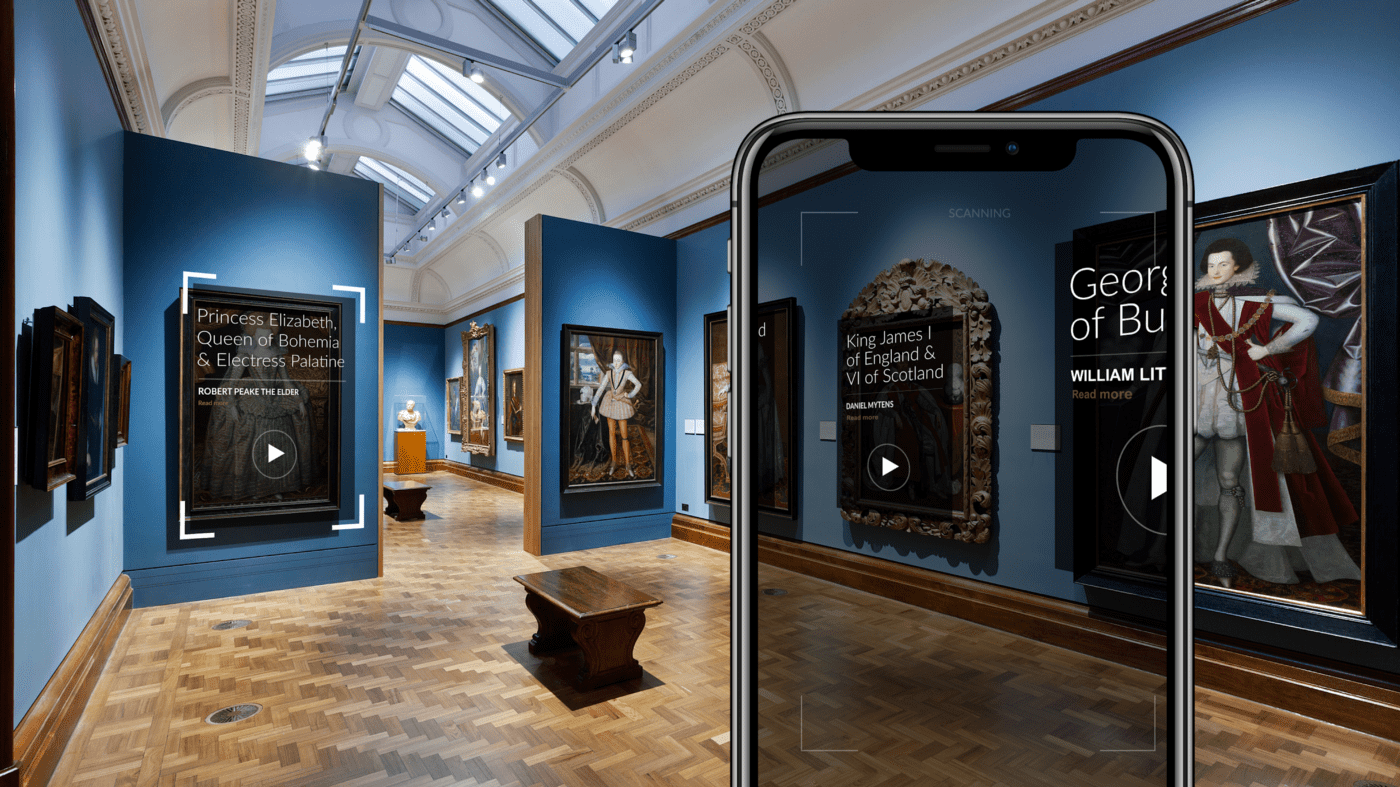
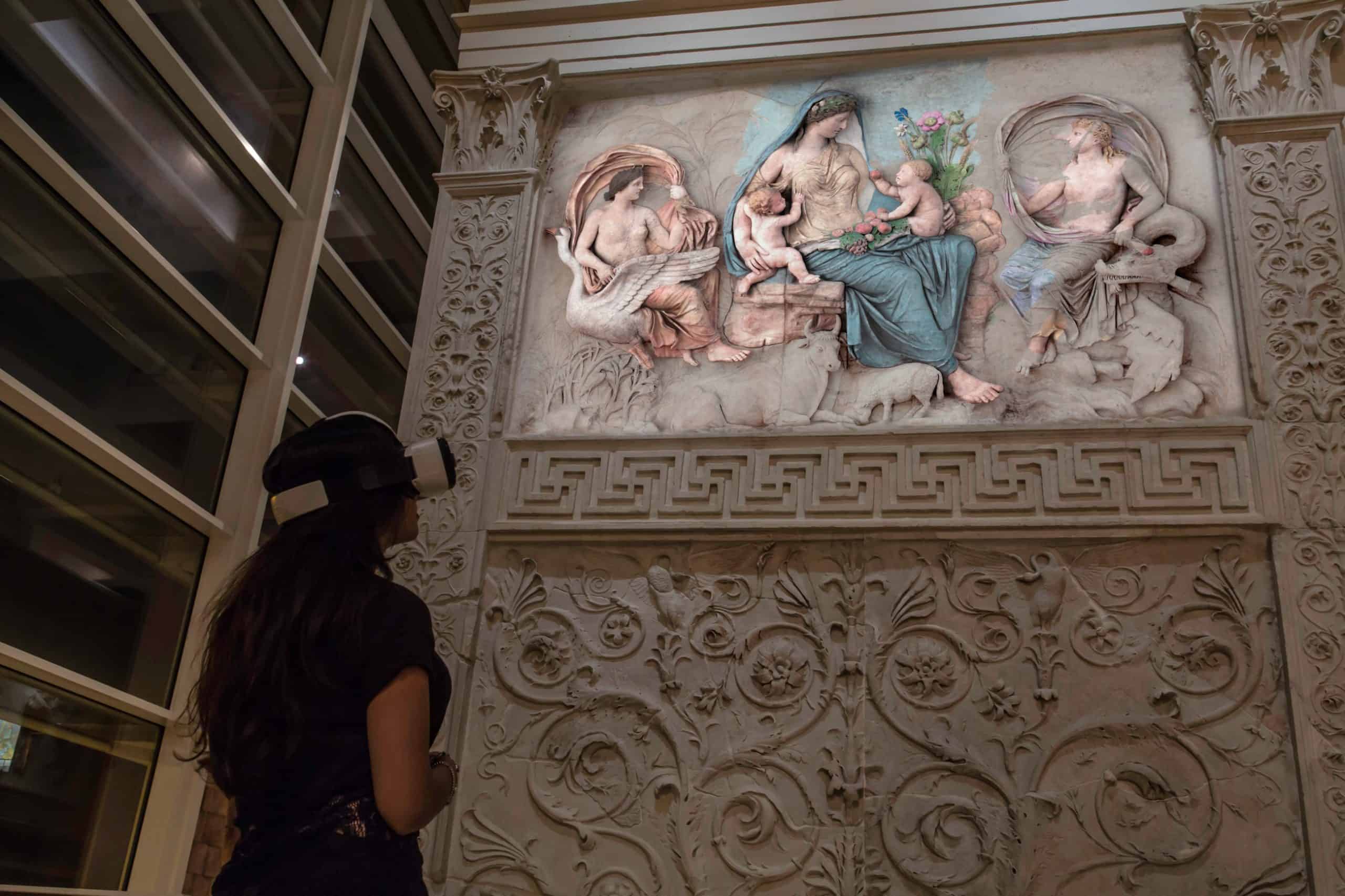
The smartphone with AR has the ability to add contextual content, augmented reality through the mobile device can for example act as a guide along the exhibition route, rather than integrating didactic information to digitally extend the narrative of the physical exhibits on display.
Will the smartphone be the most chosen device to experience AR?
The potential of augmented reality using the smartphone is capable of moving very high numbers, which are unanimously confirmed by any analytical forecast. According to a paper published by Statista, around 1.73 billion people are expected to consciously use augmented reality applications with their smartphones by 2024. The market is largely driven by mobile AR applications, which will continue to remain by far the most popular in the market, with a market impact that Statista estimated to be in the region of USD 9.5 billion in 2021, against a user base of around 810 million people.
The music industry has developed a growing interest in Augmented and Virtual Reality with the aim of improving the audiences? engagement. Today’s listeners feel a particular need to integrate music with multimedia devices that increase the quality, efficiency and immersion of the content provided by artists, as well as increasing the simplicity and speed of its enjoyment.
A Forbes study of millennials found that 78 percent of them would prefer to spend money on unique and unforgettable experiences in the music industry, as for them the performance and the memory have real value.
The very first AR & VR concert experience was made possible by the gaming platform Fortnite. In fact, the collaboration between Travis Scott and Fortnite in April 2020 was a huge success, with over 12 million viewers watching the event on the platform. It is the most popular virtual show ever. Not only that, but rapper Lil Nas X also had 33 million online views on Roblox, showing the other possible face of gaming for kids: from a virtual world for kids to an online space to take with you in your bag of cool and exciting experiences.
Billie Eilish also entered fans’ homes through the screen: she performed from the stage of a Los Angeles studio, but the show crossed cities, oceans and worlds with her images, quickly.
Using the right amount of creativity and inventiveness, AR & VR in the music industry is applicable to any environment and situation.
How is the music industry changing with AR & VR?
Augmented and virtual reality represent a real revolution in the music industry, as they have the ability to enrich the human experience and can create situations in which people turn from passive to active spectators. New technologies have completely changed the fate of online concerts, which are visible in virtual environments thanks to the rapid growth of virtual productionandmetaverse platforms, involving an unlimited number of users with broadband connections and wearable devices in a multi-sensory way.
The aim is to replace the perceptions of the real senses with computer-generated ones, which are derived from a database describing a 3D scene with object animations, within which the changes introduced by the active role the user takes in the virtual system can also be included. This is an epoch-making change in the way music is enjoyed, and obviously does not stop at concerts.
AR & VR can also be integrated with music videos, giving listeners the opportunity to participate in their performance and create immersive and unforgettable experiences. This is the example brought by the video of Bjork’s Stonemilker, presented at MoMA and shot with the possibility to interact through plug-ins, giving the perception of driving the video itself. Similarly, platforms like web casinos without gamstop are leveraging VR technologies to create highly interactive gaming environments, blurring the lines between traditional entertainment and cutting-edge virtual experiences. The video of U2’s Song for Someone was also designed for virtual reality, showcasing the diverse applications of these technologies.
And that’s what we’re getting to, a completely new way of experiencing music, more immersive, more exclusive and more direct. Many artists, as we have seen from the examples, are trying to move in an increasingly innovative way in relation to new technologies.
The keyword for AR & VR in the music industry is: interact. Users are catapulted into the artists’ performances and transformed into avatars where they have the possibility to interact with other avatars of other fans or directly with the avatar of the singer, either during backstage or by requesting a specific song. In addition, the user can move around, modify the surrounding space, form relationships and communicate with other fans. Without forgetting that the main motivation for everything is to enjoy a concert, possibly live. Interaction and movement are made possible through 360-degree filming, in which images from numerous perspectives are recorded simultaneously.
Augmented and virtual reality makes it possible to be active and present in places and environments other than those one is in, but with an extremely realistic appearance. Online concerts create virtual environments that allow the user to be involved on a multisensory level thanks to 3D images and sounds, offering a 360? experience.
How to enjoy concerts and performances with augmented and virtual reality?
More and more apps are coming out that allow the user to watch concerts in virtual reality, such as:
1. UnReal Club: the first Italian application that allows users to enjoy a virtual and immersive musical experience. It was born from the idea of combining the world of music with that of virtual reality to allow people to return to artistic performances by leveraging the potential of new immersive technologies. Access to the app is simple and intuitive: just register, create your own avatar, personalize it with gadgets and clothing and you’re done. Just like live, in each virtual location the avatars of all the users come together to watch the music event on air at that moment, to interact with each other just as if they were in a video game and to perform actions thanks to head tracking and audio chat;
2. MelodyVR: this is a start-up created in 2018 that has revolutionized the way of experiencing music. The application allows users to jump from one concert to another or follow a predefined path. There are several devices compatible with MelodyVR, the important thing is that it is a virtual reality visor. Some examples are: Samsung Gear VR, Google Cardboard, Playstation, Oculus Rift or Google Daydream View;
3. ConcertVR: a dedicated platform for concerts and music experiences. It has all the features of the other applications but also allows viewing of past events.
4. The Wave: a new kind of interactive music experience. Wearing a VR visor, users have the possibility to experience music festivals and concerts and can also socialize with their friends via the platform. Music creators can customize the way their audience is immersed in their music by transporting them from a realistic concert venue, to an amazing light show or into space. This app is the perfect tool to empower artists and transform the way fans connect with their music.
What are the benefits of AR & VR in the music industry?
The advantages and benefits of using augmented and virtual reality in the music industry are numerous:
– No limits: it is possible to attend events wherever you are without limitations such as physical impossibility, geographical remoteness or any other kind of impediment that would prevent you from seeing a band or your favorite singer perform;
– Minimal costs: if you have a device with an internet connection and a VR viewer, you can simply pay for the concert ticket at a much lower cost than a live concert;
– Simple, easy, accessible to all: attending a concert or event online is quick and easy. In just a few minutes, in fact, you can buy your ticket and watch the performance, go on stage or move backstage for a 360? immersive experience;
– It strengthens the relationship between singer and fan: by involving the user at 360?, the memory of the event will remain in their mind for a long time.
These technologies still have plenty of room to grow in the music industry, what will they create to surprise us again?
Technology is now an integral part of our lives, augmented reality and virtual reality experiences are becoming increasingly popular in the beauty industry as well, permanently changing the online shopping landscape for the beauty sector. The aim is to personalize the offer, to listen more and more to a demanding consumer, to collect useful data for the development of future products.
This is why we are increasingly talking about beauty technology. At the annual event of the Consumer Technology Associations, the importance of AR & VR technologies in personalized beauty emerged. Several innovative technologies for the beauty sector were highlighted. Who would have thought that in 2022 new technologies would allow consumers to watch and take part in the production of their own lipstick?
How is the consumer experience changing with AR in the beauty industry?
Thanks to augmented & virtual reality in the beauty industry, customers can virtually experience products on their face, thus minimising returns. They will know exactly what they are buying and how the product will perform on their skin, reducing the chances of dissatisfaction. They will be happier and in addition to increasing sales, AR can also help brands measure the interest and popularity of a particular product. Because of these numerous benefits and advantages, the adoption of these technologies by beauty brands has increased by32%, with the aim of going beyond the physical experience customers have in shop.
Although physical stores account for an important part of sales, virtual channels are increasingly a reality to be converted to. The beauty experiences that customers can enjoy through augmented reality are only the beginning of an increasingly tech-savvy beauty world. Even before the pandemic, people were increasingly concerned about testers as a hygiene issue. As global health concerns surrounding the pandemic increase, physical testers are rapidly being replaced by hyper-realistic digital testing experiences.
As early as 2020, some brands, such as MAC and Sephora, took their first steps towards artificial intelligence by installing it within their shops. For example, “magic mirrors” have been introduced: consumers can see themselves in digital mirrors with their chosen cosmetics. The user, after taking a lipstick from a box placed right in front of the mirror, can see herself with the chosen product on her lips or customers can experiment and see themselves with multiple looks and combinations of cosmetics.
Augmented Packaging, Mixed Reality Tour and Virtual Try-on: what are they?
AR & VR in the beauty industry are being used in projects experimenting with new ways of communicating the product to the end user, such as Augmented Packaging, Mixed Reality Tours and Virtual Try-on. Augmented Packaging is the container that, thanks to augmented reality, becomes a link between consumer and brand. Through virtual reality it is possible to bring customers into the company without the need for them to travel.
The impossibility of trying out a physical experience in-store will be increasingly compensated for by company websites with strong storytelling, detailed product descriptions, illustrations that evoke the texture and sensory side of the product, and having make-up and hair coloring tried out virtually. Solutions that will have to become more refined and precise to gain the trust of those who want to buy.
Virtual reality and artificial intelligence will be the new keywords of the cosmetics of the future. The goal for brands is to establish a loyal relationship with customers. For this reason, the virtual entertainment experience given to users seeks to encourage a kind of escape from the classic way of perceiving beauty.
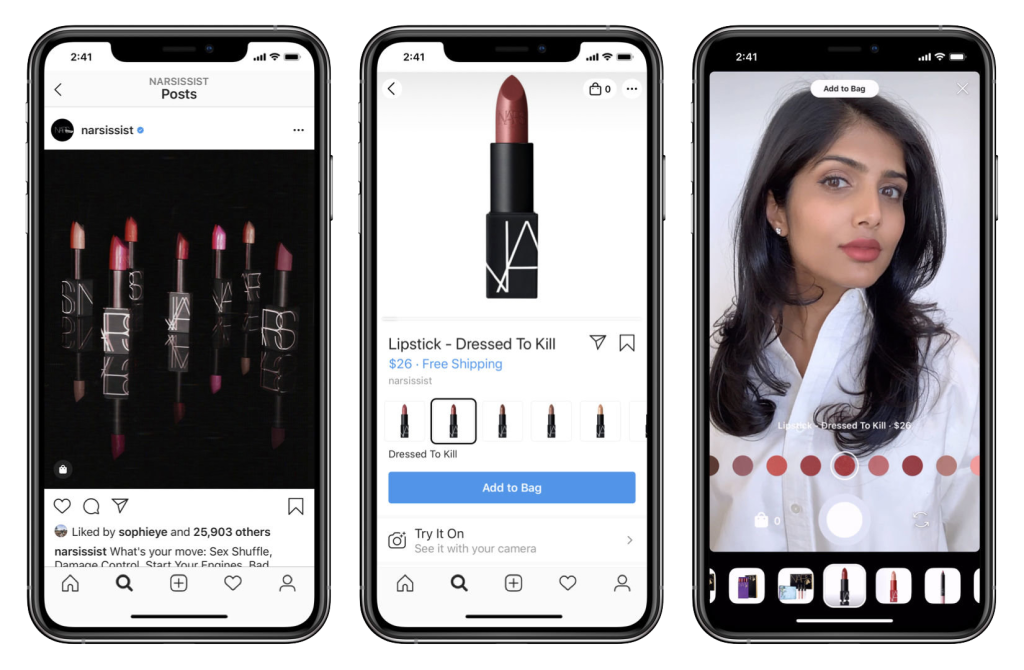
The various proposals from brands are endless to exploit the maximum potential of AR & VR, such as the ‘Virtual Try-On‘, an advanced version of the old APPs that allowed beauty products to be tested virtually. It has been launched in recent months by L’Or?al Paris, Maybelline, NYX Professional Makeup and MACCosmetics, some of the world’s best-selling make-up brands.
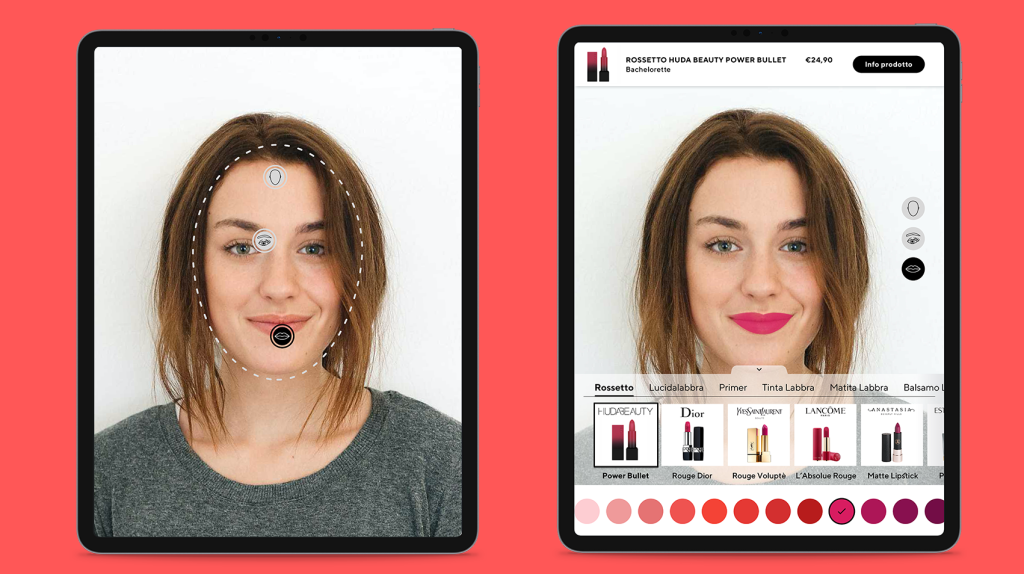
With the virtual try-on, the customer can wear new shades and products live to see the effect on the face in a completely realistic way. The virtual try-on is just a click away from smartphones and tablets or from a computer equipped with a webcam. To make the trials even more realistic, you can use the function that allows you to split the screen into two parts, so that the selected product is only applied to half the face. This makes it even easier to see how your look changes. According to data from an analysis carried out by Pambianco Beauty magazine, the virtual try-on increased user engagement by 80%.
Which are the advantages of AR & VR in the beauty industry?
The advantages of AR & VR in the beauty industry are many:
– It digitizes the experience: a real 3D online fitting of the product anywhere and anytime as if you were in a physical shop.
– Reduces uncertainty: AR removes doubts about the final outcome of the fitting, one of the main barriers to online purchase.
– Increases social engagement: the Virtual Try On in AR can be instantly shared creating a huge explosion of content on social networks.
– Saves time: trying on the product in any location regardless of your location avoids long distance travel and the stress of “fitting” on site.
– Reduces the return rate: Virtual Try On avoids the need for dissatisfied customers to go through long and laborious procedures to return the product.
– Strengthens the relationship between customer and brand: the product “comes to life”, giving it a strong value connotation from the very first moment.
Beauty industry brands that have turned to AR & VR to create memorable experiences
My Beauty Whisper: digital beauty advice for everyone. This idea took shape in the first year of the pandemic and in October 2020 My Beauty Whisper was launched: the innovative app for free personalized beauty advice, accessible to everyone. This project allows users to book their own beauty consultation with a team of experts who will advise them, via chat or call, on the most suitable cosmetics. In addition, the app offers other services such as live streaming with the best professionals or influencers in the sector and make-up, skincare and useful tips classrooms. Many beauty brands have joined the project such as Dior, Elizabeth Arden, Cartier, Elie Saab, Gucci, Biotherm, Olaplex, Aveda and many others.
Charlotte Tilbury’s online shop is launching a new NYX Cosmetics campaign on Snapchat and Triller for the Christmas shopping season, allowing users to enjoy a unique virtual and augmented reality shopping experience. The beauty brand’s debut on Triller, an app that allows users to create short entertainment videos, brings the world of beauty to a new platform. The virtual experience that users can try out on Snapchat immerses them in the world and values of the beauty brand, in a virtual experience where fun is never lacking. Through the internal camera, users can see the make-up created with the new NYX Cosmetics products directly on their face. With the external camera on the other hand, the user is transported to a real digital boutique where he or she can enjoy an A/R shopping experience that allows him or her to purchase products with a simple click.
L’Or?al and Perfect Corporation are collaborating with YouCam Makeup, a beauty app based on augmented reality. This collaboration offers make-up consumers the opportunity to virtually experience L’Or?al brands’ collections, learn about the products and shop through the App or in shops. The collaboration between Perfect Corporation and L’Or?al accelerates the creation of omnichannel services to enhance the consumer experience at every touch point. Virtual make-up, live streaming, augmented reality shopping are key features in a modern beauty journey that integrates online and offline experience.
The doors of the Metaverse are accessible to anyone interested, through the various platforms that have contributed to its advent. If, in fact, the idea of a virtual reality is often linked to a fantasy video game or to never-before-seen worlds, the platforms of the metaverse make it possible to make this virtual reality increasingly real.
According to a recent study by Gartner, in 2026 25% of the global population will spend at least one hour a day in the Metaverse for various purposes such as work, shopping, education, social interaction and entertainment. Considering that 2026 is only four years away, it is safe to say that the Metaverse will soon be part of our everyday lives.
In these ‘new worlds’ you can mostly enter for free and create your own avatar. On these Metaverse platforms there are other users, with whom you can have a coffee, go for a walk, see a concert, attend a fashion show or an art exhibition, so from this point of view it can be seen and evolution of traditional 2D chats.
One of the “oldest” virtual universes and protagonist of numerous transactions. Launched in 2016, today it can count on a solid community of users and a very long list of brands that have started to populate this platform. Based on Blockchain technology, it is a democratic and completely decentralized world; all holders of the MANA currency (Decentraland’s currency), can take part in decisions on the platform through a vote.
At the end of December 2021, there were more than 800,000 registered users and just under 500,000 monthly active users. Entering the Decentraland Metaverse is very simple: simply go to the site, create an account with your avatar, start the adventure and explore.
How to enter the world of the Metaverse with the Decentraland platform?
Decentraland is a completely open virtual world in which users are asked to interact with each other as in a parallel life, socializing and taking part in the activities and economy of Genesis City. To play in Decentraland you can log in as a guest user, simply explore the world by opening the website in your browser, create an avatar, give it a name, and accept the terms and conditions of the community.
You will also need a crypto wallet capable of properly storing your Ethereum tokens in order to experience the full benefits of Decentraland. If you don’t have a wallet, you will still be allowed to walk around and customize your avatar; but you will not be able to participate in trading activities or the in-game economy.
Decentraland hosted the first Fashion Week in the history of fashion in the virtual world from 24-27 March 2022. The aim of Metaverse Fashion Week was to experience fashion from different perspectives and to make high fashion accessible to everyone. In order to participate in the Fashion Week events, it was sufficient to connect your Metamask or visit the Metaverse in guest mode.
Decentraland provided the coordinates of all the event zones and with a simple click you could reach afterparties, digital shops, fashion shows and conferences organised by many brands. The Metaverse Fashion Week at Decentraland also gave a big boost to the price of MANA, which increased by 7% since 23 March, the day before the event began.
The Sandbox
TheSandbox is a virtual metaverse that has become popular since announcing its partnership with Meta. Its avatars have a visual block style and can build, own and monetise using NFT and SAND. The Sandbox is a decentralised, community-driven gaming ecosystem where creators can share and monetise their voxel creations and game experiences created on the Ethereum blockchain.
The Sandbox metaverse is actually a puzzle made up of many small platforms that, like a large network, connect and interact with each other. Within it, each user will be able to create, exchange, buy or sell digital avatars, or buy, sell or rent a real plot of land. Graphically, the maps are an explosion of colours. The impression is that of being in a world somewhere between Minecraft and Second Life, where there is enormous room for creativity and complex experiences can be created, based on lively and constantly moving communities.
How did the different brands approach this platform of the metaverse?
Over time, the platform has partnered with over 165 brands to create avatars in the virtual world of celebrities such as Snoop Dog and The Walking Dead.
Among the different brands that have collaborated with the platform, Gucci has created its own virtual world. The collaboration between the two companies is based on the creation of an interactive fashion experience based on Gucci Vault, an experimental space. The brand has purchased an indefinite amount of land on the platform, with the aim of creating its own virtual concept store, where it can sell items created by its designers.
Arianee, the leading web3 solutions platform dedicated to brands, also wants to create experiences balanced between real and virtual, offering users the first service that combines real and virtual assets through Nft solutions: or metaverse ready, which stands for the ability to insert solutions for companies with an Nft related to a real asset into the metaverse. The possibilities are endless and only limited by the creativity of brands who will have the opportunity to mix physical, digital, experiential, engaging and attractive offers for their users.
The entire Metaverse hype started when Mark Zuckerberg announced his company Facebook would change its name to Meta, to reflect its increasing investments in the file of wearable devices and immersive worlds.
Of course Facebook, backed by its 3 billions users base has a strong advantage in starting a new Metaverse platform, which in fact did, by announcing Horizon Worlds. This platform is currently available to selected countries (U.S. and Canada) and it is limited to those who own an Oculus (now Meta).
Horizon Worlds is linked to a Facebook account and lets you interact with other users by means of your virtual avatar. The metaverse also features a world builder that lets users build places according to their needs.
It?s early to say if Horizon Worlds will become the reference Metaverse platform, it can certainly enjoy an excellent initial positioning.
Quoted at USD 41 billion, it has the fastest growth in the metaverse sector. This platform, founded in 2004, is a virtual universe in which to interact with other users.
Most of the games available on this platform have been created by the users themselves. Many users have made the creation of games a way of life, in fact Roblox could be compared to a large library of “user-generated content”.
The aim of Roblox’s creators is educational, allowing children to test their imagination, as well as taking their first steps into the world of programming by creating their own games individually or collectively. Furthermore, according to Craig Donato, chief business officer of Roblox, one of the reasons for Roblox’s popularity is its emphasis on “unstructured play”. Unstructured play is nothing more than play activities in which children engage in games that do not have specific learning objectives.
Why is it the most popular Metaverse Platform?
Roblox is completely free, but within the platform, there is a currency called “Robux” which is not entirely free. When signing up for Roblox, the user is asked to create a username which possibly does not have to be their real name. On your profile, you can see the games you have played, you can post to your feed and you can also show who your friends are, who you follow and who follows you.
Roblox has around 100 million active users and most of them are under 18. The interesting and curious fact is that Roblox has the smallest community of all the other platforms: 24% of 10-12 year olds use Roblox, more than TikTok and Snapchat.
As well as finding the magic formula for success, the virtual platform launched a special collaboration with luxury brand Gucci. This event allowed the brand itself to feature some items that players are literally paying through the nose for. Gucci is launching the “Gucci Garden” on Roblox, a digital world deeply inspired by the commercials with which the fashion house has been promoting its imagery for years. Each player will play as a mannequin without colors, which will be decorated according to the interactions with the environment, in order to create a unique and visually engaging interactive experience.
Nike has also decided to enter the Roblox world by creating its own sub-world called Nikeland, a virtual space dedicated to the world of sport.
Spatial is one of the most interesting Metaverse platforms for at least a couple of reasons:
It supports nearly all devices and modes (web, mobile, wearable)
It has a strong focus on NFTs
Just like the other platforms, Spatial offers you the possibility to join virtual spaces with your virtual avatar that can be customized starting from a face photo, giving it a highly realistic look. Spaces are searchable visually or through a text search and are sorted according to popularity, that corresponds to the number of users currently inside a virtual space.
Many of the available spaces feature NFT artwork that users can look at and, only with the Web version, can open the corresponding artwork on the OpenSea platform, allowing you to get more information about the artist and eventually letting you buy the piece.
The experience on wearable devices such as Oculus Quest 2 is much smoother than on Desktop, but that also depends on your personal computer technical specs.
How to choose your reference Metaverse Platform?
Decentraland,Roblox and The Sandbox are similar projects but also have big differences. While Decentraland focuses on a virtual second life, The Sandbox and Roblox are real metaverse platforms where users can create games and bring fantasy worlds to life.
Below are some of the main differences:
Decentraland has limited its land to 90,601 NFT, while The Sandbox has almost double that, at 166,464 NFT;
Decentraland has three types of token: MANA, LAND, WEAR, while The Sandbox has four: SAND, GAMES, LAND, GOODS;
More importantly, The Sandbox has a detailed roadmap, planning to deploy the platform to mobile devices by the end of 2022. In contrast, Decentraland’s roadmap is probably not as ambitious. The Sandbox is more centralized with experienced game developers, while Decentraland relies on its DAO (Decentralized Autonomous Organization) for development.
Another element that you should consider when picking your reference Metaverse platform is related to supported devices. Some of them can just be enjoyed via web browser, thus offering a limited immersive experience, while others let you access the virtual worlds via mobile and wearable devices.
While a gaming metaverse like Roblox cleverly combines multiplayer dynamics with the ability for users to create content, a blockchain-based metaverse like The Sandbox allows it to go much further, allowing participants to own property, much like the real world, where they can start real business ventures. The Metaverse leverages on the blockchain technology to create various ways to monetise the experience, following similar dynamics to the real world, though in a fantasy dystopian context.
Based on overall user accessibility, focus on gameplay, aesthetics and the most detailed roadmap, The Sandbox and Roblox are the ‘winners’. While Decentraland boasts its DAO, having a more experienced and decentralized platform tends to produce better results in an arena as delicate and complex as blockchain gaming.
All of these platforms lead to an enjoyable experience. Thanks to them, more and more people will be able to live and experience the Metaverse in the coming years.
Can I build my own Metaverse?
If you are looking for business opportunities for your brand, products and services, you don?t have to rely necessarily on one of the existing platforms, you may get more benefit instead by developing your own, or partnering with similar companies into a vertical metaverse platform designed for that goal.
What may happen in the future is that, next to the existing mass platforms, we may witness the emergence of smaller, but vertical Metaverses where companies can provide a focus experience on certain goods and services. Platforms like Roblox or Horizon Worlds may not be the best fit for companies that want to to build a tailored approach to their value proposition or that want to provide a photorealistic experience, which is something currently not provided by the most used platforms.
Building your own Metaverse requires a medium to high development effort (and cost), but may offer in turn a high control over the virtual environments in terms of quality and customization.
Also the user base of a custom Metaverse would probably be smaller than the ones you can find on Horizon Worlds or Decentraland, but companies and brands may be more interested in obtaining fewer profiled users rather than more not profiled users.
The most searched word of the moment? “Metaverse”: with 677,000 results on Google, the hashtag #Metaverse is used extensively on Instagram, with over 60,000 posts and tweeted more than 500 times per hour.
By now it seems clear that the world of the Internet is changing and that we are watching the advent of the next big breakthrough in the world of innovation.
The Metaverse will be the Internet of the Future: it will change the way we perceive the world and interact with others, it will modify the way we enjoy experiences, it will create new ways of marketing and communicating, and it will make new immersive experiences with high emotional impact for its customers, thanks to the use of augmented and virtual reality.
The opportunities and advantages offered by the Metaverse for the world of marketing are many, offering new tools, new spaces to sell and buy products, new shop windows and new worlds, placing the user at the center of this new technological ecosystem based on the creation and enjoyment of experiences.
When and how will one of the most innovative sectors like marketing change in the Metaverse?
During the pandemic, digital has become the main place where many marketing processes such as collaboration, training, communication, but also sales, meetings and events have moved to, building, in a very short time, its own rules.
To be digital and to keep up with the new “Metaverse” world is no longer a choice. For brands, a new frontier is opening up in which to find new ways of building relationships with their target audience, existing and potential consumers. Today, marketing processes and strategies must be adapted to a more immersive experience: multichannel, new generation and performance, customer journey.
But that’s not all: brands are also trying to increase brand awareness in the Metaverse, by starting to study its potential. It is not just about recreating the physical world, but about expressing and sharing brand values “somewhere else” and in another way. For companies, marketing will mean designing increasingly immersive and engaging ideas and experiences for their customers. In fact, the key word that describes and characterizes the Metaverse is: user experience. The goal is to improve the quality of time spent on mobile devices, building new unique adventures that are closer to the real world.
Thanks to the Metaverse, marketing experts will be able to develop a perfect marketing strategy for their target audience, as they will be able to simulate the effectiveness of a point of sale or a promotional campaign, verify the interest of the public towards a product, create a contest, implement a hybrid creative staff between the real and the virtual world. The Metaverse allows for answers and verifications, eliminating surveys or questionnaires, which users sometimes consider boring and repetitive.
What can we expect from the world of marketing in the future?
Marketers will have to broaden their horizons and will have to think in “3D” and imagine not only the user’s in-store experience, but also a safe and efficient experience that can be enjoyed directly from the couch at home, through a VR.
The Metaverse, with its innovations, radically revolutionizes advertising and marketing techniques, such as the ‘day one’ for the launch of a new product on the market by a brand: promotional events could take place in virtual mode with unlimited access, within a specially constructed digital space, providing participants with some exclusive benefits linked to this experience.
In particular, these are going to be the main changes:
– As narrative techniques become 3D, marketing and advertising methods are also transformed: advertisers will have to respect and not interrupt the immersive and shared experience of users in the Metaverse. In order to engage and retain users, therefore, new advertising methods designed to blend fluidly into the Metaverse’s spatial dimension will be needed – completely eliminating methods such as interstitial pages that interrupt the digital experience, distracting and unnerving users. Examples of innovative forms of advertising are Nike’s virtual launch of its latest Air Jordan in Fortnite, or Gillette Venus offering different skins in Animal Crossing New Horizons.
– SEO will also be present in the Metaverse: just as we optimize content to be indexed in search engines, it is time to start positioning ourselves in the world of the Metaverse as well.
– Gamification will become an essential element of communication: interacting in a virtual three-dimensional space where users can have experiences enriched by the perception of their own and others’ presence in the shared space. The feeling of being together with other people in a digital space expands the palette of actions, reactions and ideas that can arise from interaction with others, perceived in a digital proximity implemented in the 3D space of the Metaverse.
Metaverse for e-commerce?
The answer is obviously yes. According to the report “Social Media Trends 2022” the Metaverse in e-commerce could even become a “trend” as early as next year; the growth of e-commerce in the Metaverse is a trend that will see strong growth in the coming years. The Metaverse for e-commerce could meet the needs of sellers and end consumers, allowing a virtual contact similar to the real one you can experience in the typical retail space. Above all, it responds perfectly to the needs of the new generation Z, the key target for the next 20 years, who do not perceive the barrier between offline and online. More and more brands are ready to adopt the Metaverse for ecommerce, introducing increasingly revolutionary features that will allow offline and online shopping to become a symbiosis.
The Metaverse will allow brands to offer shoppers a highly personalized digital experience that focuses on a seamless solution that makes it easier for customers to find exactly what they want and when they want it. It will be possible, thanks to virtual reality, to recover the concept of spatiality by being able to walk through shopping centers with the convenience of not even having to leave the house. A remotely controlled avatar will make every move for the user with the freedom to shop.
What can companies do to get the most out of the Metaverse in Marketing?
Many brands are giving their marketing space in the metaverse:
– Coca-Cola celebrated International Friendship Day on 30 July with the launch of its first collectibles in the virtual world, through a three-day auction. A friendship box containing some of the brand’s most iconic “objects”, but reinvented for the metaverse. For the occasion, Coca Cola also held an event in the decentraland metaverse;
– For the launch of its new model, the Nissan Juke car manufacturer decided to use customer engagement to engage and guide its users in their choice of product through various games and immersive realities. Stimulating conversion thanks to the emotional power of the video game;
– Microsoft, presented Mesh for Teams that allows users to participate in video calls as avatars, providing a sense of shared presence in a meeting. You can connect from any device, without necessarily needing VR/AR viewers.
The Metaverse in the marketing sector enables the merging of the physical and virtual worlds to significantly enrich consumers’ everyday experiences.
The concept of Metaverse, especially in the fashion world, became particularly popular during the Pandemic, when people could not go out and shop. But what is the Metaverse? “A three-dimensional space within which individuals can move, share and interact through personalised avatars”.
What can we expect in the future from this?
Balenciaga, Gucci, Moncler, Ray-Ban and Nike are just some of the fashion brands that have given in to the charms ofthe Metaverse. The fashion & luxury world sees great opportunities to collaborate with consumers in the Metaverse, a collective and “persistent” virtual reality that some experts believe will radically transform the way people shop.
Morgan Stanley’s forecasts show that the Metaverse and NFT will make up 10% of the luxury goods market by 2030, with a profit opportunity of ?50 billion, confirming the new trend that sees consumers increasingly involved in entertainment that combines digital experience-gaming-purchasing. The shopping experience can be personalised, offering the customer the possibility to interact with their favourite designer or physically attend fashion shows.
The growth rate of the Metaverse in the fashion world motivates the emergence of new specialised professions. Vogue India, for example, points to a new phenomenon: the emergence of agencies that enable them to digitise collections, to prepare everything needed to debut in the Metaverse.
How could the Metaverse revolutionise the fashion industry?
Fashion has always been a spokesperson for the social changes taking place and the role of the fashion designer is to present the market with the new contents and the transformations taking place, using an aesthetic language, made up of shapes and materials and now also of “immaterial” goods, that go straight to people’s emotional sphere.
For some brands in the fashion world, the Metaverse represents more than just a marketing opportunity, it is a greater possibility to express their creativity fully and without limits, and above all a good opportunity to reduce the environmental impact of fashion.
The development of these technologies, in fact, could allow the production of digital fashion shows, where guests feel like they are attending in person, and offer personal shopping appointments where customers meet remotely with the designer to ‘wear’ the latest collections without getting on a plane.
For example, Fashion Week takes place in several cities around the world, twice a year, with a significant environmental impact, as demonstrated by a 2020 Research Project, which measured the carbon emissions of the journey undertaken by shoppers and designers to attend just the four major fashion weeks (New York, London, Paris and Milan). The study found that total emissions amounted to 241,000 tonnes of CO2e, equivalent to 51,000 cars on the road or lighting the Eiffel Tower for 3,060 years.
What kind of advantages can fashion brands seize from the metaverse?
The Metaverse, in the fashion world, is an excellent opportunity to translate one’s value system into an even more universal form: this interconnected reality offers the possibility of making the brand known, of transmitting the values, principles and above all the products of a brand to an enormous and almost unlimited universe, giving the brand a contemporary and technological mood.This new reality is also a chance to connect with the future luxury audience, Generation Z, which has a sectoral language that traditional fashion brands struggle to understand.
Another advantage is the possibility of becoming an open, accessible and democratic space, where anyone can express their creativity. Even young designers could make their work known, without having to enter the armoured calendars of the official Fashion Weeks. This is the case of the designer who won the British Fashion Award for Metaverse Design, cSapphire, who as well as creating personalised outfits for the platform’s players, has a store that has sold over 2.5 million items, making only digital clothes.
Is gaming the future of fashion?
What is now closest to the Metaverse are gaming platforms, such as Fortnite. An example of this is the collaboration between Balenciaga and Fortnite, which has made it possible to buy clothes inspired by various Balenciaga designs, within the game. Most of these joint ventures offer buyers the chance to get their hands on a limited edition physical garment, such as the one featured in the game.
The combination of the video game and fashion industries offers unlimited opportunities for creativity that will go beyond the physical constraints of the fashion industry, avatars being of any shape you wish.
Roblox is another platform where several maisons have experimented their entry into this interconnected future. Consumers can create their own virtual user (customising their avatar in terms of style and accessories), socialise with other users and buy goods and products with the platform’s currency. Many brands, such as Louis Vuitton, have used these spaces to find new forms of promotion. Louis Vuitton collaborated with Riot Games and created original skins for League of Legends and even created a fashion collection from the game.?
Gucci launched a digital version of its Dyonisus bag on Roblox, which was made available on the platform for 48 hours in limited quantities. The result was explosive: the price of the bag far exceeded the initial price, reaching 350 thousand Roblux, translated into 4 thousand dollars.
On the same platform, Stella McCartney sold sunglasses, duvets and tote bags, while Vans created a skatepark, and a virtual shop in which to buy and customise their trainers. Valentino and Marc Jacobs customised Animal Crossing wardrobes.
MaisonDior has also partnered with the Ready Player Me platform to work on the launch of an interactive experience that its customers can only enjoy in the metaverse: each user can create their own digital avatar and bring it to life in brand-inspired environments, buy Dior fragrances and connect to video games and apps integrated into the platform.
How will fashion be perceived in the Metaverse?
United Colors of Benetton completely revolutionised its Corso Vittorio Emanuele shop during Milan Fashion Week, adapting it to the new store in the Metaverse that will open at the same time with the same experiential look and feel. The metaverse signifies a new generation of virtual reality, in which new technologies will make online interaction increasingly similar to the real thing. Visitors will not buy clothes but participate in gaming experiences that will allow them to accumulate QR codes to make purchases in the physical store. A choice that creates a further touchpoint with the consumer in the brand’s omnichannel strategy.
From the 24th to the 27th of March, the first Metaverse Fashion Week will take place through “Decentraland”. Participation in the fashion week is free of charge and does not require an invitation. During the days of the event, you will be able to take part in shows, presentations, concerts and after parties organised by the participating brands, as well as buy special outfits for your avatar and real items with Mana cryptocurrency.
Digital fashion is not an alternative to real fashion, but another face of it. The Metaverse is opening up endless possibilities for brands, who are aware that they have to interact with consumers in both virtual and physical reality, building a single reality.
Art galleries with Augmented Reality are changing considerably, moving more and more towards the world of digitalisation, promoting a new contemporary way of experiencing and looking at art.??
Art galleries are making room for the world of optical illusion and 360-degree augmented reality, experimenting with new ways of making and communicating art. AR adds new elements to the real world of art galleries and is a simpler and more mature technology because it manages not to distort the history and elements of that place, but instead adds more engaging ways of enjoying it and spreading its beauty.
New technologies, such as AR, have strengthened the relationship between artists and viewers, improving their ability to understand and evaluate the work of art despite the increase in distances and the relative division caused by the physical detachment that has affected this historical interval. This is precisely where Augmented Reality is making its appearance, a digital technology that is increasingly being used in the art world not only to provide the audience with new experiences, but also to find new ways of bringing art to the public, becoming more immersive and improving the experience inside galleries.?
Augmented reality for art
If until now we thought of Augmented Reality as a tool used only and exclusively in the world of games, today it is increasingly expanding its horizons by positively affecting the world of art, adding elements of entertainment and surprise, thus increasing visitors? engagement. AR offers the possibility of living original and highly personalized experiences.
Through the use of electronic devices, such as smartphones, tablets and wearables, it is possible for visitors to see, in addition to physical artworks, additional virtual artworks in the surrounding space of the art galleries and museums. Such pieces of art can be visualized in their real size, can be moved and manipulated freely (zooming, rotating, etc?). Augmented reality is destined to be increasingly exploited in the art world, not only as an alternative to a physical exhibition, but also in support of it.
By the end of 2022, according to Gartner’s The Future of Immersive Experiences research, 70% of art galleries will have experimented with immersive technologies to make the visitor experience unique.?
Augmented reality painting
With AR, even paintings come to life, acquiring three-dimensionality, becoming interactive with the user?s touch, transforming and moving, finally developing new surprises for the viewer with unseen and engaging virtual visual effects. Digital technology is opening up a new dimension of art and new ways of enjoying it, bringing the secrets of artistic language closer to an increasingly wide audience. Touching works of art, an action that is definitely not permitted in museums, has become the dominant experience of viewing paintings. It is indeed very common to find displays of varying sizes in museums and art galleries, however they often provide a very limited interactivity, that is also physically disconnected from the artwork itself.
AR glasses allow several works to be viewed at the same time and to move them freely through space. The use of AR in art galleries brings numerous advantages both in setting up an exhibition and in a museum, let?s explore the most relevant ones.
Create art galleries with augmented reality: what are the advantages?
The advantages, in addition to return on investment (ROI), are many: augmented reality allows younger generations such as Millennials & Generation Z to be involved, and offers the possibility of retargeting operations, that is, personalized ads that intercept users based on their online behavior, as well as the attention of the public, conveying a sense of freshness and innovation and thus increasing perceived value.
A cultural visit that is different, alternative and/or complementary to the traditional one, allowing the user to live a totally immersive experience and the art gallery to increase profits and earnings.
In addition, augmented reality allows for greater usability by reaching geographically dispersed audiences. It is an ideal tool where there is no possibility to visit a live art gallery.
All these different advantages allow the art gallery to attract an increasingly diverse audience, thus increasing engagement and interaction. Augmented reality is coming to generate a hybrid of dream and creation. An artist can decide to let us enter directly into his mind, into the way he perceives the world, involving us at 360 degrees.
Examples of art exhibitions in augmented reality:
Augmented reality in the form of multimedia storytelling is becoming increasingly popular. Art galleries are offering visitors special glasses or inviting them to download an app on their smartphones that allows them to see additional virtual content such as images, videos, 3D models and listen to audio files in real time while simultaneously observing what they see.
– In Italy, more precisely in Palermo. 30 young creatives, including artists, designers, architects and graphic designers, during a Public Imagination Workshop “Call for (AR)tist”, hosted by Palermo’s Gallery of Modern Art, adopted 20 works of street art scattered throughout Palermo’s historic center and based on them created new digital animations usable in augmented reality.
– The initiative launched by the Art Gallery of Ontario was also very successful. The Toronto gallery used digital technology to animate the paintings in its rooms. Thanks to the support of their electronic devices, visitors were able to interact directly with the subjects depicted in the paintings. For each painting, there was not only an explanation, but also a character who came to life telling stories to the visitors.
– Lisson Gallery, with exhibition spaces in London, New York and Shanghai, has launched an augmented reality app that allows you to view the works inside your home, an online exhibition by artist Rodney Graham. The effect of augmented reality comes close to the real thing and can be viewed and edited.
– The Looking Glass aims to transform some outdoor spaces into a large open-air museum, to be explored with your smartphone. To admire the works of art, all you have to do is download the appropriate app and place the device in front of the various QR codes scattered around the city. Once the simple operation has been completed, the seventeen works of art by KAWS, Olafur Eliasson, Tom?s Saraceno and the winner of the Frieze Artist Award 2021, Precious Okoyomon, will magically appear in the urban space. A myriad of impalpable and ephemeral “sculptures” to be visualized thanks to technology.
Last February 10th 2022 Inglobe Technologies was declared winner of the NPO 3FM Challenge, winning the chance to develop a pilot project for the Dutch radio with the goal to transform the live box used for live music performance, into a virtual set with the characteristics of being expandable and immersive.
In November 2021 MediaMatters announced this new innovation challenge involving NPO Innovation (the innovation department of the Dutch public broadcasting organization NPO) and NPO 3FM, a public radio station in The Netherlands.
After the initial proposals received from 34 companies, only the best 5 were invited to pitch in Hilversum, where the radio station is located. The winner has been awarded € 35.000 to do a pilot at the radio station.
NPO 3FM was looking for innovative and creative solutions, including those that use AR, to enable new ways of visualization in the field of live music performances. They asked that the submitted solution should make performances feel dynamic, authentic and attractive for performers and audience, and appealing to share.
According to NPO Innovation, “The quality of the challenge entries was very high. Inglobe’s solution came closest to the objective of the challenge: how to make the performances in the 3FM Livebox more dynamic and therefore more attractive for both audience and artists.”
Inglobe presented a solution based on its brand new Metastudio platform, a system designed to take advantage of the radio/TV studio space without the need of adding green screens or other expensive solutions like LED Walls.
Metastudio leverages Augmented Reality and Real Time tracking in order to create a hybrid environment where physical performances can be integrated into a virtual set extension with potentially infinite settings.
Thanks to Metastudio, NPO 3FM will be able to create virtual set extensions around the performers as well as to include virtual characters into the stage that may impersonate hosts, guests or even DJs. Other than just enhancing live music performances, Metastudio will provide tools and presets to manage a wide variety of use cases, including interviews, DJ sets and even Quizzes.
Inglobe’s Virtual Productiondivision is working hard to deliver solutions that will allow broadcasting companies to bring the Metaverse into broadcasting, in order to provide a superior experience to the audience.
Augmented Reality in education is considered today as an indispensable tool of the whole educational system, from the primary school to university.
The use of Augmented Reality in educationallows the transition from the so-called “teaching-listening” to an active and participative method of study, in which children, class and teachers are involved in the learning process. They are no longer just observers, but protagonists. We talk about ‘augmented learning‘, which aims to stimulate students’ creative and communicative abilities.
Augmented reality applied to education actively involves students of all ages, giving them real learning experiences that improve their understanding of what they are studying and that foster interaction with the content, thus improving not only learning but also the level of attention, thanks to the effect of surprise and wonder.
AR in education is also an inclusive tool that allows teachers to integrate communication and to simplify it: from primary schools to higher education or university, extended realities can help teachers to explain complex concepts and visualise physical objects that are difficult to understand presented by the flattened and unrealistic images of books; thus allowing to study all subjects in an engaging way: from biology to art, from physics to chemistry up to computer science and languages.
Interactive content with Augmented Reality in Educational Books
Is it really essential to make use of Augmented Reality in school books and teaching materials? The answer is yes. Numerous studies on the brain provide evidence that the best way to learn and therefore remember what you are studying for longer is to “do”. Studies have shown that, after two weeks, students remember only 10% of what they have read, but as much as 90% of what they have actively done.
Augmented reality makes the learning experience immersive and therefore exciting, the more the material to be learned is linked to emotions the longer the memory retention will be, because it is designed to be relevant to the brain.
What are the benefits of Augmented Realityfor Education in school books?
– Making connections and stimulating curiosity: augmented reality (AR) allows students and teachers to superimpose information, images and other content onto real-world scenes. This creates new contexts and effective connections that enhance learning and promote understanding. Teachers can use augmented reality apps in the classroom to turn it into a planetarium, making a science lesson more relevant;
– Stimulate engagement through realistic explorations in motion; visualise and experiment during science or physics lessons;
– Delving into hidden levels and systems based not only on theory but also on pratice part to become more familiar with the teaching material by allowing students to move and explore;
– Enriching existing programmes with extra content in the form of video, audio, animation and immersive storytelling;
– Carrying out large-scale projects and proposing challenges, the student will also stimulate problem solving skills and teamwork through the use of AR.
New Ideas for STEM Subjects Lessons
You can imagine how many things can be done during STEM (science, technology, engineering and mathematics) lessons from the primary school to the university. During math lessons students can move between 3D shapes and graphs.
In science classes, students can see the life cycle of an animal they are studying, study a live specimen in AR and explore its organs, systems and vocabulary as if they were looking at the animal in the flesh.
AR is used for learning during physics lessons, allowing students to experiment with atomic nuclei and the reactions in which they are involved.
Use cases of Augmented Reality in education
We have analysed some use cases where we believe augmented reality can have a strong impact on school books.
Use case 1: Getting in touch with the studied content
A software platform was designed to let students immerse themselves in the ecosystem of a river and explore how water interacts with animals, plants and human habitats. They could also discover what happens when the balance is altered. The learners came into contact with animals, discovered rivers, dams and ecosystems in other parts of the world.
Case study 2: The development of an educational video game.
A video game platform was developed to engage its students and assign them ‘alternative’ tasks.
By modifying even just the form of classic mathematical problems and inserting invented characters or simple stories, the students worked more enthusiastically and with better results. To find out how the story ended and what happened to the main characters, students had to solve the maths and physics problems they encounter each time.
The Liquid Book. Updating existing materials with AR.
In the effort of offering up to date and fresh educational content, most publishers release annual updates of their books and student, in turn, have to buy them even if they owned an older edition of the very same title. This need of continuously updating educational books may not be percieved positively from families that can’t pass the books of their first born to their second child.
AR actually offers a solution to this problem by providing the updates, and even selling them, through a mobile app, in association with the book. Publishers can monetise on the updates only, without needing to produce a new edition altogether (with all its relevant costs) and the book enjoys an extended lifespan.
No longer an enemy to fight, the second hand market becomes in fact an indirect ally for the circulation of the “cornerstone-book” upon which to build a new way of enjoying contents (with even vertical integration opportunities). Families attain significant savings. Think of a case where, instead of 50 euro for a brand new book, one can pay 25 euro for its second hand version plus 7 euro for the relevant updates: savings in the region of 35/40% are not unreasonable to imagine.
This hypothesis of “liquid book” would then resolve the false trade-off between publishers’ profits and unwarranted costs out the families’ pockets, while allowing a plunge in the digital era without leaving the reassuring presence of the physical book.
But there is more. Employing augmented reality would open endless possibilities in terms of innovative contents, as well as offer a helpful tool for students with special needs – all stemming from the very same cornerstone: the good old schoolbook.
Finally, there is a significant environment-related consideration to make: not only would the liquid book model reduce the waste of quickly dismissed books, but also the Co2 emissions linked to the production and distribution of the final product.
A win for all, then? Well, not really, as it would appear. In the depicted scenario, the actual manufacturers of the books, that is, the printing companies, seem to be the ones losing out.
Not so fast, though. This proposal does not threaten the book: it saves it.
The most likely alternative scenario, in fact, is not the indefinite conservation of the status quo – clearly unrealistic – but a radical online shift instead: augmented reality can give paper a new life.
In a such re-designed value chain, printing companies should in fact consider to include augmented reality within their products’ portfolio: by using ad-hoc platforms they can do so without developing in-house technical competences – hence without shifting their focus away from their core business – thus innovate in a planned and strategic manner, not in a panicky response to a sudden threat.
City Tours with AR & VR offer tourism unlimited possibilities to engage the consumer, tourist visits could become more interesting and particularly attractive for all types of visitors, including the youngest. Virtual reality involves the use of a headset, which helps to bring a user into a digital environment. Through the use of images and sounds, the user is placed in a virtual world, in which she can move around and interact with the environment. Augmented reality city guides can create a fun, interactive and flexible way of visiting the city.
Immersive City Tours create an interesting new way to explore a new and unfamiliar city as well as cultural heritage sites. Using dedicated AR & VR applications for mobile or wearable devices, pieces of useful information can appear at certain locations, for example playing videos of major attractions, displaying tourist itineraries and also offering the possibility for users to set a destination and create a customized route according to their needs and tastes.
AR & VR City Tours combine new advances in Augmented Reality and Virtual Reality technologies to provide travellers with more exciting and smart tour guiding experiences. Wherever they are, users can take advantage of these technologies to experience their next travel adventure. The use of 3D and other multimedia content can help capture users’ attention through sensory experiences, stimulate or recreate certain moods and feelings, create stimuli and invite action.
Let AR & VR apps become your personal City Guide
Every city has a wonderful history, hidden around every corner of it, through City Tours you can discover lesser known places, bring historical buildings back to life exactly where they were, linking the past with the present and learning every detail of the city’s history.
City Tours with AR & VR also allow access to those tourist attractions that, due to certain characteristics such as fragility or danger, are not normally accessible to all, thus eliminating the ecological impact of mass tourism or safety risks. Thanks to these new technologies, it is possible to touch a stalactite that has taken thousands of years to form without running the risk of blocking its normal growth process.
Moreover, transforming and converting stressful travel planning into a fun experience such as searching for accommodation, transport, restaurants or reviews can become an adventure in itself with 3D animations.
Exploring accommodations with AR & VR before booking
For example, in the Hotel industry, Augmented Reality travel apps offer unlimited opportunities to engage guests and increase the chances of bookings. Information content visualized in an immersive way, also with the support of gamification techniques, can motivate guests to check out 360° room tours and interact with all the available services. You can impress your guests with indoor AR navigations that show a full range of hotel services in an engaging yet intuitive way.
Adding a layer of digital guidance, visual content and even 3D characters for entertainment, to the exact physical location, makes travel guides more specific, more informative and interactive for tourists. AR applications convert your mobile phone into your own personal virtual travel guide. AR allows you to receive captivating information as you walk. AR content can also be shared on social media in real time, helping foster word of mouth processes.
Try before you buy
Through a “Try before you buy” approach, Augmented and virtual reality can offer hotels, travel agents and other tourism businesses the opportunity to let potential customers experience travel locations virtually. This means that users will be able to experience attractions they are likely to visit, take a dip in the sea or a walk in the mountains, from the comfort of their sofa at home. The actual destination experience. Using a VR visor, people can discover the beauty of the desired destination, with the aim of stimulating in them the desire to visit it live. The user is transported to unique places, feeling like the protagonist of a story that unfolds around him.
Benefits of using City tours with AR & VR
The Japanese call it the ‘Paris syndrome’, or the disappointment of those who arrive at their destination, during a long planned and desired trip, to discover that the place they are visiting does not meet their expectations. In some cases, the disappointment is so strong that the tourist is forced to cut the trip short. Virtual reality allows for a complete revolution in the concept of ‘information material’, transcending even multimedia and allowing the traveller to immerse himself entirely in the experience of the place he is going to visit.
Augmented and virtual reality applied to the travel sector makes experiences richer, safer, more accessible and increasingly exciting as users explore through city tours, visit cities by virtually walking through their interiors, view main attractions and information through a new modality that creates curiosity in users. The aim is to create interactive content that accompanies the visitor throughout the experience and builds loyalty. 75% of customers say that the use of city tours has had a critical impact on their travel booking decisions.
Numerous studies demonstrated that users spend 5-10 times more time on websites that offer the possibility to travel directly from the couch at home, connecting people with often distant physical spaces. In addition, integrating a Virtual Tour on your website will result in 30% more interactions and contacts and a 20% increase in visitors.
AR & VR can offer experiences and information in different languages. Tourists travelling through foreign cities can get informational and content, translations of signs and much more by simply framing a QR code or framing the work itself with their smartphone to get the information and details in their preferred language.
Taking a trip through augmented reality allows you to organise it better. The journey will be original, attractive and fun. The power of augmented reality lies in immersion, seeing reality virtually and then touching it.
AR,VR and museums may seem two distant concepts, but they are perfectly synergistic since, if used in combination, can create profound and memorable experiences.
The digital evolution that is affecting many areas of the economy also concerns museums. More and more visitors demand for emotional, engaging and more informative experiences.
Augmented and Virtual Reality can be the perfect tools to provide a real immersive visit experience, since that can enrich the existing environment with new elements and help the visitors retain their memories for longer. Moreover, such an increased engagement makes them want to share their experiences with other potential visitors, both by word or month or by sharing their thoughts on social media.
AR technologies support museums to reach a new level of interaction with visitors and offer them a unique opportunity to look at the world around them from a different perspective. Augmented reality gives traditional museums the possibility to incorporate elements of dynamism and movement into their interiors, catching the attention of the public and engaging new visitors.
The relationship between Augmented Reality and museums aims to enhance the artistic and cultural heritage and to offer a memorable journey, fully involving the visitor, making her feel an integral part of the experience, enriching the enjoyment of works of art with extra information and interactive content. By connecting with some kind of devices, for example a smartphone or a tablet, offered by the museum itself, the visitor becomes more involved and active. In some cases Museums may also release some kind of mobile app that visitors can download and experience on their own devices.
In order to engage visitors through Augmented and Virtual Reality, museums must integrate innovative but also functional technologies. No visitor would be attracted by applications or devices that are too difficult or cumbersome to use. The visitor experience must be easy and intuitive, and the solutions adopted must be almost invisible and non-invasive.
What are the benefits and advantages of AR in museums?
The choice of integrating Augmented Reality in museums gives the possibility to expand the target audience. Experiences can be created with customised thematic paths for children, combining the experience of learning and knowledge with play. Gamification, for example, is an experience that is enriched by the addition of fun challenges, quizzes, puzzles and much more. The more fun it is, the more little visitors will learn and remember. With gamification, visitors can be taken on a journey that includes small mysteries to be solved in order to discover curiosities and include fun and engaging elements into the journey.
AR technologies help museums to reach a new level of interaction with visitors and offer them a unique opportunity to look at the world around them from a different perspective.
The decision to offer visitors an emotional as well as informative and experiential path of knowledge transmission is effective and attractive especially for the younger generations.
Augmented reality technologies can also help visitors interact with different touchpoints, online and offline, from the website, social media, brochures to multimedia guides, increasing engagement.
Summing it up, AR and VR have many important advantages for museums such as:
Engaging and expanding the target audience
Creating increasingly personalised experiences
Offering visitors a new, fun and memorable way of learning
Creating additional revenue streams through Premium tickets
What are the most common AR and VR use cases for a museum?
Depending on the nature and typology of Musemus, Augmented and Virtual Reality can enable a number of different use cases, let?s explore them together.
A new way to look at paintings with AR and VR
With the use of Augmented Reality, the visitor pointing the phone?s camera towards a work of art can experience additional content. The user can listen to the description and the story of a work directly from the artist; they can hear ancient songs, street noises, chattering, bringing back to the present the typical environment of the time when the work was created. Extinct animals may come back to life, interacting with the little ones.
The various ancient wars and battles could be relieved at first hand, scientific demonstrations would be explained with concrete examples. Frescos could be seen by the visitor as new or retrace with the artist the creation of the artwork; paintings could be brought to life and interact with the visitor.
Sculptures and buildings can be brought back to life
The same is true for sculptures or other tridimensional objects exhibited in museums. Immersive technologies can help focus the visitors? attention on specific elements of a work of art, with the help of 3D highlights superimposed on the real object.
AR and VR have proven to be very useful especially when the goal is to show a visitor how certain pieces of art or ruines used to look like in their former glory.
Discover museums through a virtual tour guide
When guide tours are not available AR and VR come in support by providing 3D avatars or holograms that can guide the visitors through a predefined path and help them get the best out of the Museum, helping them to discover and experience even the most hidden gems.
Preview the museum experience at home
Who said Augmented and Virtual Reality can only be used inside a museum? In order to tempt and intrigue potential visitors, Museums may release public AR/VR mobile apps that let users get some anticipation of what they can find inside the museum, something very similar to what happens with movie trailers.
A visitors? journey can start comfortably from the sofa, at home, and continue with the real visit in the museum. App in this case may even provide a way to buy the tickets at a special discount.
Enjoy the ancient Roman colony experience with augmented reality
The ancient Roman colony Fregellae was an important Roman colony located on the Via Latina near the left branch of the Liri river. The city was probably founded by the Oscans and then occupied by the Volsci, before the destruction by the Samnites in 330 BC. In that year the people of Fabrateria Vetus (modern Ceccano) sought the help of Rome against the Samnites. In 328 BC a Latin colony was established near the site of the Volscian Fregellae. Not everybody knows that Fregellae faced the advance of Hannibal in 212 BC by destroying the bridge over the Liri river. During its existence Fregellae was a flourishing center in southern Lazio.
The Fregellae experience with augmented reality offers an immersive and interactive reconstruction of the area of the archaeological excavations. It provides information about its history and meaning. Thanks to the 360° experience, users can navigate and interact with 3D reconstructions of the colony.
Download the app and experience the ancient Roman colony with augmented reality for free
Starting from a spatial visualization of the map, users can select the points of interest and enable an immersive visualization of 3D reconstructions based on the use of device sensors (gyroscope and accelerometer).
How to experience Roman colony with augmented reality thanks to the AR-media Player app
Created by AR-media “the Fregellae experience” is an immersive experience in the area of the archaeological excavations with the aim of innovating cultural heritage experiences through the power of emotions, opening the way to new audience segments with dynamism and interactivity to increase their involvement. Users see the life of the important Roman colony “Fregellae” flowing before their eyes through a more complete and varied view of history. They travel new roads, immerse themselves in the city’s lesser-known spaces and discover colonies, sanctuaries, underground passages and side streets.
You can try this experience by downloading the free AR-media App for iOS or Android. Download the app and frame the QR Code using the button at the top right of the app. Click on the “save” button and then the “open” button, project the camera of your phone/tablet on the floor and begin to immerse yourself in this experience.
Thanks to reconstructions made with attention, even to the smallest details, you go back to the past and get in touch with the architecture as it was; through the application the user can move freely by touching on specific arrows and travel in thisvirtual 360° world.
To make this experience more immersive and evocative, it is possible to go inside each construction, giving the illusion of being physically where you are not. By pointing the phone at a building and tapping on the “i” button, the user can listen to audio explanations, information and other useful data.
In this way the ancient Roman colony “Fregellae” comes back to life, upgrading and showcasing its beauty. The visitor is invited to perform a series of actions that will further engage the perceptual channels for a memorable experience.
Build AR and VR experiences for archaeological areas with AR-media
The relationship between AR-media and the archaeological sectorrepresents a long process of digital evolution that is taking place in different archaeological areas. The choice of AR-media is to be able to give users a journey that is not only informative but also emotional. TheAR-media application transforms the visit into a multisensory experience, involving the visitor, transforming her into a participating and active actor and expanding the journey with interactive content. By connecting from a smartphone or tablet the user is immersed in a unique virtual context with a high emotional impact.
AR-media’s augmented reality helps to connect history with the new digital reality and is particularly suited for:
Virtual tours both indoors and outdoors
Augmentation of ruins, helping the visitor to visualize the ancient beauty of the sites
Sites with visitors from many countries, thanks to the support for multi language projects
Increasing the sites’ revenues by providing a premium immersive experience alongside the more traditional visit experience
Augmented and Virtual Reality make the cultural experience immersive and engages users before, during and after the visit.
Industry experts have long known that Augmented Reality is a powerful marketing tool, while in more recent times the Pokémon Go boom has made everyone understand the huge business impact of the technology.
There have been many businesses that have ridden the wave exploiting PokeStop and Pokémon gyms in order to attract a greater number of customers, and getting some success.
Pokémon Go, to be honest, is not the world’s most powerful implementation of Augmented Reality, although in its simplicity it was able to achieve unprecedented success.
Although the digital revolution has dramatically changed the way we use information, still a relevant piece of information is conveyed through paper, such as newspapers, magazines, catalogs, flyers, books, etc …
Despite having lost ground to digital, paper products are still a powerful means of communication and this is confirmed by the McKinsey Global Media Report 2015 which basically highlights two trends: the first concerns the maturity of the print media (+ 1.7% growth from 2014 to 2019); the second a steady growth of the digital (+ 9.5% in the same period).
This suggests that these two seemingly distant worlds, can live well together, and indeed they can also cooperate. In fact, according to research by Digimarc, 75% of consumers think that digital media is a complement to paper, rather than a replacement.
Marketers from all sectors can think of innovative ways for presenting their products and services, combining greater clarity of the offer to a greater customer engagement. It has been demonstrated, according to the claim made by Lisa Hu, that using Augmented Reality you can get a dwell time 2.5 times higher than that of traditional media (TV, radio and newspapers).
To date, cases of successful Augmented Reality implementations in the publishing area relate to, among others, the creation of immersive catalogs, magazines and books with AR.
Augmented Reality for events and trade shows
The promotional environment for excellence, for many companies, is that of fairs and events in general. These are special occasions for companies to show off theirs strengths and to try to engage visitors in order to convert them into customers or at least into leads.
In this context, companies focus a lot on entertainment, giving visitors the opportunity to try the products and to make the time spent at the stands a memorable experience.
The use cases of marketing actions with the support of Augmented Reality in this area are diverse, ranging from brochures and catalogs with immersive 3D visualization of the product, to the organization of contests and gaming experiences to engage and amaze visitors giving them a concrete idea of the real potential of the product.
AR for packaging
A sub-set of paper products, to which more and more companies turn their attention to design marketing actions with Augmented Reality, is packaging.
What better time to engage the customer and to provide additional information on the product except when she is face to face with the package?
There are interesting use cases of interactive packaging that put people in a position to activate additional content or mini-games that come to life from a bottle of a soft drink, rather than from the foil of the chips of a fast food and so on.
The result is an increase in brand reputation and customer loyalty, because when customers are faced with a similar product, they tend to pick the more exciting purchase experience.
Augmented Reality for in-store experiences
The natural ability of Augmented Reality to expand people’s vision makes it particularly suited to design in-store marketing experiences, allowing retail companies to offer additional layers of information to the visitors.
This category of use cases includes indoor navigation to guide people in a particular area of the store, maybe to locate special deals; the display of products and information that is not physically present in the stores because of space limitations; the possibility to sort or read the data on the origin, understand the production process, watch a promotional video, etc …
These experiences can be enriched by the gamification of the buying process with premium and retention mechanisms.