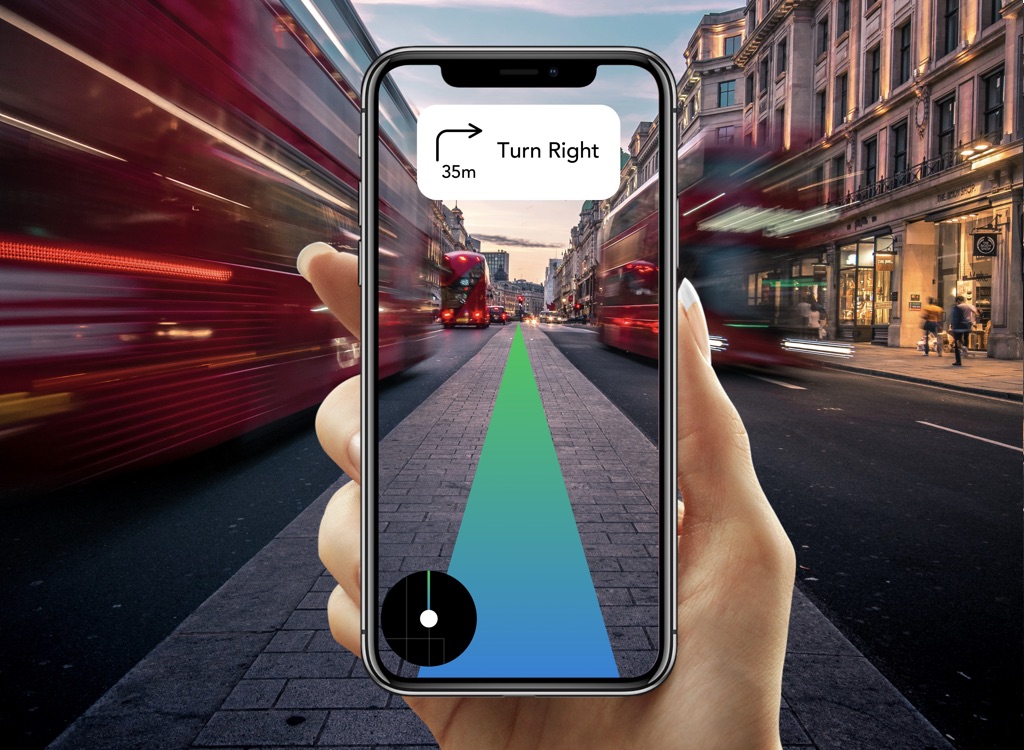
It’s finally that time of the year where you pull out your dusty suitcase, put on your favorite sunglasses and leave the city to go towards exotic beaches, steep mountains and unexplored places. On the other hand, we know that going for holidays can be very tricky and stressful sometimes, for example when you get lost in the middle of the Sahara desert where all you see is sand, or when you can’t find your way out from the depths of the jungle with that tiger staring at you…. Ok, perhaps we are going a bit extreme, but your struggle during your holidays may be very real.
Luckily, we have some Augmented Reality tips that can help you relax a little bit more and enjoy your holiday the way you deserve. Whether your dream place is the highest peak of a mountain or the flattest wave of the ocean, we got you covered. Let’s discover now the best AR apps for your holidays.
The best AR Apps for your Holidays into the Wild
Peakvisor
If you love trekking and exploring new mountains this AR App is a must have. Peakvisor allows you to instantly see the names of the mountains in front of you, so that you immediately identintificate where you are and your surroundings. By pointing your smartphone in front of you, little banners with the names of the mountains will appear together with the high. Moreover, Peakvisor also has a 3D map program incorporated so that you can do your research before going exploring. Being an App for explorers, it can also work offline, you just have to remember to download your trails before your hiking.
iNaturalist
While hiking, we happen to meet unseen gems like particular flowers or rare trees and unfortunately we might not know what kind of plant/tree is. With iNaturalist, by scanning the image in front of you with the camera of your smartphone, you are able to see the name and some information about the plant you are looking at. Of course you might encounter some inaccuracies. For example if the quality of the image is not very high, the system might not be able to recognize the right species, or if the element you want to know about is too rare you might not find it at all inside of the app. This App, indeed, is managed by experts and a community, that is why it can happen not to find the exact match.
iOverlander
iOverlander is one of the best Apps for campings. Using GPS recognition, it allows you to find the perfect camping spot WORLDWIDE. It also gives you information about the condition of the campsite, where to find water, food, wi-fi and nearby points of interest. The beauty of iOverlander is its community: you will find lots of people just like you that give tips and precious advice in order to give you the best camping experience.
The best AR Apps for your Holidays in a famous City
Are you thinking about going to visit a new city and feeling afraid not to make the best of it? Well, it all depends on which city you are going to. There are some tourist places now that have implemented AR in their touring guides in order to give to the tourists more immersive experiences of their City and a fuller and deeper involvement in the exploring aspect.
For instance, if you are planning to spend your holidays in the north of Italy, you should definitely have on your smartphone AR Apps like TabUI. TabUI is an Italian App that allows you to gather information about the places you are visiting by simply pointing your smartphone at your point of interest. For now, though, it only works in some areas of North Italy. While, if you are keen to visit Italian Architecture Monuments among the cities of Turin and Rome, you don’t want to miss trying Arch.i, an AR App that works by pointing your smartphone at basically any monument of architectural work to instantly have the chance to know everything you want about it. Moreover, if you are planning to stay in the Italian Capital a little bit more, we suggest using another AR app that can guide you through the ancient streets of Rome and tell you everything secret of the Roman Empire: Charta Roma.
Other numerous Apps that help you visit a place in a deeper and more immersive way might be “Santorini ARâ€, focused on the greek city of Santorini and “National Parks by Chimaniâ€, an amazing Augmented Reality Guide that will let you explore the American National Parks in way you have never imagined.
Your must have AR Apps for every Holiday
Virtlo
Virtlo is an Augmented Reality App only available for IOS for now, able to tell you all the points of interest nearby, such as restaurants, hotels, museums, parks and even stations by using your smartphone. You can also see the distance from where you are so you can explore the city in the best way possible. The app is completely free and it’s open source, which means that everyone can add some tip or point of interest and help the others.
Google Translate
How not to mention Google Translate when it comes to travel and technology? Google Translate allows you to instantly translate every written word to every language by putting your phone’s camera on the word you want to translate. Google will do all the rest. This means that if during a trip you want to know what is written on a street signal, in a restaurant menu or a contract, you can instantly translate it by using your phone. Of course, you need to be careful because not every translation is accurate and the chances of a misunderstanding are quite high, but for basic sentences it will work just fine.
All you have to do now is just pack and enjoy your holidays, wherever you are going!
“When using augmented reality in the operating room, it’s like having a GPS navigator in front of your eyes in a natural way so you don’t have to look at a separate screen to see your patient’s CT scanâ€, said Dr. Timothy Witham, professor of neurosurgery at the Johns Hopkins University School of Medicine. And this is only one of numerous benefits that the adoption of augmented reality in medicine field has generated. Augmented reality (AR), as we know, is the technology that allows digital contents (such as images, video, objects, animation ecc..) to take place in the real world. It’s a technology that is changing the way we live, we think and most of all it’s shaping the future, leading us towards new innovative, smarter and improved lifestyles.
In the medicine aerea, AR is creating new ways of helping people and saving lives like never before. It allows doctors to have more accuracy, more focus, more information and, of course, a better outcome and diagnosis. Including virtual objects and tools in the real world, doctors can see things right in front of them and in terms of accuracy this is a huge step forward. Also, timing speaking, it cuts all the waiting, looking, searching moments, increasingly reducing time of operations.
electronic medical record concept. medical technology.
How Augmented Reality in medicine works
In order to integrate the Augmented Reality in medicine we need to define some technical practical aspects that allow us to use it properly.
Among the main actions in using AR in medicine, the camera calibration is one of the most important one. In this process, the camera needs to “understand†the environment that will host the Augmented Reality object.
In the medicine AR, the crucial action to take is the patient registration. A computed tomography (CT) or magnetic resonance imaging (MRI) provides a view of the internal anatomy of the patient and also the target points in case of surgery operations.
Another essential component is object tracking which is essential in order to calculate the exact position that it will be necessary to operate.
Why Augmented Reality in medicine is so important
AR can let us know if there are defibrillators nearby
It could happen all the time, while walking in a street, that you might see someone who suddenly collapsed and of course the first thing you’ll do is to call an ambulance. Now, though, there are some apps that, using AR, can also tell you if there are defibrillators nearby, so that you might be able to give additional help in the meantime. There could also be other applications that thanks to the AR localization can be crucial in saving lives, giving essential information to the individuals.
AR can teach us about the human body
Augmented reality is every year more used also in the education field, especially when talking about medicine. It is studied that studying (or teaching) by welcoming the help of Augmented reality can help students to learn better, faster and especially to understand in a deeper way difficult concepts. Being able to see and try in a more 3dimensional and immersive way, rather than reading a book, allows students to remember more and assimilate better. In fact, it is known that learning using other senses rather than just reading enhances the chances to remember, internalize and elaborate harder and more articulated topics.
AR can be very appreciated both for kids who are willing to learn more about the human body in a funnier, immersive way and for medicine students at the University that can learn faster, better and though become better doctors. For instance, during a lecture it could be possible to show a certain part of the body such as a heart or a bone and have the chance to study it by watching it on your tablet or phone in 3D.
Doctor uses augmented reality goggles and human skeleton for teaching student
It’s marking the new frontiers of the surgery
Everyone knows that when it comes to surgery, precision is the crucial element for the outcome of an intervention and here it is where AR can really show all its potential. Augmented Reality in medicine allows surgeons to be more precise ( Studies affirmed that AR gives the 98% of the accuracy, which makes it at the same level or even higher of other methods).
In June 2020, for instance, for the first time at Johns Hopkins a spinal surgery has been made using AR technology in living patient , and one of the first sentences that came out from the surgeon when talking whether to use AR or not he says “I feel more comfortable when I use itâ€.
This was the first AR surgery and it was a spinal surgery on a living patient, but, as we have seen, AR surgery is expanding very fast and also more complicated operations have been conducted with success. For example, AR surgery can involve cardiac operations, such as the removal or alterations of heart parts, and also bone tumor resection, allowing doctors to be more accurate and precise and that make patients feel safer and calmer.
AR in medicine might also detect mental illnesses
Did you know that when talking, humans send unconscious messages through their facial movements, the position of the body and also their tone of voice and that they have nothing to do with what they are saying? Well, a lot of us already knew that by analyzing a person’s gesture and expressions, or the way he/she talks, for instance, it is possible to understand if that person seems attracted or interested to us, but, did you know that it is also possible to understand if that person might suffer from depression, anxiety or other mental conditions? Well, Augmented Reality can help with that too.
Through the scanning of a human body in movement, AR can detect if some gesture or expression might mean something serious and thus give us more awareness about our conditions. The other innovative part is that you might do the scanning on your own, or with the help of a familiar person, and only after your personal diagnosis, you can go to the doctor. In this way you could spare time trying to do a personal diagnosis and/or help the doctor with a better and deeper diagnosis since you are able to give him more information about your condition.
Our Augmented Reality in medicine expertise
Inglobe Technologies is a well known company in AR medical field with projects that involve techniques such as Rehabilitative Robotic Platform and Risk Management. On March 25, 2015, Inglobe Technologies and Tecres joined forces to create one of the first immersive experiences in the medical field: the Tecres interactive Mirror and App. In this experience, we created a set of tools that make the communication of advanced orthopedic technology not only effective but also amusing. The system recognizes humans in the interaction area that are scanned in the metaphorical X-ray Mirror, where an X-ray skeleton, controlled by the user, interacts with the products.
If you want to stand out at introducing your brand, the first necessary aspect that you need to consider is delivering a business card that differs from all the others, in order to be remembered and to awaken more interest. Well, the ultimate value that can make a huge difference in your business card is the Augmented Reality (AR) element.
An AR Business card makes you stand out from all the other “regular†business cards especially because of its “wow†effect that allows you to produce more appealing results compared to the other large amount of business cards that always (let’s be honest) end up resting in the most hidden and forgotten part of our wallet.
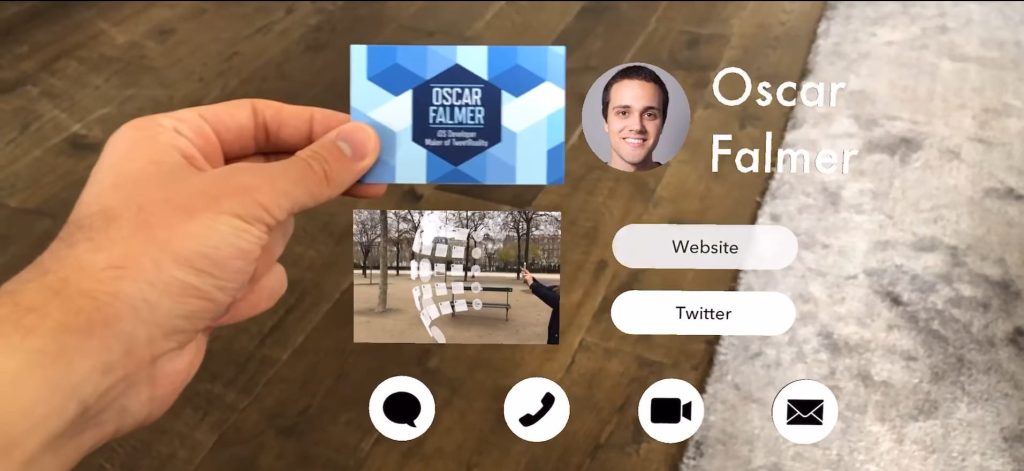
Thanks to an Augmented Reality business card you can also show more about you than you would do on a normal business card. By simply pointing the smartphone on your AR business card, it is possible to add several actions to your card so that the user can live a definitely more appealing knowledge experience and this allows you to stand out more among the others and instantly give an additional sense of professionality and will to emerge.
Some of the advantages of an AR business card
The advantages of using an AR business card compared to a “regular†business card are limitless. By presenting an AR business card you definitely have more chances to:
increase engagement: it is known that printed products that have implemented the AR element create more engagement and more curiosity to the people who are seeing it for the first time (increasing the chances to see it for a second, third and fourth time…);
show that you keep up with modern times: we all know that business cards will always be important in the business/marketing field, but showing that you have been able to give them a new updated and technological life will definitely give you an aura of modernity and originality that it will be impossible not to consider in the working field;
increase ROI: whether your AR business card will help you get that job or not, it will for sure contribute to generate clicks and interactions on your website and portals, helping you achieving higher numbers in terms of engagement, clicks and visits;
be more respectful with the environment: yes, business cards are made in paper and so are AR business cards, but thanks to the AR technology, a single business card can contain a large amount of information otherwise impossible to enclose in a little piece of paper. This means less use of paper and more information given at the same time.
Endless possibilities to stand out with an AR business card
Through your AR business card, you can show more about yourself and your work. For instance, you can add your social pages in it, so that with only one click others can see immediately your profile pages and immediately have a “virtual†perception of you. Same with your website and/or your email address and phone number.
Moreover, you could also show an original video presentation, where you present your work, your vision and a bit about yourself, or if you feel like it, you could also create an avatar of you that explains your work for you as soon as people click on it.
You can create animations, put links to your works and socials, add images, videos and even games if you want to add a major sense of amusement.
The technology behind the AR business card
In order to create an AR business card, Augmented Reality technology uses marker-based recognition, that means that you need a marker to activate the augmentation. By scanning the image marker with your smartphone, you will activate the experience and start seeing your augmented business card in a way you couldn’t believe possible.
The marker you need in order to activate the augmentation can basically be activated in two different modes. There is the easier one, which is by using Web based AR: in this case, you only need to implement an 2D image marker, which usually is a QR code on your card and by scanning the QR code and clicking the link given, the magic will appear.
Otherwise, there are AR business cards that canbe activated using a mobile app. This can appear a little more tricky and, even though the “wow effect†will totally be worth the downloading, lazier people can find the use of additional apps more difficult and this could generate the hated proposition “I will look at it later†that we must avoid at all costs.
Now see the magic happens
Our platform AR-media allows you to create impressive AR business cards, able to stand out among all the others. With simple steps you can bring your business card to another level, doing something more original and worth-remembering.
Here’s a quick tutorial on how to start creating an experience with AR-media. Start creating your own AR business card.
The word ‘Lidar’ is made up of: Light and Radar. Lidar (Light Detection And Ranging) identifies the technology that measures the distance to an object by illuminating it with laser light and, at the same time, is able to return high-resolution three-dimensional information about the surrounding environment. Lidar works similarly to a radar, but uses laser technology to measure distances and depth. This is crucial for augmented reality (AR)-based apps and photography.
A Lidar typically uses several components: lasers, photo detectors and readout integrated circuits (ROICs) with time-of-flight (TOF) capability to measure distance by illuminating a target and analyzing reflected light. The operation of Lidar technology is based on an ‘immediate’ principle and is referred to as ‘Time of Flight’ (T0F) or time of flight. Time of flight can be obtained by sending a pulsed signal via a laser, but also by measuring the phase and frequency of the reflected light signal against a reference signal.
What are the advantages of Lidar technology?
The use of Lidar technology has several advantages:
– Allows fast and accurate measurement;
– Wide resolution;
– Simplicity and ease of use
Due to its simplicity of application and use, Lidar technology is defined as a ‘Transverse’ technology and is most widely used in several markets:
1) Construction: Lidar is used in the construction/building sector as it helps to reproduce the reality of construction in a very easy and highly reliable manner;
2) Mapping: in recent years, this technology has been increasingly used in everything related to morphology mapping/precision remote sensing: it helps to establish the differences in elevation between terrains with a particular eye on the morphology of a given area (even potentially coarse). In this way, Lidar operators can create numerous Digital Terrain Models (also using drones), the accuracy of which will be very high and the margin of error very small;
3) eCommerce: sellers can easily create a 3D version of their products for sale, simply by using an iPhone and helping potential customers better understand what the products look like. Many eCommerce shops already offer a 3D visualization of the product in addition to photos.
4) Automotive: Lidar sensors used as a ‘visual’ tool to build self-driving vehicles. In this context, Lidar systems are used to detect obstacles, such as other vehicles or pedestrians, or the environment surrounding the vehicle.
Lidar: a step forward by Apple in Augmented Reality
Appleintroduced a Lidar sensor in its smartphones for the first time and made Lidar available to everyone. Lidar may be the greatest creative and professional innovation ever to come to the camera section of a smartphone. The iPhone 12 Pro’s Lidar is based on ARKit, Apple’s framework for augmented reality.
With iOS 14 came ARKit 4, which added several new features: it increases resolution, allows multiple faces to be tracked simultaneously, enables motion capture, and better handles occlusion, that is, the possibility of virtual objects being covered in the scene by a real person. In addition to position tracking, which allows virtual objects to be linked to physical points.
The Lidar used by Apple is a module consisting of two elements, a transmitting and a receiving element. The transmitting element is based on an array of VCSELs, vertical cavity surface-emitting lasers, an acronym that will mean nothing to many but which is the same technology used by optical mice today.
Digital twin: what is it and how does the digital twin model work?
Digital Twin is a virtual representation of an object, connected to it throughout its life cycle.
The Digital Twin is updated in real time by data collected from sensors connected to the physical asset and uses simulation programmes, machine learning and reasoning to provide useful information about the asset and to develop predictive models of the object’s future performance and reactions to certain conditions. With the advancement of digital technologies, the Digital Twin allows for more efficient management of systems, saving costs and time.
The market for digital twins is growing rapidly and this fact indicates that their demand will continue to grow in the future. In 2020, the market for digital twins has been valued at $3.1 billion. Some industry analysts speculate that it could continue to grow rapidly until at least 2026, reaching an estimated $48.2 billion.
What are the benefits of using Digital Twins?
– Improved research and development: the use of digital twins enables more efficient product research and design by creating a lot of data on possible performance outcomes. This information can lead to insights that help companies apply the necessary refinements to products before they go into production.
– Increased efficiency: even after a new product has gone into production, digital twins can help reflect and monitor production systems, paying particular attention to achieving and maintaining maximum efficiency throughout the production process.
– Product end-of-life: Digital twins can also help manufacturers decide what to do with products that reach the end of their life cycle and need to receive final treatment, through recycling or other measures. Using digital twins, they can determine which product materials can be recovered.
The markets that use digital twins with great success are those dealing with large-scale products or projects such as:
– Engineering (systems)
– Automobile manufacturing
– Aircraft manufacturing
– Railway car design
– Building construction
– Manufacturing industry
– Energy companies
How can digital twins be used to experience augmented reality?
Digital twins and AR are one of the most interesting digital representations of recent times. Based on an incredible technological variety and complexity, digital twins constitute a true connector between the physical world and its infinite virtual instances, with which the full simulative power of the digital can be harnessed. The constant flow of data generated between the physical and digital twin enables the interaction of various enabling technologies of Industry 4.0, such as artificial intelligence and augmented reality. Users can, through digital twins and AR, make use of simulations and predictive analysis to prevent problems before they occur, explore new opportunities and support new projects in a more informed and objective way than would be possible with traditional methods.
Compared to ‘simple’ virtual simulations focused on a single event or phenomenon, digital twins involve the entire life cycle of physical twins. The real-time data flow is processed to extract information value that is useful for generating knowledge to support complex decisions and the continuous improvement of processes or products themselves.
Today’s virtual worlds lack a very important aspect: the connection between reality and the metaverse, i.e. the virtual reality shared via the Internet, where one is represented in three dimensions through one’s desired avatar. And this is where the digital twins come into action, with the IOT once again creating the sensory links needed to interface the real and the virtual.
Digital twins and AR are about to enable companies to visualize key information about their operational technologies. The ability to visualize physical and virtual environments is an untapped advantage for industries such as manufacturing, transportation and energy, where heavy machinery and other physical equipment are often at the heart of business operations.
It is becoming increasingly imperative and necessary to combine these physical assets into applications and IT infrastructure to improve operations, customer service and produce business-critical insights that help companies gain a competitive advantage. This is where digital twins and AR each have a role to play in helping companies achieve full Industry 4.0 transformation and automation.
If you are among those who’s asking how far WebAR has come in the development of experiences, like we are, and want to know more about its r-evolution, then you’ve landed in the right place (plus, we have a demo for you at the end of the page).
What is web ar?
“Augmented Reality is the enrichment of the perception of the context around us with digital data, created by technologies that allow the overlay of contents seen as part of the environment in which the subject finds itselfâ€. In order to make this concept true, we usually need to download a specific app on our device and see the magic happen. WebAR breaks off from the tied-in-a-app definition, bringing Augmented Reality on the internet browser, freeing developers from the management of the apps and stores and allowing users to have access more easily and more rapidly to immersive experiences.
The r-evolution of WebAR happens exactly when the virtual object needs to be put into the environment: no special software or app is needed, only a smartphone or tablet and its camera, and an internet connection of course. Indeed, in order to have a positive result, the camera of the device plays the most important role. The information about the environment is detected by the phone camera, and through it the environment is scanned and analyzed and data is transferred from the camera to the Web environment.
The features of Web AR basically remain the same as application-based ones:
Image tracking: by scanning a specific 2D image with the camera of your device (such as flyers, pictures, artworks and books), the Augmented Reality object will appear in your device (whether can be a video, a 3D model, another picture, an animation..), allowing you to live a deeper experience of that 2D image and giving you a more complete and more sensorial involvement;
Marker tracking: basically the same as the image tracking but the scanning process takes place with a specific object or defined symbols, rather than 2D images;
Location based AR: for instance virtual tours and maps support. Users, while moving freely in the environment, can have access to adding info about the place where they are, receiving help in finding certain places or knowing more about a specific monument or city.
It is necessary to remember, though, that even though Web AR does not require special apps, sometimes it might require specific adjustments in terms of softwares and tools in the devices, such as ARkit for iOS and ARCore for Android. Generally, WebAR nowadays is available for all the latest smartphone devices above iOS 11. Ergo, Web AR might still have some weaknesses that need to be improved and/or revised, and the battle between Web AR and app AR is still far from declaring a winner. Let’s see more specifically what are the main differences between them and what are their hardest limitations.
Web AR VS App-based AR: differences and limits
Why WebAR is the r-evolution we were all waiting for
Well, as mentioned above, the first and most relevant difference between Application-based AR and Web AR is the “place†where they are released: application-based AR is only available using an app whether Web AR is accessible online without downloading other apps. The web aspect makes the whole access process way easier since you only need a URL link, a QR code or an NFC tag in order to live the experience.
There are many advantages especially for developers. In fact, WebAR is able to significantly reduce time and cost of an app-based experience. First of all you don’t need app store providers’ validation, hence the market process is a lot quicker; you can give support and fix bugs immediately; you can release all the updates that you want potentially in no time.
Why Web AR seems to become a revolution is for a simple, yet crucial reason: people like immediacy.Researchers have shown that when people need to download in order to use an experience, 50% of them are more keen to drop off and refuse to try the experience than to “waste†time on downloading an app that they will probably use just once. Hence the immediacy of the Web AR is undoubtedly its biggest asset.
Immediacy, easiness and ready-to-usability are central aspects in the innovation of Web AR that cannot be undervalued from agencies and companies whose aim is to compel the client through new innovative ways. For agencies, Web AR might definitely represent a new level of marketing and appeal to new followers and clients, giving to the users a brand new type of client experience.
But there are still weaknesses in the development of the experiences
Being WebAR browser-based, it might happen to go towards a low performance. In terms of information transferring, WebAR spends more time and memory to transfer the digital object because of its lack of the resources that otherwise are present in the app-based and this can mean a lower quality of the digital object both in terms of image and animation. In order to live a better experience, the best solution would be the creation of “simpler†experiences, with less interactions
Having good internet connection is the number one requirement in order not to occur in low-quality experiences or impossible-to-see experiences, that is why Wi-fi is preferable. App based AR can give you the ability to download the experiences in advance and use them at any time, even in the absence of an internet connection.
Another restriction of the WebAR is the limited battery capability. Using applications, indeed, smartphones and other devices usually last longer because the app uses the functionalities already present in the device, whereas, in Web AR, browsers need access to the camera sensors, analysis and other resources and this can significantly reduce the last of the battery.
However, predictions about the future of the Web AR are more than positive that is why we talk about a r-evolution. Just think about three or four years ago and how long AR and Web AR have gone up to now. Of course there are features to optimize, tools to fix and aspects to refine, but as for other technologies that have been changing and improving with time, there is no doubt that the development of the Web AR and its experiences will follow the same destiny.
Anyway, we know you can’t wait to try our Web AR. So if you want to have a taste, wait no longer and try it now by scanning the QR code or by clicking below.
You don’t have any more excuses to be lazy nowadays, by starting to improve your lifestyle using Augmented Reality. New technologies have always been seen as enemies of the healthy lifestyle, since they’ve always been perceived as something static, impossibile to use if not sat still on a chair or a sofa, in front of a computer, a laptop or a smartphone. Well, things have changed by now. Today, new technologies have learned to live among the most active men and women, moreover, they help them stay fit, active and improve their general mental and physical health. Researchers have now stated that this relationship between fitness/wellbeing and technology is to be considered more possible thanks to immersive technologies, which have the potential to add more value, sense of experience and motivation to the standard ways of keeping a healthy lifestyle.
What do we mean by improve one’s lifestyle with AR?
Following a healthy lifestyle is not alway as easy as we think. The common conception of “healthy lifestyle” means trying to be less sedentary as you can, avoiding junk food and fats, practicing mindfulness or some kind of meditation and, well, taking time to relax and enjoy life.
Using Augmented Reality, some (if not all) of these aspects can result in easier to follow, more accessible and even more convenient. Moreover, thanks to new technologies, you appear to have more control over your work on having a healthy lifestyle, because there is anyone else than you checking on your improvements, appointments, meals and so on… everything is manageable following your personal timing and schedules.
Staying fit with AR
Your gym wherever you go
In order to have a healthy lifestyle, being able to have a fitness routine is something almost mandatory. Sometimes though, keeping a fitness routine might appear more difficult than we think. For instance, as we know, a lot of jobs require several hours a day to sit on a chair, so that after 8 hours of work, we might not feel exactly in the mood for going to the gym. And here’s the part where Augmented Reality comes to save your day: what if you don’t need to “go” to the gym, but all you need is AR/VR equipment that brings the gym to you? This might be the first and one of the most important aspects of AR helping you improve your lifestyle .
The variety of sports and ways to do it using AR is impressive and it is totally up to you. By using smart equipment, headsets, or smartphones, doing sports has never been easier and funnier. By buying an AR device, you can recreate the environment of a gym at your own place, you could also have your personal trainer, and sometimes even talk with other people “in the same gym” so that the relational part of the gym remains existent. Moreover, having your gym at home means that you don’t need to respect your gym time-schedule, so that if you want to do your workout at midnight, you are more than free to do it (only make sure not to be too loud and let your neighbors sleep). Your personal trainer will be there, at any time, waiting for you, in your virtual gym.
Real-time data
While the gym might be virtual, your results are definitely real. With the help of an AR device in the daily fitness routine, people can perfectly track all the activities. These devices take track of everything from what distance you cover when jogging or cycling, to the calories consumed. Thanks to this data, users can make critical decisions about their future workouts, like whether to increase or reduce intensity, helping you not overstress while monitoring the activity and allowing you to see your improvements at the same time.
AR/VR technology is able to give you real-time insight on your activity. It can suggest the workout that works best for you, based on your weight, height, precedent activities and possible results, allowing you to have the best workout outcome.
AR can keep you more motivated and bring fun to your workout session
It is known that motivation is the most critical factor affecting your fitness routine, and staying motivated all the time is almost impossible. AR fitness technology can help with that. AR apps can choose the perfect workout for you, starting from the basics and intensify the exercises with your timing and possibilities. This improves your motivation, since you are more able to see the first results in terms of strength, change of the exercises and your saved history. As we saw earlier, it is all tracked, and seeing your results clearly will definitely help you stay motivated.
AR can also bring a more gaming experience, especially when using specific apps like “Zombie, run” where you find yourself running from zombies or “run social”, a virtual experience where you can choose the perfect place for your jogging session like a beach, a wood, Central Park and many more. This generates amusement in the user together with motivation and the simple workout can become an innovative and inspiring experience.
Improve your eating habits with AR
Improving your lifestyle is hard work that goes beyond just caring about the fitness aspect. It is something that involves several positions. One important aspect to be considered for instance is our personal diet. Having a healthy lifestyle means also conducting a healthy diet, eating healthy food and not too much. In this case too, AR can come to rescue you!
The first and the biggest innovation that AR can bring to your food habits is raising awareness and understandability on what you are eating, giving you information about the type of food, the calories, the quantity suggested to consume and other. Researchers are now studying AR glasses that record in real time what is in your plate, giving you all the info necessary. The best part is that the info given changes while you’re eating, monitoring every step of the feeding process, from the whole plate to its emptiness, so that you know exactly what you are eating and how. Another app called Habit.at uses AR to change the perception that people have toward specific kinds of food. How it works: it basically changes the environment around the plate, with the aim of dissuading from bad eating habits, so that healthy foods will be surrounded by a more positive and funnier environment, in order to stimulate on keeping eating those foods.
AR can help you improve your mental health
Reducing anxiety with AR
Sometimes, all we need to feel like our lifestyle seems improved is a little break: a break from our everyday life and our daily routines. And sometimes, only 10 deep minutes are enough to re-energize us. Augmented reality can help with that too! There are, indeed, amazing little experiences that one can use to reduce anxiety, feeling less stressed or just to have 10 minutes of calm fun. In those experiences you can immerse yourself in amazing landscapes and places using the right device, that otherwise would have been impossible to go to, such as the most breathtaking beach of the Maldives, the calm woods of Norway, beautiful Italian flowers field etc. and stay there the exact amount of time that you need to rebalance yourself. For an even more relaxing experience, also SPAs are starting to introduce virtual experiences like that in their services, combining existing treatments with virtual surroundings, to have a full, mind blowing, relaxing experience.
Starting your meditation journey has never been easier
Another importa aspect of improving your lifestyle with AR and VR is meditating. Numerous AR apps now can help you guide your first steps toward meditation. With guided voices and virtual tours, it is possible to feel immersed deep in one’s mind, facilitating the process of focusing on oneself and accelerating the learning process of meditation discipline. The most known apps are Psious, Clevr and Guided Meditation.
Medically speaking, besides surgery and general healthcare, AR is now used in mental health in psychology, helping patients to overcome their phobias, traumas and other issues. Anyway, we feel ready to try improving our lifestyle using AR and see how the results will be. Are you joining us, too?
The music industry has developed a growing interest in Augmented and Virtual Reality with the aim of improving the audiences? engagement. Today’s listeners feel a particular need to integrate music with multimedia devices that increase the quality, efficiency and immersion of the content provided by artists, as well as increasing the simplicity and speed of its enjoyment.
A Forbes study of millennials found that 78 percent of them would prefer to spend money on unique and unforgettable experiences in the music industry, as for them the performance and the memory have real value.
The very first AR & VR concert experience was made possible by the gaming platform Fortnite. In fact, the collaboration between Travis Scott and Fortnite in April 2020 was a huge success, with over 12 million viewers watching the event on the platform. It is the most popular virtual show ever. Not only that, but rapper Lil Nas X also had 33 million online views on Roblox, showing the other possible face of gaming for kids: from a virtual world for kids to an online space to take with you in your bag of cool and exciting experiences.
Billie Eilish also entered fans’ homes through the screen: she performed from the stage of a Los Angeles studio, but the show crossed cities, oceans and worlds with her images, quickly.
Using the right amount of creativity and inventiveness, AR & VR in the music industry is applicable to any environment and situation.
How is the music industry changing with AR & VR?
Augmented and virtual reality represent a real revolution in the music industry, as they have the ability to enrich the human experience and can create situations in which people turn from passive to active spectators. New technologies have completely changed the fate of online concerts, which are visible in virtual environments thanks to the rapid growth of virtual productionandmetaverse platforms, involving an unlimited number of users with broadband connections and wearable devices in a multi-sensory way.
The aim is to replace the perceptions of the real senses with computer-generated ones, which are derived from a database describing a 3D scene with object animations, within which the changes introduced by the active role the user takes in the virtual system can also be included. This is an epoch-making change in the way music is enjoyed, and obviously does not stop at concerts.
AR & VR can also be integrated with music videos, giving listeners the opportunity to participate in their performance and create immersive and unforgettable experiences. This is the example brought by the video of Bjork’s Stonemilker, presented at MoMA and shot with the possibility to interact through plug-ins, giving the perception of driving the video itself. Similarly, platforms like web casinos without gamstop are leveraging VR technologies to create highly interactive gaming environments, blurring the lines between traditional entertainment and cutting-edge virtual experiences. The video of U2’s Song for Someone was also designed for virtual reality, showcasing the diverse applications of these technologies.
And that’s what we’re getting to, a completely new way of experiencing music, more immersive, more exclusive and more direct. Many artists, as we have seen from the examples, are trying to move in an increasingly innovative way in relation to new technologies.
The keyword for AR & VR in the music industry is: interact. Users are catapulted into the artists’ performances and transformed into avatars where they have the possibility to interact with other avatars of other fans or directly with the avatar of the singer, either during backstage or by requesting a specific song. In addition, the user can move around, modify the surrounding space, form relationships and communicate with other fans. Without forgetting that the main motivation for everything is to enjoy a concert, possibly live. Interaction and movement are made possible through 360-degree filming, in which images from numerous perspectives are recorded simultaneously.
Augmented and virtual reality makes it possible to be active and present in places and environments other than those one is in, but with an extremely realistic appearance. Online concerts create virtual environments that allow the user to be involved on a multisensory level thanks to 3D images and sounds, offering a 360? experience.
How to enjoy concerts and performances with augmented and virtual reality?
More and more apps are coming out that allow the user to watch concerts in virtual reality, such as:
1. UnReal Club: the first Italian application that allows users to enjoy a virtual and immersive musical experience. It was born from the idea of combining the world of music with that of virtual reality to allow people to return to artistic performances by leveraging the potential of new immersive technologies. Access to the app is simple and intuitive: just register, create your own avatar, personalize it with gadgets and clothing and you’re done. Just like live, in each virtual location the avatars of all the users come together to watch the music event on air at that moment, to interact with each other just as if they were in a video game and to perform actions thanks to head tracking and audio chat;
2. MelodyVR: this is a start-up created in 2018 that has revolutionized the way of experiencing music. The application allows users to jump from one concert to another or follow a predefined path. There are several devices compatible with MelodyVR, the important thing is that it is a virtual reality visor. Some examples are: Samsung Gear VR, Google Cardboard, Playstation, Oculus Rift or Google Daydream View;
3. ConcertVR: a dedicated platform for concerts and music experiences. It has all the features of the other applications but also allows viewing of past events.
4. The Wave: a new kind of interactive music experience. Wearing a VR visor, users have the possibility to experience music festivals and concerts and can also socialize with their friends via the platform. Music creators can customize the way their audience is immersed in their music by transporting them from a realistic concert venue, to an amazing light show or into space. This app is the perfect tool to empower artists and transform the way fans connect with their music.
What are the benefits of AR & VR in the music industry?
The advantages and benefits of using augmented and virtual reality in the music industry are numerous:
– No limits: it is possible to attend events wherever you are without limitations such as physical impossibility, geographical remoteness or any other kind of impediment that would prevent you from seeing a band or your favorite singer perform;
– Minimal costs: if you have a device with an internet connection and a VR viewer, you can simply pay for the concert ticket at a much lower cost than a live concert;
– Simple, easy, accessible to all: attending a concert or event online is quick and easy. In just a few minutes, in fact, you can buy your ticket and watch the performance, go on stage or move backstage for a 360? immersive experience;
– It strengthens the relationship between singer and fan: by involving the user at 360?, the memory of the event will remain in their mind for a long time.
These technologies still have plenty of room to grow in the music industry, what will they create to surprise us again?
“May AR be with you”: Yes, we have decided to celebrate Star Wars day with the best AR/VR immersive experiences. We know, this may not be the original quote from the legendary, stellar movie Star Wars, but this gets straight to the point, right? In order to celebrate the Star Wars day, which happens to be, of course, May the 4th, there are no excuses not to relive the most captivating stories and the best images, recalling the most sensational immersive experiences based on the outstanding movie series. The following are the best picks in the manner of games, virtual and augmented reality experiences, virtual production and, why not, even metaverse where Star Wars has come into our very homes.
Celebrate with “Star Wars, Trials on Tatooine” and “Star Wars Pinball VR”
In order to celebrate Star Wars day with the best AR/VR immersive experiences, in terms of games, “Star Wars, Trials on Tatooine” is a must. Even if it is not the newest Star Wars game, since it was born in 2016, it definitely represents one of the “must try” SW virtual experiences of all time. The game takes place in a galaxy far away from Star Wars, right after the events of the Return of the Jedi, called Tatooine, where you can actually wield a lightsaber and be transported into the desert of Tatooine and defend the droid R2-D2 from the stormtroopers. Technically speaking, the game requires a powerful computer since its photo-realistic approach and it uses a single controller. It can be downloaded for free on SteamVR.
Have you ever heard about a Star Wars-themed Pinball experience? Well, it is not exactly like any other Pinball games, but if you want to Celebrate Star Wars day with the best AR/VR immersive experiences, you should definitely try it. In fact, “Star Wars – Pinball VR” is a Pinball VR experience and this is what makes it extremely original and curious. In the game, not only can you play the “traditional” Pinball game with a virtual Pinball machine, but, moreover, there are items and tools in the game itself which enhance your gaming experience like never before.
In the game there are different Pinball machines, and every Pinball machine represents a different story of the Star Wars saga, including The Mandalorian, the newest Star Wars TV series. The Pinball game itself is definitely one of a kind Pinball game. In fact, it is not everyday that you see 3D astronauts, shooting and explosions taking life in a Pinball game. To enhance your VR experience even more, you can also find yourself fighting against one of the main characters and playing numerous additional mini games. In the game, you find your Pinball machine in a personal playroom, called “the fan cave”, and to make it even more captivating, you can become your very own room designer and customize it the way you prefer, putting your hero statue, winning your Pinball trophies and much more. Star Wars Pinball VR is available on Oculus Quest, SteamVR, and PlayStation VR headsets.
Immerse yourself in AR/VR “Star Wars: Jedi Challenges” experience
Released by Disney, this is one of the best Star Wars AR (Augmented Reality) Video Games with equipment, and this is by far the best way to celebrate Star Wars day. Created in collaboration with Lenovo. With a headset, a lightsaber handle, a LED motion tracking, and your smartphone, you have the chance to bring Star Wars into reality!
Star Wars: Jedi Challenges involves three games in it. The first is Lightsaber Battles, where, once wielded your lightsaber handle, you need to fight against your enemies who will appear in your room, choosing among different types of game, like defeating waves of enemy troops across all eras in Assault Mode, facing off in 1-on-1 duels against Kylo Ren, Darth Vader and others, using Force powers to strategically defeat your enemies.
The second experience available in the game is Strategic Combat. In a large-scale war ground, you can train yourself in military strategies by commanding armies in order to defeat the enemies, win against the forces of the Darkside or/and recreate epic battles. Improving your skills, you can also unlock new levels and go on in the game.
The third Star Wars experience is Holochess. With Holochess, you can also train your concentration and strategy in chess ground with monsters and aliens based on the movie Star Wars IV – A new Hope. In the game you need to collect eight different creatures with different strengths and weaknesses and win against the enemy.
Celebrate Star Wars day rewatching “The Mandalorian”
You can celebrate Star Wars day also by rewatching the best SW movies, celebrating the innovative production processes. Indeed, the production process of The Mandalorian is extremely innovative in terms of technologies used for visual effects, where the actors directly interact with the virtual objects and the surroundings. This is called Virtual Production. That means that the crew can change from scene to scene, in the same location, without interruptions. Using this type of technology you don’t even need to go to specific locations to create your work. In the Mandalorian, indeed, it is impossible to recognise whether a scene has been created with Virtual Production or not.
The ultimate Star Wars immersive experience: Reborn, the Metaverse
Being claimed as the “most anticipated Metaverse game of 2022”, Star Wars: Reborn seems to be the Metaverse game we were all waiting for.
As seen from British Weekly, according to the creator, Reborn should be composed of more than 1000 planets, where every player cooperates to build one and asset it, or even build new ones. The highest hype is all around one of the planets, which should represent the Hollywood planet and where lots of celebrities are expected to participate.
These are our favorite picks to celebrate Star Wars day with the best AR/VR immersive experiences. So, now that you have loads of options on how to celebrate Star Wars day, have you decided your favorite “galaxy” where to pull out your lightsaber yet?
The doors of the Metaverse are accessible to anyone interested, through the various platforms that have contributed to its advent. If, in fact, the idea of a virtual reality is often linked to a fantasy video game or to never-before-seen worlds, the platforms of the metaverse make it possible to make this virtual reality increasingly real.
According to a recent study by Gartner, in 2026 25% of the global population will spend at least one hour a day in the Metaverse for various purposes such as work, shopping, education, social interaction and entertainment. Considering that 2026 is only four years away, it is safe to say that the Metaverse will soon be part of our everyday lives.
In these ‘new worlds’ you can mostly enter for free and create your own avatar. On these Metaverse platforms there are other users, with whom you can have a coffee, go for a walk, see a concert, attend a fashion show or an art exhibition, so from this point of view it can be seen and evolution of traditional 2D chats.
One of the “oldest” virtual universes and protagonist of numerous transactions. Launched in 2016, today it can count on a solid community of users and a very long list of brands that have started to populate this platform. Based on Blockchain technology, it is a democratic and completely decentralized world; all holders of the MANA currency (Decentraland’s currency), can take part in decisions on the platform through a vote.
At the end of December 2021, there were more than 800,000 registered users and just under 500,000 monthly active users. Entering the Decentraland Metaverse is very simple: simply go to the site, create an account with your avatar, start the adventure and explore.
How to enter the world of the Metaverse with the Decentraland platform?
Decentraland is a completely open virtual world in which users are asked to interact with each other as in a parallel life, socializing and taking part in the activities and economy of Genesis City. To play in Decentraland you can log in as a guest user, simply explore the world by opening the website in your browser, create an avatar, give it a name, and accept the terms and conditions of the community.
You will also need a crypto wallet capable of properly storing your Ethereum tokens in order to experience the full benefits of Decentraland. If you don’t have a wallet, you will still be allowed to walk around and customize your avatar; but you will not be able to participate in trading activities or the in-game economy.
Decentraland hosted the first Fashion Week in the history of fashion in the virtual world from 24-27 March 2022. The aim of Metaverse Fashion Week was to experience fashion from different perspectives and to make high fashion accessible to everyone. In order to participate in the Fashion Week events, it was sufficient to connect your Metamask or visit the Metaverse in guest mode.
Decentraland provided the coordinates of all the event zones and with a simple click you could reach afterparties, digital shops, fashion shows and conferences organised by many brands. The Metaverse Fashion Week at Decentraland also gave a big boost to the price of MANA, which increased by 7% since 23 March, the day before the event began.
The Sandbox
TheSandbox is a virtual metaverse that has become popular since announcing its partnership with Meta. Its avatars have a visual block style and can build, own and monetise using NFT and SAND. The Sandbox is a decentralised, community-driven gaming ecosystem where creators can share and monetise their voxel creations and game experiences created on the Ethereum blockchain.
The Sandbox metaverse is actually a puzzle made up of many small platforms that, like a large network, connect and interact with each other. Within it, each user will be able to create, exchange, buy or sell digital avatars, or buy, sell or rent a real plot of land. Graphically, the maps are an explosion of colours. The impression is that of being in a world somewhere between Minecraft and Second Life, where there is enormous room for creativity and complex experiences can be created, based on lively and constantly moving communities.
How did the different brands approach this platform of the metaverse?
Over time, the platform has partnered with over 165 brands to create avatars in the virtual world of celebrities such as Snoop Dog and The Walking Dead.
Among the different brands that have collaborated with the platform, Gucci has created its own virtual world. The collaboration between the two companies is based on the creation of an interactive fashion experience based on Gucci Vault, an experimental space. The brand has purchased an indefinite amount of land on the platform, with the aim of creating its own virtual concept store, where it can sell items created by its designers.
Arianee, the leading web3 solutions platform dedicated to brands, also wants to create experiences balanced between real and virtual, offering users the first service that combines real and virtual assets through Nft solutions: or metaverse ready, which stands for the ability to insert solutions for companies with an Nft related to a real asset into the metaverse. The possibilities are endless and only limited by the creativity of brands who will have the opportunity to mix physical, digital, experiential, engaging and attractive offers for their users.
The entire Metaverse hype started when Mark Zuckerberg announced his company Facebook would change its name to Meta, to reflect its increasing investments in the file of wearable devices and immersive worlds.
Of course Facebook, backed by its 3 billions users base has a strong advantage in starting a new Metaverse platform, which in fact did, by announcing Horizon Worlds. This platform is currently available to selected countries (U.S. and Canada) and it is limited to those who own an Oculus (now Meta).
Horizon Worlds is linked to a Facebook account and lets you interact with other users by means of your virtual avatar. The metaverse also features a world builder that lets users build places according to their needs.
It?s early to say if Horizon Worlds will become the reference Metaverse platform, it can certainly enjoy an excellent initial positioning.
Quoted at USD 41 billion, it has the fastest growth in the metaverse sector. This platform, founded in 2004, is a virtual universe in which to interact with other users.
Most of the games available on this platform have been created by the users themselves. Many users have made the creation of games a way of life, in fact Roblox could be compared to a large library of “user-generated content”.
The aim of Roblox’s creators is educational, allowing children to test their imagination, as well as taking their first steps into the world of programming by creating their own games individually or collectively. Furthermore, according to Craig Donato, chief business officer of Roblox, one of the reasons for Roblox’s popularity is its emphasis on “unstructured play”. Unstructured play is nothing more than play activities in which children engage in games that do not have specific learning objectives.
Why is it the most popular Metaverse Platform?
Roblox is completely free, but within the platform, there is a currency called “Robux” which is not entirely free. When signing up for Roblox, the user is asked to create a username which possibly does not have to be their real name. On your profile, you can see the games you have played, you can post to your feed and you can also show who your friends are, who you follow and who follows you.
Roblox has around 100 million active users and most of them are under 18. The interesting and curious fact is that Roblox has the smallest community of all the other platforms: 24% of 10-12 year olds use Roblox, more than TikTok and Snapchat.
As well as finding the magic formula for success, the virtual platform launched a special collaboration with luxury brand Gucci. This event allowed the brand itself to feature some items that players are literally paying through the nose for. Gucci is launching the “Gucci Garden” on Roblox, a digital world deeply inspired by the commercials with which the fashion house has been promoting its imagery for years. Each player will play as a mannequin without colors, which will be decorated according to the interactions with the environment, in order to create a unique and visually engaging interactive experience.
Nike has also decided to enter the Roblox world by creating its own sub-world called Nikeland, a virtual space dedicated to the world of sport.
Spatial is one of the most interesting Metaverse platforms for at least a couple of reasons:
It supports nearly all devices and modes (web, mobile, wearable)
It has a strong focus on NFTs
Just like the other platforms, Spatial offers you the possibility to join virtual spaces with your virtual avatar that can be customized starting from a face photo, giving it a highly realistic look. Spaces are searchable visually or through a text search and are sorted according to popularity, that corresponds to the number of users currently inside a virtual space.
Many of the available spaces feature NFT artwork that users can look at and, only with the Web version, can open the corresponding artwork on the OpenSea platform, allowing you to get more information about the artist and eventually letting you buy the piece.
The experience on wearable devices such as Oculus Quest 2 is much smoother than on Desktop, but that also depends on your personal computer technical specs.
How to choose your reference Metaverse Platform?
Decentraland,Roblox and The Sandbox are similar projects but also have big differences. While Decentraland focuses on a virtual second life, The Sandbox and Roblox are real metaverse platforms where users can create games and bring fantasy worlds to life.
Below are some of the main differences:
Decentraland has limited its land to 90,601 NFT, while The Sandbox has almost double that, at 166,464 NFT;
Decentraland has three types of token: MANA, LAND, WEAR, while The Sandbox has four: SAND, GAMES, LAND, GOODS;
More importantly, The Sandbox has a detailed roadmap, planning to deploy the platform to mobile devices by the end of 2022. In contrast, Decentraland’s roadmap is probably not as ambitious. The Sandbox is more centralized with experienced game developers, while Decentraland relies on its DAO (Decentralized Autonomous Organization) for development.
Another element that you should consider when picking your reference Metaverse platform is related to supported devices. Some of them can just be enjoyed via web browser, thus offering a limited immersive experience, while others let you access the virtual worlds via mobile and wearable devices.
While a gaming metaverse like Roblox cleverly combines multiplayer dynamics with the ability for users to create content, a blockchain-based metaverse like The Sandbox allows it to go much further, allowing participants to own property, much like the real world, where they can start real business ventures. The Metaverse leverages on the blockchain technology to create various ways to monetise the experience, following similar dynamics to the real world, though in a fantasy dystopian context.
Based on overall user accessibility, focus on gameplay, aesthetics and the most detailed roadmap, The Sandbox and Roblox are the ‘winners’. While Decentraland boasts its DAO, having a more experienced and decentralized platform tends to produce better results in an arena as delicate and complex as blockchain gaming.
All of these platforms lead to an enjoyable experience. Thanks to them, more and more people will be able to live and experience the Metaverse in the coming years.
Can I build my own Metaverse?
If you are looking for business opportunities for your brand, products and services, you don?t have to rely necessarily on one of the existing platforms, you may get more benefit instead by developing your own, or partnering with similar companies into a vertical metaverse platform designed for that goal.
What may happen in the future is that, next to the existing mass platforms, we may witness the emergence of smaller, but vertical Metaverses where companies can provide a focus experience on certain goods and services. Platforms like Roblox or Horizon Worlds may not be the best fit for companies that want to to build a tailored approach to their value proposition or that want to provide a photorealistic experience, which is something currently not provided by the most used platforms.
Building your own Metaverse requires a medium to high development effort (and cost), but may offer in turn a high control over the virtual environments in terms of quality and customization.
Also the user base of a custom Metaverse would probably be smaller than the ones you can find on Horizon Worlds or Decentraland, but companies and brands may be more interested in obtaining fewer profiled users rather than more not profiled users.
The use of Virtual Production sets a revolution in the field of content production. As we all know, the pandemic marked the end and the beginning of a new era. Together with numerous problems and insecurities, it brought significant technological resolutions and innovations, in order to make life easier and (why not) cheaper and allowing a lot of things to be more accessible remotely. Even if it was born before the pandemic, Virtual Production definitely got a significant boost ?thanks to it?.
Virtual Production is the touchpoint where the live action world and the digital one meet, removing the barriers between live production and visual effects, so that it becomes feasable to make them work together simultaneously. By using VP, the chances to make a high quality content with less effort and lower budgets are limitless and the only limit to your creativity is basically your mind. With Virtual Production, every place can be transformed to another: an empty desert can become a crowded city and basically every scenario can be digitized and created by simply using digital interactive sets or LED walls without the necessary and long use of the post-production.
This kind of technology is possible thanks to certain platforms and suites, such as Unreal Engine and Unity, that allow the creation of games, movies, any 3D content or even a metaverse, the new internet revolution where we live as virtual avatars in virtual worlds. In the Virtual Production context, the actors directly interact with the virtual objects and the surroundings. But this is only the tip of the iceberg, let?s take a closer look at what Virtual Production is and why it appears to be a great revolution.
The differences between Virtual Production and traditional VFX
VP begins from the pre-production stage
Compared to the traditional Visual Effects (VFX), Virtual Production presents several aspects that make it completely different, starting from the very beginning. The process of using VP, indeed, starts in the pre-production phase, where you can have an initial look of what your content should look like. Using traditional VFX such as green screen and chroma key, this process is basically impossible to make. With Virtual Production you don?t need to go to certain places, spend time finding the right image and hope and guess that the final look will be the same as you thought. You can have a plain view even before starting.
Real-time production makes the process quicker and without the necessary use of post-production
Virtual Production allows you to create amazing high quality experiences cutting the long process of post-production that has always been necessary in order to realize the image intended to be created. In fact, the real-time aspect makes the whole experience quicker, since possible changes become applicable on set at that moment. The real-time aspect allows the production to also make live experiences whether it can be the newest way to make weather forecasts or whole music concerts creating incredible images otherwise impossible until not so long ago.
It is the case of Madison Beer immersive concert experience, made by Sony and Unreal Engine, gone live on Tik Tok during the pandemic and now available on Youtube, where Madison Beer played an entire concert in real time virtual production, showing worldly what Virtual Production and creativity can do.
With Virtual Production you don?t necessarely need to use Green Screen or LED Walls
One of the biggest revolutions of Virtual Production, as said, is its quicker process. This is due to the fact that for some kinds of productions, the use of Green Screens or LED Walls may not be necessary, since all the creations are made virtually. Using a virtual environment, in fact, the crew can change from scene to scene, in the same location, without interruptions.
Not using the green screen means more accuracy of the image realism and also less stress over the guessing of the right lighting, colors, ideas of how it should be and the sense of disconnection that may come.
This also benefits the actors, who have the possibility to see in real-time how the environment is and thus, the acting process seems to be easier and more engaging. Moreover, it is more empathetic to the audience, creating in the actors the so-called ?sense of presence?.
If you are a Star Wars fan, you have probably heard about the The Mandalorian Series. Well, season two is entirely made with Virtual Production in collaboration with Unreal Engine. It is now famous for its unbelievable high quality and revolutionary making process.
Leveraging on the same assets for multiple productions (Cinema, Videogames)
With the tools dedicated to creating Virtual Productions becoming more and more sofisticated, with an attainable quality level close to photorealism, production houses are turning more and more to VP because it allows them to make use of 3D assets for multiple purposes, for example they can do both a Movie and a Videogame with the same environment and that’s certainly a cost-effective solution. A recent case of Virtual Production of this kind is The Matrix Awakens, where they used the same 3D assets (e.g. the city) for both the Movie and the Videogame.
Virtual Production means high quality with lower budgets
The need of finding the right places, of moving to certain areas in order to make particular scenes, or the need of a numerous crew is no longer a burden that the productions need to carry thanks to Virtual Production. With 3D technologies and virtual production, the workload is a lot lightened and thus the budgets become significantly reduced, that’s mostly possible because a less hardware-intensive approach can be used. You don?t need Hollywood’s budgets, but just a little studio where you can burst your creativity.Â
This is a substantial revolutionary aspect, since the lower costs increase the number of the companies who can take advantage of using Virtual Production. This means that even smaller companies can experiment with the improvements and the conveniences of Virtual Production and aim to have high quality final products. The lower budget also allows companies from different backgrounds such as marketing, communication agencies and so on, to experiment with these new technologies and create brand new high quality content.
In the end, Virtual Production can actually ?save you?. It helps you save time, it helps you save money and it helps you save a lot of stress, all of that guaranteeing the most effective high quality product.
Using AR, artists can bring art to a new level. We all know that every time a new technology or a new tool takes life in our world, the artists are among the first ones to try it, experiment it and eventually make it more commercial. The truth is that they can actually be the pioneers of a new way of seeing life, with their vision of combining creativity and technology and sometimes they really do their part in changing things and make the world a little brighter. This is the case of Augmented Reality.
Why use AR in art
According to some of the artists that are using it, Augmented Reality (AR) can bring the art world to a new level. They could have the chance to express themselves in ways they couldn’t believe possible and most of all, every piece of art can become a new different kind of experience.
An AR artwork can appear more immersive, adding more value to the experience of the public. Art is creating emotions, feelings, deep thoughts on the person who is looking; art is sharing terrifying secrets and revolutions while creating beauty. Augmented Reality can enhance all that, not only for Art Galleries and Museums, but also for Freelance Artists.
AR artists in the art scene
Numerous artists are now involving in their works the AR component as means to create more immersive experiences and generate stronger emotions. Here are the ones who impressed us more.
The company Adrien M and Claire B
The company Adrien M and Claire B is a french artist company that combines digital and living arts, creating unique performances full of beauty and poetry. Using technological tools to enhance their living art performances, they “transcend the spatial boundaries of stage and the time limits of performance, […] creating an art of movement to set the human body in resonance with graphic and digital arts. The result is a poetic visual language blending imaginary, real and virtual dimensions while bearing unlimited opportunities for artistic exploration.” With ‘Acqua Alta – crossing the mirror’, the company created an immersive AR experience where “ink drawings and white folded paper come together to reveal the virtual life of dancing miniature beings and their dive into the imaginary realms of water”.
Esoulito
Esoulito is a brazilian artist based in Sao Paulo, who combines Augmented Reality with street art and murals, creating a brand new way of making street art. You can have access to all his works on his IG profile or have a look at his website, where it is possible to admire most of his works and collection and eventually buy them. He creates old classic portraits like the Birth of Venus or ancient statues modified in street art. To all that, he adds the AR element, to make them move, live, and send further messages. Our favorite is definitely the AR Monnalisa in street art!
Sianfan
Another AR and VR artist that is worth mentioning is Sianfan. The peculiarity of Sianfan is her ability to merge the digital world with nature and with her own body, creating beautiful experiences full of poetry and intensity. In her work “Partial Bodies”, she presented a meditation between the natural and the virtual world and their relationship, analyzing the female body and nature in a digital environment. Her work can be described as “undeniably digital, yet innately organic, the entangled bodies present fragmented forms that reflect the uneasy relationship between the natural and the virtual.”
Marc o matic
If you love steampunk style and technology, you cannot but love Marc o Matic. He is famous for merging traditional art and technical animation and immersive tech, with a retro steampunk style all in it. Using mobile devices, viewers are able to see the work of art in a much deeper way. When hovering your phone over an artwork, the AR element brings the artwork to life through animation and sound, revealing more detail to the story behind the work. Needless to say, the result is simply amazing! He defines himself a “creative technologist”, indeed, he also creates virtual reality art works and 2D and 3D animations.
Creating art with AR-media
Basically all the artists mentioned above need to use an app in order to make the viewer see the AR element in their works. For instance, to give life to your works, you can use AR-media. With AR-media you can design, implement and share your creations without coding, creating all the immersive experiences you want and taking art to a new level.
It doesn’t matter if you, as an AR Artist, want to create immersive content associated to a painting or a graffiti, or if you want to visualize a 3D model in the environment. AR-media lets you create both Planar and Spatial Augmented Reality experiences.
Using Augmented Reality in the art field can be a new and innovative way to take art to a new level. AR artists can enhance and grow their already existing artworks, but also experiment to create brand new ones, allowing them to express themselves in ways they couldn’t imagine being possible. They now have the potential to unlock new forms of storytelling and self-expression, bringing the viewers to live deeper experiences and thus enhance feelings in the spectators. What are you waiting for?
The most searched word of the moment? “Metaverse”: with 677,000 results on Google, the hashtag #Metaverse is used extensively on Instagram, with over 60,000 posts and tweeted more than 500 times per hour.
By now it seems clear that the world of the Internet is changing and that we are watching the advent of the next big breakthrough in the world of innovation.
The Metaverse will be the Internet of the Future: it will change the way we perceive the world and interact with others, it will modify the way we enjoy experiences, it will create new ways of marketing and communicating, and it will make new immersive experiences with high emotional impact for its customers, thanks to the use of augmented and virtual reality.
The opportunities and advantages offered by the Metaverse for the world of marketing are many, offering new tools, new spaces to sell and buy products, new shop windows and new worlds, placing the user at the center of this new technological ecosystem based on the creation and enjoyment of experiences.
When and how will one of the most innovative sectors like marketing change in the Metaverse?
During the pandemic, digital has become the main place where many marketing processes such as collaboration, training, communication, but also sales, meetings and events have moved to, building, in a very short time, its own rules.
To be digital and to keep up with the new “Metaverse” world is no longer a choice. For brands, a new frontier is opening up in which to find new ways of building relationships with their target audience, existing and potential consumers. Today, marketing processes and strategies must be adapted to a more immersive experience: multichannel, new generation and performance, customer journey.
But that’s not all: brands are also trying to increase brand awareness in the Metaverse, by starting to study its potential. It is not just about recreating the physical world, but about expressing and sharing brand values “somewhere else” and in another way. For companies, marketing will mean designing increasingly immersive and engaging ideas and experiences for their customers. In fact, the key word that describes and characterizes the Metaverse is: user experience. The goal is to improve the quality of time spent on mobile devices, building new unique adventures that are closer to the real world.
Thanks to the Metaverse, marketing experts will be able to develop a perfect marketing strategy for their target audience, as they will be able to simulate the effectiveness of a point of sale or a promotional campaign, verify the interest of the public towards a product, create a contest, implement a hybrid creative staff between the real and the virtual world. The Metaverse allows for answers and verifications, eliminating surveys or questionnaires, which users sometimes consider boring and repetitive.
What can we expect from the world of marketing in the future?
Marketers will have to broaden their horizons and will have to think in “3D” and imagine not only the user’s in-store experience, but also a safe and efficient experience that can be enjoyed directly from the couch at home, through a VR.
The Metaverse, with its innovations, radically revolutionizes advertising and marketing techniques, such as the ‘day one’ for the launch of a new product on the market by a brand: promotional events could take place in virtual mode with unlimited access, within a specially constructed digital space, providing participants with some exclusive benefits linked to this experience.
In particular, these are going to be the main changes:
– As narrative techniques become 3D, marketing and advertising methods are also transformed: advertisers will have to respect and not interrupt the immersive and shared experience of users in the Metaverse. In order to engage and retain users, therefore, new advertising methods designed to blend fluidly into the Metaverse’s spatial dimension will be needed – completely eliminating methods such as interstitial pages that interrupt the digital experience, distracting and unnerving users. Examples of innovative forms of advertising are Nike’s virtual launch of its latest Air Jordan in Fortnite, or Gillette Venus offering different skins in Animal Crossing New Horizons.
– SEO will also be present in the Metaverse: just as we optimize content to be indexed in search engines, it is time to start positioning ourselves in the world of the Metaverse as well.
– Gamification will become an essential element of communication: interacting in a virtual three-dimensional space where users can have experiences enriched by the perception of their own and others’ presence in the shared space. The feeling of being together with other people in a digital space expands the palette of actions, reactions and ideas that can arise from interaction with others, perceived in a digital proximity implemented in the 3D space of the Metaverse.
Metaverse for e-commerce?
The answer is obviously yes. According to the report “Social Media Trends 2022” the Metaverse in e-commerce could even become a “trend” as early as next year; the growth of e-commerce in the Metaverse is a trend that will see strong growth in the coming years. The Metaverse for e-commerce could meet the needs of sellers and end consumers, allowing a virtual contact similar to the real one you can experience in the typical retail space. Above all, it responds perfectly to the needs of the new generation Z, the key target for the next 20 years, who do not perceive the barrier between offline and online. More and more brands are ready to adopt the Metaverse for ecommerce, introducing increasingly revolutionary features that will allow offline and online shopping to become a symbiosis.
The Metaverse will allow brands to offer shoppers a highly personalized digital experience that focuses on a seamless solution that makes it easier for customers to find exactly what they want and when they want it. It will be possible, thanks to virtual reality, to recover the concept of spatiality by being able to walk through shopping centers with the convenience of not even having to leave the house. A remotely controlled avatar will make every move for the user with the freedom to shop.
What can companies do to get the most out of the Metaverse in Marketing?
Many brands are giving their marketing space in the metaverse:
– Coca-Cola celebrated International Friendship Day on 30 July with the launch of its first collectibles in the virtual world, through a three-day auction. A friendship box containing some of the brand’s most iconic “objects”, but reinvented for the metaverse. For the occasion, Coca Cola also held an event in the decentraland metaverse;
– For the launch of its new model, the Nissan Juke car manufacturer decided to use customer engagement to engage and guide its users in their choice of product through various games and immersive realities. Stimulating conversion thanks to the emotional power of the video game;
– Microsoft, presented Mesh for Teams that allows users to participate in video calls as avatars, providing a sense of shared presence in a meeting. You can connect from any device, without necessarily needing VR/AR viewers.
The Metaverse in the marketing sector enables the merging of the physical and virtual worlds to significantly enrich consumers’ everyday experiences.
In the past year, NFTs became one of the most talked-about topics in the crypto-world, marking their biggest rise since their creation in 2014. So, if 2021 marked an incredible increase of NFT, what can we expect from NFTs in 2022? Will 2022 be the rise or the fall of NFTs?
Well, before making any predictions about the future, let us take a step back and analise what we are really talking about. What is an NFT?
What is an NFT?
Before discovering wether 2022 will be the rise or the fall of NFTs, let’s start understanding what they really are. NFT is the acronym of “Non-fungible-token”. It is “fungible” anything that can be exchanged or replaced with something identical, whereas “non-fungible” is everything that cannot be replaced, something unique. For example, it is possible to change/exchange any kind of banknote, that means that it is “fungible”, but it is impossible to change an NFT with another since it is not interchangeable. Each NFT has unique properties and is not worth the same amount as another one.
The biggest characteristic of the NFT is its “digital exclusive”, in the sense that an NFT can only be anything digital: a drawing, music, game-item, a video… everything that can be put in the digital world (so basically everything) and that can be traded with cryptocurrency (the most used in this field is Ethereum, but there are many more). Anyone has probably heard about the NFT of the first tweet in history, created by the Founder of Twitter Jack Dorsey, sold for over $2.9 million. Curious to know more about it, now?
Create and sell an NFT
Non-Fungible-Tokens can be bought and sold, exactly like other cryptocurrencies, on specialised platforms. One of the biggest NFTs platforms is OpenSea. OpenSea is a marketplace specialised in the buying-and-selling of crypto currencies and digital assets. It’s based on the Ethereum Blockchain (one of the most known cryptocurrency at the moment after BitCoin). The reason why OpenSea is gaining popularity day by day is its extreme simplicity. In fact, it is very intuitive and easy to use. All you have to do is create an account on the platform, connect an Ethereum wallet and upload the digital contents you want to sell.
How NFTs can change the art market
Needless to say, the art market, above all the others, is the one that, maybe, compose the biggest part of the NFTs, indeed, one of the most appreciated aspects of the NFTs is exactly its use for the digital art market. Until now, digital artists have always struggled with the economic and recognition part of their work since this idea of “an easy-to-replicate” kind of art and therefore the tendency of being less considered. With the “non-fungible” aspect, NFTs can totally reverse this factor and digital art creations, making every NFT unique. In this way, finally, the digital art world might have the recognition it deserves and be “treated” exactly like any other tangible artistic work. Apparently, the rise of the NFT in the art field is due not only to the possibility of seeing your artwork recognised, but also to the possible and appealing amount of money that an artist could do with its art, because of the tendency of taking as example some of the “ones who made it”, for example the Digital artist Beeple who sold “Everydays — the First 5000 Days” for $69.3 million or the famous CryptoPunk NFT sold for $1.8 million.
NFTs are not just related to art…
It must be said that Non-fungible-tokens are not only applicable in the Art area. As said, everything that can be digital can be transformed into an NFT, thus, you can now have access to certain events only by buying a special NFT ticket. The ultimate news makes it known to the world that in 2023 we will also be able to see the first NFT Restaurantdirectly from New York, where, by owning a Restaurant NFT you will somehow receive a membership that allows you to enter and hopefully dine in the Restaurant.
AR NFTs, the new frontier
2021 was the year of NFTs. Well, they actually existed since 2014, but this past year they experienced a real massive explosion and, whether you are an expert in the subject or not, you have probably heard this word at least once by now.
Thus, for 2022, the NFT world is beginning to speak about AR NFTs (Augmented Reality Non-Fungible-Tokens) as the new frontier of the NFTs. For the first time, NFTs which have always been restricted in the bidimensional world, could now have access to the three dimensional world. In other words, including the AR element in the creation of an NFT you add the ability to visualise it in your physical surroundings by using a specific app or a website.
Moreover, the use of AR NFTs could add the “scarcity aspect” even more. Indeed, especially for the tourism sector, it could be interesting adding some AR content only available with NFTs, such as a particular AR guide in a museum, 3D access to exclusive parts of the gallery or even the chance to see a work of art such as a paint or a sculpture in a deeper and more accurate way.
As we have seen so far, creating an NFT is quite simple and intuitive (especially using well known platforms). What could seem a little bit more challenging is creating an AR NFT, since it might require the addition of tools and platforms that allow the visualisation in the environment. The biggest advantage, though, is exactly this one: in a world where NFTs are created with an extreme simplicity, having the possibility to create a different work could make the creator stand out among the others, creating immersive and outstanding experiences.
Why NFTs could fall
According to a large part of the web, though, Non-Fungible-Tokens are going towards a slow fall, especially due to the several damages that they might be responsible for. Thus, it would be irresponsible to not mention the risks and disadvantages that occur in selling and buying NFTs.
Owning an NFT does not mean you can use it
The first incomprehension that seems to appear all the time is actually around the very definition of NFTs. Indeed, buying and “owning” a specific NFT does not mean being able to do everything you want with it, like copy it or using it for other purposes. You just own it. That might generate concerning thoughts about the very reason why you should buy an NFT in the first place, if basically it might be something that can be seen/listened/viewed anytime from any screen.
“Different” points of view about NFT art really is
Another concerning aspect of NFTs involves the art market. Apparently, the large amount of “artistic creations” in the NFT world may actually damage the NFT art market, because of the speculative aims that non-artists can have. That is why considering art something like code-made lions or monkeys for many users can appear difficult and people start asking if creations that do not seem very “artistic” (maybe because of a lack of emotions, soul and passion put into the creation of them) might not be worth buying and therefore create mistrust.
The risk of getting scammed
Despite its large popularity, NFTs world does not have legal guarantees yet that protect buyers and sellers, thus the chance of being scammed seem to be quite high. The buyer can never really know if the NFT bought refers to something created by the seller or if it is something taken from other parts. Something even worse could occur, like selling NFTs that are not even present in the digital world.
The negative impact on the environment
Another aspect that needs to be discussed is the environmental one. The super strong computers that generate NFTs consume an enormous amount of energy. These computers need very high capacity in order to work with the Ethereum Blockchain and guarantee proof-of-work (sort of security system that oversees transactions in the cryptocurrency world). In fact, when selling and buying an NFT, there is the so-called “gas fee” which is exactly a fee that needs to be paid for having used a large amount of energy. There are websites, such as cryptoart.wtf where it is possible to see the amount of emission that NFTs are making. According to cryptoart, the footprint of the NFT Space Cat seems to be not so far from the electricity usage for two months of an EU citizen.
At the end, it is quite impossibile to declare wether 2022 will be the rise or the fall of NFTs. What we can say is that despite all the risks and the disadvantages of selling/buying NFTs, it must be said that the predictions are quite positive. Apparently, the NFT market is going to change, improve and surely become bigger. There are already movements towards an NFT market greener replacing proof-of-work with proof-of-stake. According to the crypto experts, something about the safety of buying/selling NFTs will be made soon. About NFTs creators, instead, it appears that Augmented Reality will play a very significant role in the renewal of the 2022NFTs.
Art galleries with Augmented Reality are changing considerably, moving more and more towards the world of digitalisation, promoting a new contemporary way of experiencing and looking at art.??
Art galleries are making room for the world of optical illusion and 360-degree augmented reality, experimenting with new ways of making and communicating art. AR adds new elements to the real world of art galleries and is a simpler and more mature technology because it manages not to distort the history and elements of that place, but instead adds more engaging ways of enjoying it and spreading its beauty.
New technologies, such as AR, have strengthened the relationship between artists and viewers, improving their ability to understand and evaluate the work of art despite the increase in distances and the relative division caused by the physical detachment that has affected this historical interval. This is precisely where Augmented Reality is making its appearance, a digital technology that is increasingly being used in the art world not only to provide the audience with new experiences, but also to find new ways of bringing art to the public, becoming more immersive and improving the experience inside galleries.?
Augmented reality for art
If until now we thought of Augmented Reality as a tool used only and exclusively in the world of games, today it is increasingly expanding its horizons by positively affecting the world of art, adding elements of entertainment and surprise, thus increasing visitors? engagement. AR offers the possibility of living original and highly personalized experiences.
Through the use of electronic devices, such as smartphones, tablets and wearables, it is possible for visitors to see, in addition to physical artworks, additional virtual artworks in the surrounding space of the art galleries and museums. Such pieces of art can be visualized in their real size, can be moved and manipulated freely (zooming, rotating, etc?). Augmented reality is destined to be increasingly exploited in the art world, not only as an alternative to a physical exhibition, but also in support of it.
By the end of 2022, according to Gartner’s The Future of Immersive Experiences research, 70% of art galleries will have experimented with immersive technologies to make the visitor experience unique.?
Augmented reality painting
With AR, even paintings come to life, acquiring three-dimensionality, becoming interactive with the user?s touch, transforming and moving, finally developing new surprises for the viewer with unseen and engaging virtual visual effects. Digital technology is opening up a new dimension of art and new ways of enjoying it, bringing the secrets of artistic language closer to an increasingly wide audience. Touching works of art, an action that is definitely not permitted in museums, has become the dominant experience of viewing paintings. It is indeed very common to find displays of varying sizes in museums and art galleries, however they often provide a very limited interactivity, that is also physically disconnected from the artwork itself.
AR glasses allow several works to be viewed at the same time and to move them freely through space. The use of AR in art galleries brings numerous advantages both in setting up an exhibition and in a museum, let?s explore the most relevant ones.
Create art galleries with augmented reality: what are the advantages?
The advantages, in addition to return on investment (ROI), are many: augmented reality allows younger generations such as Millennials & Generation Z to be involved, and offers the possibility of retargeting operations, that is, personalized ads that intercept users based on their online behavior, as well as the attention of the public, conveying a sense of freshness and innovation and thus increasing perceived value.
A cultural visit that is different, alternative and/or complementary to the traditional one, allowing the user to live a totally immersive experience and the art gallery to increase profits and earnings.
In addition, augmented reality allows for greater usability by reaching geographically dispersed audiences. It is an ideal tool where there is no possibility to visit a live art gallery.
All these different advantages allow the art gallery to attract an increasingly diverse audience, thus increasing engagement and interaction. Augmented reality is coming to generate a hybrid of dream and creation. An artist can decide to let us enter directly into his mind, into the way he perceives the world, involving us at 360 degrees.
Examples of art exhibitions in augmented reality:
Augmented reality in the form of multimedia storytelling is becoming increasingly popular. Art galleries are offering visitors special glasses or inviting them to download an app on their smartphones that allows them to see additional virtual content such as images, videos, 3D models and listen to audio files in real time while simultaneously observing what they see.
– In Italy, more precisely in Palermo. 30 young creatives, including artists, designers, architects and graphic designers, during a Public Imagination Workshop “Call for (AR)tist”, hosted by Palermo’s Gallery of Modern Art, adopted 20 works of street art scattered throughout Palermo’s historic center and based on them created new digital animations usable in augmented reality.
– The initiative launched by the Art Gallery of Ontario was also very successful. The Toronto gallery used digital technology to animate the paintings in its rooms. Thanks to the support of their electronic devices, visitors were able to interact directly with the subjects depicted in the paintings. For each painting, there was not only an explanation, but also a character who came to life telling stories to the visitors.
– Lisson Gallery, with exhibition spaces in London, New York and Shanghai, has launched an augmented reality app that allows you to view the works inside your home, an online exhibition by artist Rodney Graham. The effect of augmented reality comes close to the real thing and can be viewed and edited.
– The Looking Glass aims to transform some outdoor spaces into a large open-air museum, to be explored with your smartphone. To admire the works of art, all you have to do is download the appropriate app and place the device in front of the various QR codes scattered around the city. Once the simple operation has been completed, the seventeen works of art by KAWS, Olafur Eliasson, Tom?s Saraceno and the winner of the Frieze Artist Award 2021, Precious Okoyomon, will magically appear in the urban space. A myriad of impalpable and ephemeral “sculptures” to be visualized thanks to technology.
Last February 10th 2022 Inglobe Technologies was declared winner of the NPO 3FM Challenge, winning the chance to develop a pilot project for the Dutch radio with the goal to transform the live box used for live music performance, into a virtual set with the characteristics of being expandable and immersive.
In November 2021 MediaMatters announced this new innovation challenge involving NPO Innovation (the innovation department of the Dutch public broadcasting organization NPO) and NPO 3FM, a public radio station in The Netherlands.
After the initial proposals received from 34 companies, only the best 5 were invited to pitch in Hilversum, where the radio station is located. The winner has been awarded € 35.000 to do a pilot at the radio station.
NPO 3FM was looking for innovative and creative solutions, including those that use AR, to enable new ways of visualization in the field of live music performances. They asked that the submitted solution should make performances feel dynamic, authentic and attractive for performers and audience, and appealing to share.
According to NPO Innovation, “The quality of the challenge entries was very high. Inglobe’s solution came closest to the objective of the challenge: how to make the performances in the 3FM Livebox more dynamic and therefore more attractive for both audience and artists.”
Inglobe presented a solution based on its brand new Metastudio platform, a system designed to take advantage of the radio/TV studio space without the need of adding green screens or other expensive solutions like LED Walls.
Metastudio leverages Augmented Reality and Real Time tracking in order to create a hybrid environment where physical performances can be integrated into a virtual set extension with potentially infinite settings.
Thanks to Metastudio, NPO 3FM will be able to create virtual set extensions around the performers as well as to include virtual characters into the stage that may impersonate hosts, guests or even DJs. Other than just enhancing live music performances, Metastudio will provide tools and presets to manage a wide variety of use cases, including interviews, DJ sets and even Quizzes.
Inglobe’s Virtual Productiondivision is working hard to deliver solutions that will allow broadcasting companies to bring the Metaverse into broadcasting, in order to provide a superior experience to the audience.
Augmented Reality in education is considered today as an indispensable tool of the whole educational system, from the primary school to university.
The use of Augmented Reality in educationallows the transition from the so-called “teaching-listening” to an active and participative method of study, in which children, class and teachers are involved in the learning process. They are no longer just observers, but protagonists. We talk about ‘augmented learning‘, which aims to stimulate students’ creative and communicative abilities.
Augmented reality applied to education actively involves students of all ages, giving them real learning experiences that improve their understanding of what they are studying and that foster interaction with the content, thus improving not only learning but also the level of attention, thanks to the effect of surprise and wonder.
AR in education is also an inclusive tool that allows teachers to integrate communication and to simplify it: from primary schools to higher education or university, extended realities can help teachers to explain complex concepts and visualise physical objects that are difficult to understand presented by the flattened and unrealistic images of books; thus allowing to study all subjects in an engaging way: from biology to art, from physics to chemistry up to computer science and languages.
Interactive content with Augmented Reality in Educational Books
Is it really essential to make use of Augmented Reality in school books and teaching materials? The answer is yes. Numerous studies on the brain provide evidence that the best way to learn and therefore remember what you are studying for longer is to “do”. Studies have shown that, after two weeks, students remember only 10% of what they have read, but as much as 90% of what they have actively done.
Augmented reality makes the learning experience immersive and therefore exciting, the more the material to be learned is linked to emotions the longer the memory retention will be, because it is designed to be relevant to the brain.
What are the benefits of Augmented Realityfor Education in school books?
– Making connections and stimulating curiosity: augmented reality (AR) allows students and teachers to superimpose information, images and other content onto real-world scenes. This creates new contexts and effective connections that enhance learning and promote understanding. Teachers can use augmented reality apps in the classroom to turn it into a planetarium, making a science lesson more relevant;
– Stimulate engagement through realistic explorations in motion; visualise and experiment during science or physics lessons;
– Delving into hidden levels and systems based not only on theory but also on pratice part to become more familiar with the teaching material by allowing students to move and explore;
– Enriching existing programmes with extra content in the form of video, audio, animation and immersive storytelling;
– Carrying out large-scale projects and proposing challenges, the student will also stimulate problem solving skills and teamwork through the use of AR.
New Ideas for STEM Subjects Lessons
You can imagine how many things can be done during STEM (science, technology, engineering and mathematics) lessons from the primary school to the university. During math lessons students can move between 3D shapes and graphs.
In science classes, students can see the life cycle of an animal they are studying, study a live specimen in AR and explore its organs, systems and vocabulary as if they were looking at the animal in the flesh.
AR is used for learning during physics lessons, allowing students to experiment with atomic nuclei and the reactions in which they are involved.
Use cases of Augmented Reality in education
We have analysed some use cases where we believe augmented reality can have a strong impact on school books.
Use case 1: Getting in touch with the studied content
A software platform was designed to let students immerse themselves in the ecosystem of a river and explore how water interacts with animals, plants and human habitats. They could also discover what happens when the balance is altered. The learners came into contact with animals, discovered rivers, dams and ecosystems in other parts of the world.
Case study 2: The development of an educational video game.
A video game platform was developed to engage its students and assign them ‘alternative’ tasks.
By modifying even just the form of classic mathematical problems and inserting invented characters or simple stories, the students worked more enthusiastically and with better results. To find out how the story ended and what happened to the main characters, students had to solve the maths and physics problems they encounter each time.
The Liquid Book. Updating existing materials with AR.
In the effort of offering up to date and fresh educational content, most publishers release annual updates of their books and student, in turn, have to buy them even if they owned an older edition of the very same title. This need of continuously updating educational books may not be percieved positively from families that can’t pass the books of their first born to their second child.
AR actually offers a solution to this problem by providing the updates, and even selling them, through a mobile app, in association with the book. Publishers can monetise on the updates only, without needing to produce a new edition altogether (with all its relevant costs) and the book enjoys an extended lifespan.
No longer an enemy to fight, the second hand market becomes in fact an indirect ally for the circulation of the “cornerstone-book” upon which to build a new way of enjoying contents (with even vertical integration opportunities). Families attain significant savings. Think of a case where, instead of 50 euro for a brand new book, one can pay 25 euro for its second hand version plus 7 euro for the relevant updates: savings in the region of 35/40% are not unreasonable to imagine.
This hypothesis of “liquid book” would then resolve the false trade-off between publishers’ profits and unwarranted costs out the families’ pockets, while allowing a plunge in the digital era without leaving the reassuring presence of the physical book.
But there is more. Employing augmented reality would open endless possibilities in terms of innovative contents, as well as offer a helpful tool for students with special needs – all stemming from the very same cornerstone: the good old schoolbook.
Finally, there is a significant environment-related consideration to make: not only would the liquid book model reduce the waste of quickly dismissed books, but also the Co2 emissions linked to the production and distribution of the final product.
A win for all, then? Well, not really, as it would appear. In the depicted scenario, the actual manufacturers of the books, that is, the printing companies, seem to be the ones losing out.
Not so fast, though. This proposal does not threaten the book: it saves it.
The most likely alternative scenario, in fact, is not the indefinite conservation of the status quo – clearly unrealistic – but a radical online shift instead: augmented reality can give paper a new life.
In a such re-designed value chain, printing companies should in fact consider to include augmented reality within their products’ portfolio: by using ad-hoc platforms they can do so without developing in-house technical competences – hence without shifting their focus away from their core business – thus innovate in a planned and strategic manner, not in a panicky response to a sudden threat.
You can give new life to your Newspapers with AR. Since we all saw the first film of Harry Potter, back in 2001, we all imagined how it could have been to have the first page of our favorite newspaper moving, having life and maybe showing you exactly what you want to see. Well, thanks to the “magic” of Augmented Reality, this is now finally possible.
Of course, the AR “magic” can be activated only using a digital “wand” such as our everyday smartphone or tablet. The process itself is quite easy: using a mobile device, the AR app recognises the target image and lets you see the “magic” appear, watching the photo or the article coming to life through your device.
Why you should give new life to your Newspaper using AR
To increase the engagement and therefore sales
New generations tend to use printed products less, especially newspapers, since they now grow up surrounded by technology tools in every step of their lives. Younger generations, indeed, may find printed products slower, less updated and less engaging, simply because of a lack of interactivity that digital products instead offer constantly. It is known, now, that digital is taking over print more and more every year. Using AR, though, the interactivity aspect is fully filled, giving to the readers an enhanced engagement with the content.
To have an updated Newspaper with open information
If printed products are well known for their static nature, the use of AR can mutate this aspect too. When a newspaper is published, the information on it cannot be changed or updated and sometimes, when published, the news is already old. AR can resolve (or evolve) this feature by adding, for example, a link to the news to make the readers be able to stay updated about the developments of that particular news.
The article in the newspaper could also be only a fragment of the news and by using AR, the reader could have the chance to see more about that news, with deeper investigations by way of videos, updated articles, more photos and so on…
To make readers “hear” the Article
Everyone happens to be so busy that there is no time to read a full article, so think: “what if I could listen to it on my way to work?”. Well, with AR this is possible. Connecting the reader’s smartphone to the newspaper, the reader might be able to listen to the article or every other content present in the newspaper. Moreover, it is important to say that not only it is something that can help busy or lazy people, but also the ones who have sight problems and find it difficult to read a normal newspaper article.
To share a deeper knowledge thanks to the Three-dimensionality
The AR Three-dimensionality is definitely one of the main aspects that give new life to your Newspaper. The adoption of AR in newspapers can also help the reader to better understand specific graphic content thanks to the transformation of those in 3D models, perfectly seen in the mobile device. For instance, it is possible to have a full 3D view of a photo or an object present in the newspaper, by simply scanning it on the mobile device and looking at it from every angle.
To create active readers
Using AR in the newspaper might also mean being an active reader and making real contributions in the collection of the news. It might be possible, indeed, for the readers to add their own information, creating a sort of open source newspaper where everyone can add comments, integrate information and maybe share footage of what happened in that article. That could even help the journalists who are looking for deeper information and make the reader feel like an active helper in the newspaper and raise in him the willingness to read the next page, the next day and the day after and the day after that…
The worlds of information and publishing are more and more going through a digitalization path and the adoption of AR could integrate the print product with the digital, creative a more tangible, immersive and innovative way of making information.
City Tours with AR & VR offer tourism unlimited possibilities to engage the consumer, tourist visits could become more interesting and particularly attractive for all types of visitors, including the youngest. Virtual reality involves the use of a headset, which helps to bring a user into a digital environment. Through the use of images and sounds, the user is placed in a virtual world, in which she can move around and interact with the environment. Augmented reality city guides can create a fun, interactive and flexible way of visiting the city.
Immersive City Tours create an interesting new way to explore a new and unfamiliar city as well as cultural heritage sites. Using dedicated AR & VR applications for mobile or wearable devices, pieces of useful information can appear at certain locations, for example playing videos of major attractions, displaying tourist itineraries and also offering the possibility for users to set a destination and create a customized route according to their needs and tastes.
AR & VR City Tours combine new advances in Augmented Reality and Virtual Reality technologies to provide travellers with more exciting and smart tour guiding experiences. Wherever they are, users can take advantage of these technologies to experience their next travel adventure. The use of 3D and other multimedia content can help capture users’ attention through sensory experiences, stimulate or recreate certain moods and feelings, create stimuli and invite action.
Let AR & VR apps become your personal City Guide
Every city has a wonderful history, hidden around every corner of it, through City Tours you can discover lesser known places, bring historical buildings back to life exactly where they were, linking the past with the present and learning every detail of the city’s history.
City Tours with AR & VR also allow access to those tourist attractions that, due to certain characteristics such as fragility or danger, are not normally accessible to all, thus eliminating the ecological impact of mass tourism or safety risks. Thanks to these new technologies, it is possible to touch a stalactite that has taken thousands of years to form without running the risk of blocking its normal growth process.
Moreover, transforming and converting stressful travel planning into a fun experience such as searching for accommodation, transport, restaurants or reviews can become an adventure in itself with 3D animations.
Exploring accommodations with AR & VR before booking
For example, in the Hotel industry, Augmented Reality travel apps offer unlimited opportunities to engage guests and increase the chances of bookings. Information content visualized in an immersive way, also with the support of gamification techniques, can motivate guests to check out 360° room tours and interact with all the available services. You can impress your guests with indoor AR navigations that show a full range of hotel services in an engaging yet intuitive way.
Adding a layer of digital guidance, visual content and even 3D characters for entertainment, to the exact physical location, makes travel guides more specific, more informative and interactive for tourists. AR applications convert your mobile phone into your own personal virtual travel guide. AR allows you to receive captivating information as you walk. AR content can also be shared on social media in real time, helping foster word of mouth processes.
Try before you buy
Through a “Try before you buy” approach, Augmented and virtual reality can offer hotels, travel agents and other tourism businesses the opportunity to let potential customers experience travel locations virtually. This means that users will be able to experience attractions they are likely to visit, take a dip in the sea or a walk in the mountains, from the comfort of their sofa at home. The actual destination experience. Using a VR visor, people can discover the beauty of the desired destination, with the aim of stimulating in them the desire to visit it live. The user is transported to unique places, feeling like the protagonist of a story that unfolds around him.
Benefits of using City tours with AR & VR
The Japanese call it the ‘Paris syndrome’, or the disappointment of those who arrive at their destination, during a long planned and desired trip, to discover that the place they are visiting does not meet their expectations. In some cases, the disappointment is so strong that the tourist is forced to cut the trip short. Virtual reality allows for a complete revolution in the concept of ‘information material’, transcending even multimedia and allowing the traveller to immerse himself entirely in the experience of the place he is going to visit.
Augmented and virtual reality applied to the travel sector makes experiences richer, safer, more accessible and increasingly exciting as users explore through city tours, visit cities by virtually walking through their interiors, view main attractions and information through a new modality that creates curiosity in users. The aim is to create interactive content that accompanies the visitor throughout the experience and builds loyalty. 75% of customers say that the use of city tours has had a critical impact on their travel booking decisions.
Numerous studies demonstrated that users spend 5-10 times more time on websites that offer the possibility to travel directly from the couch at home, connecting people with often distant physical spaces. In addition, integrating a Virtual Tour on your website will result in 30% more interactions and contacts and a 20% increase in visitors.
AR & VR can offer experiences and information in different languages. Tourists travelling through foreign cities can get informational and content, translations of signs and much more by simply framing a QR code or framing the work itself with their smartphone to get the information and details in their preferred language.
Taking a trip through augmented reality allows you to organise it better. The journey will be original, attractive and fun. The power of augmented reality lies in immersion, seeing reality virtually and then touching it.
If someone is still concerned whether the use of technology in our daily lives could be right or wrong, it needs to chill immediately. It has been revealed now that, not only technology does exactly what it has been created for, which is helping humans in their everyday tasks, but especially new technologies like VR and AR play an important role in fighting climate change. It’s true there is no Planet B, but there is Planet A(R).
Augmented reality has been revealed to be a relevant hi-tech tool in the environmental sector, thanks to its ability both to raise awareness about the topic and to make concrete acts that allow people to have a lower impact on the environment. The contributions that come from the use of AR in the environmental sector are numerous and very effective, let’s observe some of them.
Raising awareness with Augmented and Virtual Reality to fight Climate change
The power of the “sense of presence”
One of the biggest powers of Augmented Reality is its immersive experience that generates in people what psychologists call “the sense of presence”. In fact, with the ability to recreate objects, people and entire environments around a person, Augmented reality can easily create experiences that make the user feel like she is “living the moment”. This sense of presence can be used also when talking about Climate Change, for example with the creation of projects like “This is Climate Change”, by the MIT, where users experience the effects of climate change in most affected areas of the world by visualizing a series of short 360° VR films titled Fire, Famine, Feast, and Melting Ice. Studies revealed that, once one experiences an event on its very hand, she would be more likely to understand the effects and thus, become more sensitive to it.
The chance to see the unseen
What if you could reach the most unreachable parts of the world, like the deepest waters of the ocean or the coldest lands of the Antarctic and see what actually is going on there? Well, professor Jeremy Bailenson, from Stanford University, made it possible with his VR game that takes you to the heart of the oceans, letting you see the whole ocean acidification process.
Other projects where VR and AR play an important role in fighting Climate change could be transporting the user in the merge of plastic present in the oceans and making him see how difficult it is to live in those situations for fishes and marine ecosystems. Seeing what is actually happening in certain lands that otherwise would be impossible to see, makes the observer understand the reality and the gravity of the situation, creating a higher probability of generating awareness and the willingness to act differently.
Changing the world while having fun
VR and AR play an important role in fighting Climate change starting from schools too. School is the principal way through which the new generation’s minds are shaped, that is why raising awareness among the younger is such an important mission. The Italian project “Immaginaria 360°” knows it well. A VR project created for schools that takes the students to the most polluted area of the world, showing them how the hand of man can destroy our beloved world. The purpose of this project is not only to show the effect of the pollution in some areas of the world, but mostly to teach the right actions we need to take in order to minimize their effects and improve the sustainability in our daily lives.
Augmented & Virtual Reality examples to fight Climate change
Planting a tree in the real world by planting it in the virtual one
In 2017, WWF in collaboration with Lenovo and Google gave life to an amazing project that combines virtual and real world with the aims of both raising awareness and pushing people to do concrete actions. With its VR game “Into the Wild”, in fact, WWF gave the chance to the gamers to take real actions also outside the game: gamers for example can plant trees in the game and for every tree planted, a real one can be planted in the real world.
Controlling our impact with Augmented Reality
Augmented Reality can be used also to see the impact we are making in a specific moment. By using, for instance, an app, it could be easy to have access to a series of information that could allow users to be instantly aware of their carbon footprint, the amount of pollution in the environment and what they could do to reduce it. They could also have access to information about air quality in determined cities with designated detectors connected with specific apps that could show real-time pollution data in those specific areas of the city. In this way users can both me aware of the pollution levels in their area and take better decisions to protect their health (e.g. not exercising outdoors when the air quality is too bad).
Reducing the need of moving with transports
Augmented Reality can also contribute to minimizing transport gas emissions. During the pandemic we have seen how much we can actually do without going out of our house especially in terms of entertainment experiences, such as going to the cinema or theatres. Augmented reality could not only avoid the need of getting in the car/bus and going to the theatre, but also boost the viewer experience by using new appetizing technologies. The same argument can be used for some kinds of travel experiences, simulating trips and places and, last but not least, in the working field.
New technologies such as VR and AR play an important role in fighting Climate change. As seen, they can help us to take the right actions and make the right decisions in order to make our part in making the world a better place to live in.
Learning through AR & VR technologiescan be a very effective educational methodology, able to engage the students and make content more attractive to them. The entire process can become more interactive and fun. In the field of education and training there are application tools that can help to improve the teaching-learning process by making it more connected with the surrounding environment; learning can become a more collaborative journey through the creation of interactive spaces that can encourage greater student involvement.
Through augmented reality, teachers can engage students by capturing their attention, making them have a great time: they will be able to remember the proposed topics more easily, even the most difficult ones will be more understandable. We believe that AR & VR for learning can become an essential component of the educational process, helping schools and teachers to meet the needs and habits of the new generations.
For those who have kids in school age, the last couple of months have been quite a revelation. Used to kiss them goodbye in the morning and see them again only many hours later, whatever happened all day long inside the classroom was largely a guessing game, with the sole prop of clues that were either sporadic (the interaction with the teachers) or outright poor (the recounts of the usually reticent pupils).
But when suddenly home-schooling became the new normal, it was as if the fourth wall collapsed, allowing us to take a glimpse at what happens routinely behind the scenes. A somewhat displacing experience, the one thing it did was giving us a better understanding of both the benefits and the limitations of digital and traditional means to deliver education.
There is no doubt that a physical interaction with teachers and peers is crucial, not only for learning purposes, but also for a healthy social development; on the other hand, the increased adoption of communication technologies that are already part of the youngsters’ lives plays a role in engaging them more and better in the learning process.
As such, we suddenly found ourselves at a crossroads where we must solve the dilemma and obtain the best of both worlds: by blending real world and digitally constructed contents, immersive technologies can be the answer. Let’s be clear about this: the pandemic did not raise the question from nowhere; it simply put it right at the top of the agenda. The case for mixed reality was already there well before the outbreak, and it rests on a set of reasons that we can schematically summarise as follows.
The Benefits of Augmented Reality for Education
Improve students’ engagement
This is arguably the most powerful driver, as the interactive nature of AR & VR for learning helps raise attention’s levels on any subject. Think about a maths lesson where pupils learn proportions by designing a building and then seeing it digitally erected: if their calculations are wrong, the result will be evidently disastrous! Not only that, but they will be extra-motivated to understand the theory better in order to improve the outcome. In addition, AR &VR enable students to study and learn more effectively, without distractions, they can improve their understanding of topics and have a better information retention over time.
Increase knowledge retention
Research on the topic is extensive and unequivocal: by pulling contents through their own discovery, users recollect more memories – and more vividly – than they do when they are at the receiving end of a “passive” teaching approach.
Augmented Reality is the perfect vehicle at this respect: one thing is to learn chemistry on a book; a totally different experience is to so by conducting experiments virtually, thus – by the way – without the need to equip an expensive lab. Augmented and virtual reality are kinaesthetic learning, a system that helps students learn things better through direct practice instead of listening to lectures orally.
Gamification of Learning with AR & VR
How to apply the dynamics of video games to stimulate learning in schools?
Gamification is the use of game elements in contexts other than gaming, such as in education. Through challenges, exciting quizzes, based on the video games model, students are able to obtain a higher motivation as well as increased interest and creativity.
Learners will be more motivated and will eventually achieve better results. It is also motivating for teachers to be able to use innovative teaching strategies and tools in order to connect better with the new generations.
Seek cost-effectiveness in Education
The “virtual lab” example has introduced the idea, but there is more to add in respect to costs saving.
Sure, immersive technologies entail upfront investments that, especially in the case of public institutions, might initially be seen as a stumbling block. A couple of things however must be taken into account: first of all, applications of this kind increasingly run on hardware that is already in the students’ hands (their own mobile devices); and in the mid-run, the flexibility and the ease in updating the contents reduces the costs for designing and renewing the lessons. In short: while acquisition costs are decreasing, cost savings are getting more and more conspicuous.
AR-Media included in the i-pear toolkit of educational AR & VR platforms
The AR-Media platform has been selected to be featured on the iPearnetwork (Inclusive Peer Learning with Augmented Reality Apps) project by the AETMA Lab of IHU University, Greece. The iPEAR project brings together the expertise of technology-enhanced learning researchers, computer scientists and educators to build a strategic partnership to optimize the adoption of Augmented Reality (AR) technology in education. The project will create innovative, accessible training resources for teachers that help implement and integrate active and collaborative learning pedagogical approaches supported by AR.
Technological advances have influenced every aspect of our lifestyle: from communication, to the world of work, to social life. The school and educational context has also opened up to technology and digital teaching innovations to ensure that schools keep up with the times.
AR-media believes in the importance of integrating education with Augmented and Virtual Reality by providing its users with diversifiedplans created to meet different needs. Recently we made available dedicated educations plans for Students, Teachers, Classrooms, Schools and even a custom Academy plan with more personalization options.
We aim to offer the most competitive prices on the market, to let everyone work and study with Augmented Reality tools. AR-mediafor Education offers exclusive features such as the possibility to create tests and quizzes, send assignments to the Students and give them a feedback/mark and much more.