Tag: ar-media

  • Create your AR Business Card: dare to be different!

    Create your AR Business Card: dare to be different!

    If you want to stand out at introducing your brand, the first necessary aspect that you need to consider is delivering a business card that differs from all the others, in order to be remembered and to awaken more interest. Well, the ultimate value that can make a huge difference in your business card is the Augmented Reality (AR) element. 

    An AR Business card makes you stand out from all the other “regular” business cards especially because of its “wow” effect that allows you to produce more appealing results compared to the other large amount of business cards that always (let’s be honest) end up resting in the most hidden and forgotten part of our wallet. 

    Thanks to an Augmented Reality business card you can also show more about you than you would do on a normal business card. By simply pointing the smartphone on your AR business card, it is possible to add several actions to your card so that the user can live a definitely more appealing knowledge experience and this allows you to stand out more among the others and instantly give an additional sense of professionality and will to emerge.
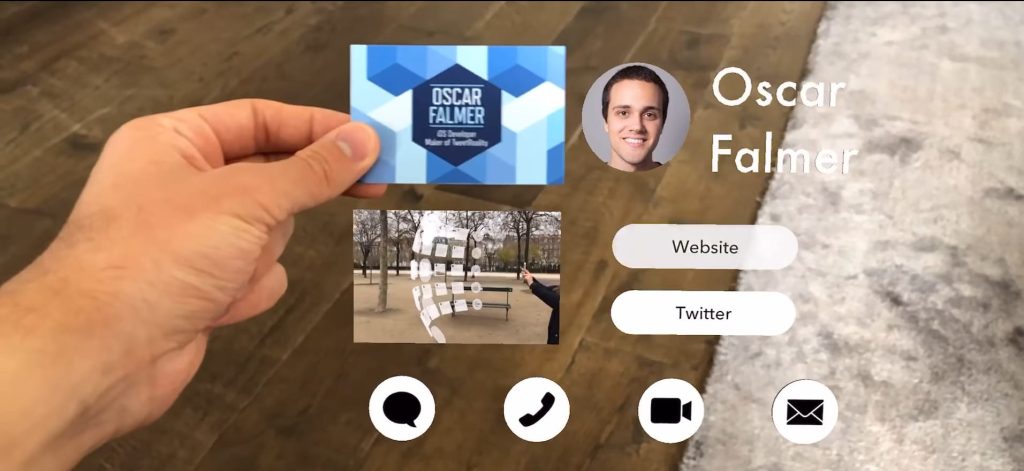
    ar business card example

    Some of the advantages of an AR business card 

    The advantages of using an AR business card compared to a “regular” business card are limitless. By presenting an AR business card you definitely have more chances to:

    • increase engagement: it is known that printed products that have implemented the AR element create more engagement and more curiosity to the people who are seeing it for the first time (increasing the chances to see it for a second, third and fourth time…);
    • show that you keep up with modern times: we all know that business cards will always be important in the business/marketing field, but showing that you have been able to give them a new updated and technological life will definitely give you an aura of modernity and originality that it will be impossible not to consider in the working field;
    • increase ROI: whether your AR business card will help you get that job or not, it will for sure contribute to generate clicks and interactions on your website and portals, helping you achieving higher numbers in terms of engagement, clicks and visits;
    • be more respectful with the environment: yes, business cards are made in paper and so are AR business cards, but thanks to the AR technology, a single business card can contain a large amount of information otherwise impossible to enclose in a little piece of paper. This means less use of paper and more information given at the same time. 

    Endless possibilities to stand out with an AR business card

    Through your AR business card, you can show more about yourself and your work. For instance, you can add your social pages in it, so that with only one click others can see immediately your profile pages and immediately have a “virtual” perception of you. Same with your website and/or your email address and phone number. 

    Moreover, you could also show an original video presentation, where you present your work, your vision and a bit about yourself, or if you feel like it, you could also create an avatar of you that explains your work for you as soon as people click on it. 

    You can create animations, put links to your works and socials, add images, videos and even games if you want to add a major sense of amusement.

    ar business cards

    The technology behind the AR business card

    In order to create an AR business card, Augmented Reality technology uses marker-based recognition, that means that you need a marker to activate the augmentation. By scanning the image marker with your smartphone, you will activate the experience and start seeing your augmented business card in a way you couldn’t believe possible. 

    The marker you need in order to activate the augmentation can basically be activated in two different modes. There is the easier one, which is by using Web based AR: in this case, you only need to implement an 2D image marker, which usually is a QR code on your card and by scanning the QR code and clicking the link given, the magic will appear. 

    Otherwise, there are AR business cards that can be activated using a mobile app. This can appear a little more tricky and, even though the “wow effect” will totally be worth the downloading, lazier people can find the use of additional apps more difficult and this could generate the hated proposition “I will look at it later” that we must avoid at all costs.

    Now see the magic happens

    Our platform AR-media allows you to create impressive AR business cards, able to stand out among all the others. With simple steps you can bring your business card to another level, doing something more original and worth-remembering.

    Here’s a quick tutorial on how to start creating an experience with AR-media. Start creating your own AR business card.

  • WebAR: the benefits of AR without using an app

    WebAR: the benefits of AR without using an app

    If you are among those who’s asking how far WebAR has come in the development of experiences, like we are, and want to know more about its r-evolution, then you’ve landed in the right place (plus, we have a demo for you at the end of the page).

    What is web ar?

    “Augmented Reality is the enrichment of the perception of the context around us with digital data, created by technologies that allow the overlay of contents seen as part of the environment in which the subject finds itself”. In order to make this concept true, we usually need to download a specific app on our device and see the magic happen. WebAR breaks off from the tied-in-a-app definition, bringing Augmented Reality on the internet browser, freeing developers from the management of the apps and stores and allowing users to have access more easily and more rapidly to immersive experiences. 

    The r-evolution of WebAR happens exactly when the virtual object needs to be put into the environment: no special software or app is needed, only a smartphone or tablet and its camera, and an internet connection of course. Indeed, in order to have a positive result, the camera of the device plays the most important role. The information about the environment is detected by the phone camera, and through it the environment is scanned and analyzed and data is transferred from the camera to the Web environment.

    Web AR

    The features of Web AR basically remain the same as application-based ones:

    • Image tracking: by scanning a specific 2D image with the camera of your device (such as flyers, pictures, artworks and books), the Augmented Reality object will appear in your device (whether can be a video, a 3D model, another picture, an animation..), allowing you to live a deeper experience of that 2D image and giving you a more complete and more sensorial involvement;
    • Marker tracking: basically the same as the image tracking but the scanning process takes place with a specific object or defined symbols, rather than 2D images;
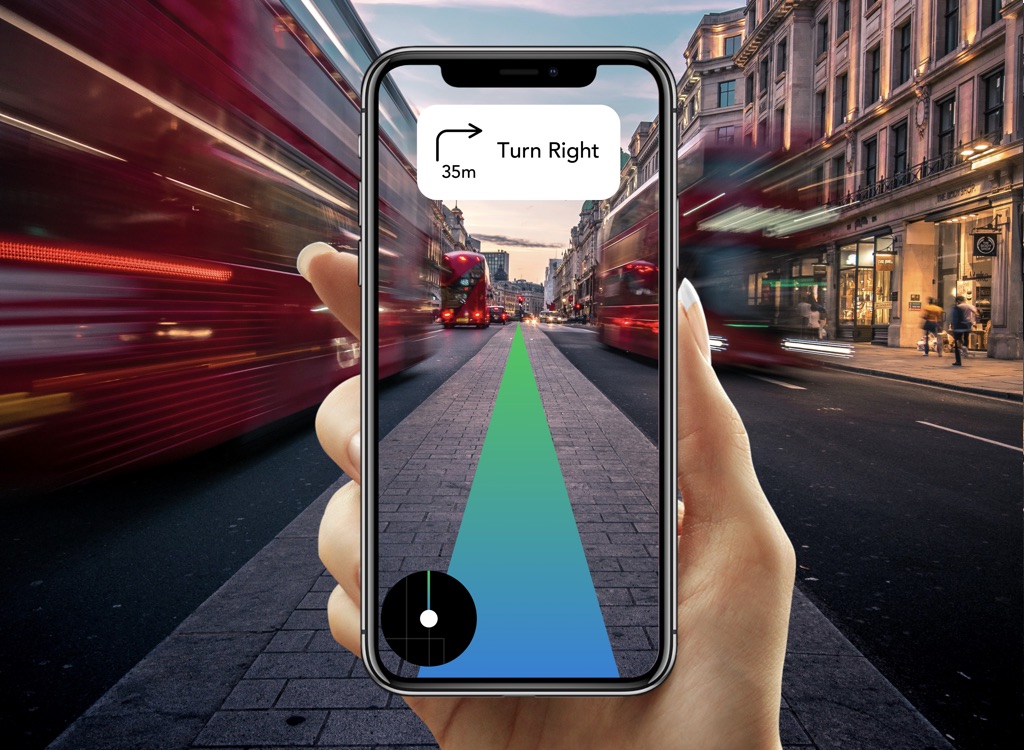
    • Location based AR: for instance virtual tours and maps support. Users, while moving freely in the environment, can have access to adding info about the place where they are, receiving help in finding certain places or knowing more about a specific monument or city.

    It is necessary to remember, though, that even though Web AR does not require special apps, sometimes it might require specific adjustments in terms of softwares and tools in the devices, such as ARkit for iOS and ARCore for Android. Generally, WebAR nowadays is available for all the latest smartphone devices above iOS 11. Ergo, Web AR might still have some weaknesses that need to be improved and/or revised, and the battle between Web AR and app AR is still far from declaring a winner. Let’s see more specifically what are the main differences between them and what are their hardest limitations. 
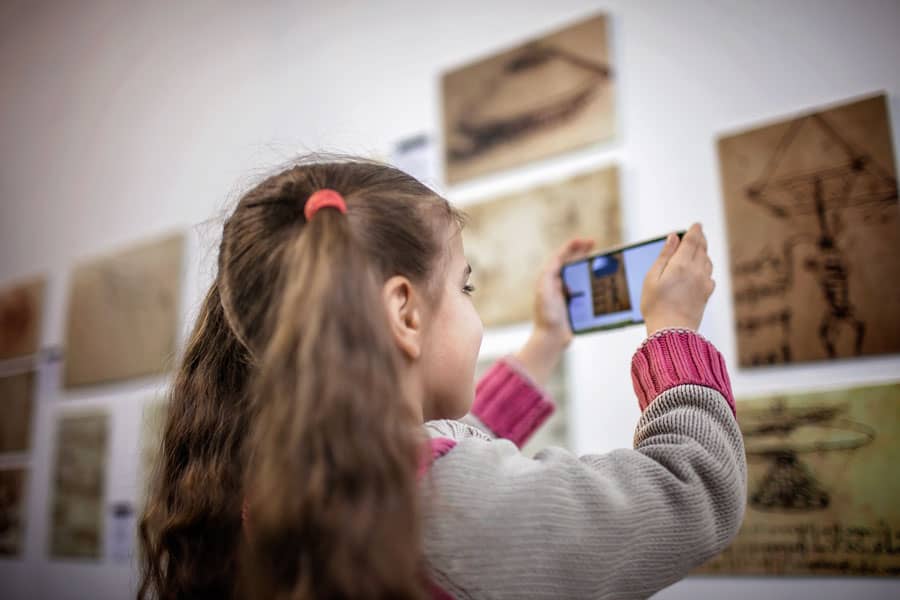
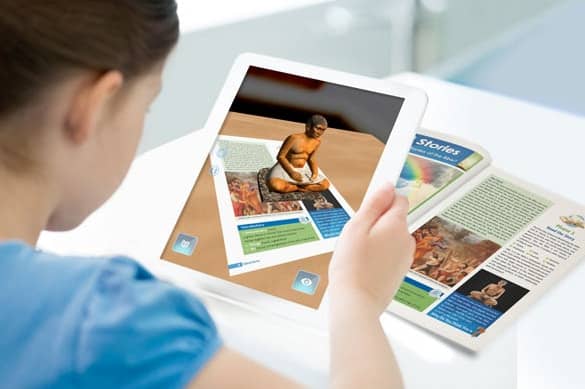
    web ar revolution

    Web AR VS App-based AR: differences and limits

    Why WebAR is the r-evolution we were all waiting for

    • Well, as mentioned above, the first and most relevant difference between Application-based AR and Web AR is the “place” where they are released: application-based AR is only available using an app whether Web AR is accessible online without downloading other apps. The web aspect makes the whole access process way easier since you only need a URL link, a QR code or an NFC tag in order to live the experience. 
    • There are many advantages especially for developers. In fact, WebAR is able to significantly reduce time and cost of an app-based experience. First of all you don’t need app store providers’ validation, hence the market process is a lot quicker; you can give support and fix bugs immediately; you can release all the updates that you want potentially in no time. 
    • Why Web AR seems to become a revolution is for a simple, yet crucial reason: people like immediacy. Researchers have shown that when people need to download in order to use an experience, 50% of them are more keen to drop off and refuse to try the experience than to “waste” time on downloading an app that they will probably use just once. Hence the immediacy of the Web AR is undoubtedly its biggest asset. 

    Immediacy, easiness and ready-to-usability are central aspects in the innovation of Web AR that cannot be undervalued from agencies and companies whose aim is to compel the client through new innovative ways. For agencies, Web AR might definitely represent a new level of marketing and appeal to new followers and clients, giving to the users a brand new type of client experience.

    smartphone WebAR r-evolution

    But there are still weaknesses in the development of the experiences

    • Being WebAR browser-based, it might happen to go towards a low performance. In terms of information transferring, WebAR spends more time and memory to transfer the digital object because of its lack of the resources that otherwise are present in the app-based and this can mean a lower quality of the digital object both in terms of image and animation. In order to live a better experience, the best solution would be the creation of “simpler” experiences, with less interactions
    • Having good internet connection is the number one requirement in order not to occur in low-quality experiences or impossible-to-see experiences, that is why Wi-fi is preferable. App based AR can give you the ability to download the experiences in advance and use them at any time, even in the absence of an internet connection.
    • Another restriction of the WebAR is the limited battery capability. Using applications, indeed, smartphones and other devices usually last longer because the app uses the functionalities already present in the device, whereas, in Web AR, browsers need access to the camera sensors, analysis and other resources and this can significantly reduce the last of the battery.
    AR-media no coding Augmented Reality platform

    However, predictions about the future of the Web AR are more than positive that is why we talk about a r-evolution. Just think about three or four years ago and how long AR and Web AR have gone up to now. Of course there are features to optimize, tools to fix and aspects to refine, but as for other technologies that have been changing and improving with time, there is no doubt that the development of the Web AR and its experiences will follow the same destiny. 

    Anyway, we know you can’t wait to try our Web AR. So if you want to have a taste, wait no longer and try it now by scanning the QR code or by clicking below.

    qr code WebAR
  • How AR artists can bring art to a new level

    How AR artists can bring art to a new level

    Using AR, artists can bring art to a new level. We all know that every time a new technology or a new tool takes life in our world, the artists are among the first ones to try it, experiment it and eventually make it more commercial. The truth is that they can actually be the pioneers of a new way of seeing life, with their vision of combining creativity and technology and sometimes they really do their part in changing things and make the world a little brighter. This is the case of Augmented Reality.

    Why use AR in art

    According to some of the artists that are using it, Augmented Reality (AR) can bring the art world to a new level. They could have the chance to express themselves in ways they couldn’t believe possible and most of all, every piece of art can become a new different kind of experience. 

    An AR artwork can appear more immersive, adding more value to the experience of the public. Art is creating emotions, feelings, deep thoughts on the person who is looking; art is sharing terrifying secrets and revolutions while creating beauty. Augmented Reality can enhance all that, not only for Art Galleries and Museums, but also for Freelance Artists.

    AR artists in the art scene

    Numerous artists are now involving in their works the AR component as means to create more immersive experiences and generate stronger emotions. Here are the ones who impressed us more. 

    The company Adrien M and Claire B

    The company Adrien M and Claire B is a french artist company that combines digital and living arts, creating unique performances full of beauty and poetry. Using technological tools to enhance their living art performances, they “transcend the spatial boundaries of stage and the time limits of performance, […] creating an art of movement to set the human body in resonance with graphic and digital arts. The result is a poetic visual language blending imaginary, real and virtual dimensions while bearing unlimited opportunities for artistic exploration.” With ‘Acqua Alta – crossing the mirror’, the company created an immersive AR experience where “ink drawings and white folded paper come together to reveal the virtual life of dancing miniature beings and their dive into the imaginary realms of water”. 

    AR artists Acqua Alta - crossing the mirror

    Esoulito

    Esoulito is a brazilian artist based in Sao Paulo, who combines Augmented Reality with street art and murals, creating a brand new way of making street art. You can have access to all his works on his IG profile or have a look at his website, where it is possible to admire most of his works and collection and eventually buy them. He creates old classic portraits like the Birth of Venus or ancient statues modified in street art. To all that, he adds the AR element, to make them move, live, and send further messages. Our favorite is definitely the AR Monnalisa in street art! 

    Sianfan

    Another AR and VR artist that is worth mentioning is Sianfan. The peculiarity of Sianfan is her ability to merge the digital world with nature and with her own body, creating beautiful experiences full of poetry and intensity. In her work “Partial Bodies”, she presented a meditation between the natural and the virtual world and their relationship, analyzing the female body and nature in a digital environment. Her work can be described as “undeniably digital, yet innately organic, the entangled bodies present fragmented forms that reflect the uneasy relationship between the natural and the virtual.”

    AR artists_Sianfan Partial bodies

    Marc o matic

    If you love steampunk style and technology, you cannot but love Marc o Matic. He is famous for merging traditional art and technical animation and immersive tech, with a retro steampunk style all in it. Using mobile devices, viewers are able to see the work of art in a much deeper way. When hovering your phone over an artwork, the AR element brings the artwork to life through animation and sound, revealing more detail to the story behind the work. Needless to say, the result is simply amazing! He defines himself a “creative technologist”, indeed, he also creates virtual reality art works and 2D and 3D animations. 

    AR artists Marc o metic

    Creating art with AR-media

    Basically all the artists mentioned above need to use an app in order to make the viewer see the AR element in their works. For instance, to give life to your works, you can use AR-media. With AR-media you can design, implement and share your creations without coding, creating all the immersive experiences you want and taking art to a new level. 

    It doesn’t matter if you, as an AR Artist, want to create immersive content associated to a painting or a graffiti, or if you want to visualize a 3D model in the environment. AR-media lets you create both Planar and Spatial Augmented Reality experiences.

    Using Augmented Reality in the art field can be a new and innovative way to take art to a new level. AR artists can enhance and grow their already existing artworks, but also experiment to create brand new ones, allowing them to express themselves in ways they couldn’t imagine being possible. They now have the potential to unlock new forms of storytelling and self-expression, bringing the viewers to live deeper experiences and thus enhance feelings in the spectators. What are you waiting for?

  • 2022: the rise or the fall of NFTs?

    2022: the rise or the fall of NFTs?

    In the past year, NFTs became one of the most talked-about topics in the crypto-world, marking their biggest rise since their creation in 2014. So, if 2021 marked an incredible increase of NFT, what can we expect from NFTs in 2022? Will 2022 be the rise or the fall of NFTs?

    Well, before making any predictions about the future, let us take a step back and analise what we are really talking about. What is an NFT? 

    What is an NFT?

    Before discovering wether 2022 will be the rise or the fall of NFTs, let’s start understanding what they really are. NFT is the acronym of “Non-fungible-token”. It is “fungible” anything that can be exchanged or replaced with something identical, whereas “non-fungible” is everything that cannot be replaced, something unique. For example, it is possible to change/exchange any kind of banknote, that means that it is “fungible”, but it is impossible to change an NFT with another since it is not interchangeable. Each NFT has unique properties and is not worth the same amount as another one.

    The biggest characteristic of the NFT is its “digital exclusive”, in the sense that an NFT can only be anything digital: a drawing, music, game-item, a video… everything that can be put in the digital world (so basically everything) and that can be traded with cryptocurrency (the most used in this field is Ethereum, but there are many more). Anyone has probably heard about the NFT of the first tweet in history, created by the Founder of Twitter Jack Dorsey, sold for over $2.9 million. Curious to know more about it, now?

    Dorsey nft tweet

    Create and sell an NFT

    Non-Fungible-Tokens can be bought and sold, exactly like other cryptocurrencies, on specialised platforms. One of the biggest NFTs platforms is OpenSea. OpenSea is a marketplace specialised in the buying-and-selling of crypto currencies and digital assets. It’s based on the Ethereum Blockchain (one of the most known cryptocurrency at the moment after BitCoin). The reason why OpenSea is gaining popularity day by day is its extreme simplicity. In fact, it is very intuitive and easy to use. All you have to do is create an account on the platform, connect an Ethereum wallet and upload the digital contents you want to sell. 

    open sea website

    How NFTs can change the art market 

    Needless to say, the art market, above all the others, is the one that, maybe, compose the biggest part of the NFTs, indeed, one of the most appreciated aspects of the NFTs is exactly its use for the digital art market. Until now, digital artists have always struggled with the economic and recognition part of their work since this idea of “an easy-to-replicate” kind of art and therefore the tendency of being less considered. With the “non-fungible” aspect, NFTs can totally reverse this factor and digital art creations, making every NFT unique. In this way, finally, the digital art world might have the recognition it deserves and be “treated” exactly like any other tangible artistic work. Apparently, the rise of the NFT in the art field is due not only to the possibility of seeing your artwork recognised, but also to the possible and appealing amount of money that an artist could do with its art, because of the tendency of taking as example some of the “ones who made it”, for example the Digital artist Beeple who sold “Everydays — the First 5000 Days” for $69.3 million or the famous CryptoPunk NFT sold for $1.8 million. 

    NFTs monkey

    NFTs are not just related to art…

    It must be said that Non-fungible-tokens are not only applicable in the Art area. As said, everything that can be digital can be transformed into an NFT, thus, you can now have access to certain events only by buying a special NFT ticket. The ultimate news makes it known to the world that in 2023 we will also be able to see the first NFT Restaurant directly from New York, where, by owning a Restaurant NFT you will somehow receive a membership that allows you to enter and hopefully dine in the Restaurant. 

    nft restaurant

    AR NFTs, the new frontier 

    2021 was the year of NFTs. Well, they actually existed since 2014, but this past year they experienced a real massive explosion and, whether you are an expert in the subject or not,  you have probably heard this word at least once by now. 

    Thus, for 2022, the NFT world is beginning to speak about AR NFTs (Augmented Reality Non-Fungible-Tokens) as the new frontier of the NFTs. For the first time, NFTs which have always been restricted in the bidimensional world, could now have access to the three dimensional world. In other words, including the AR element in the creation of an NFT you add the ability to visualise it in your physical surroundings by using a specific app or a website. 

    Moreover, the use of AR NFTs could add the “scarcity aspect” even more. Indeed, especially for the tourism sector, it could be interesting adding some AR content only available with NFTs, such as a particular AR guide in a museum, 3D access to exclusive parts of the gallery or even the chance to see a work of art such as a paint or a sculpture in a deeper and more accurate way. 

    As we have seen so far, creating an NFT is quite simple and intuitive (especially using well known platforms). What could seem a little bit more challenging is creating an AR NFT, since it might require the addition of tools and platforms that allow the visualisation in the environment. The biggest advantage, though, is exactly this one: in a world where NFTs are created with an extreme simplicity, having the possibility to create a different work could make the creator stand out among the others, creating immersive and outstanding experiences.

    ar nfts art

    Why NFTs could fall 

    According to a large part of the web, though, Non-Fungible-Tokens are going towards a slow fall, especially due to the several damages that they might be responsible for. Thus, it would be irresponsible to not mention the risks and disadvantages that occur in selling and buying NFTs. 

    Owning an NFT does not mean you can use it

    The first incomprehension that seems to appear all the time is actually around the very definition of NFTs. Indeed, buying and “owning” a specific NFT does not mean being able to do everything you want with it, like copy it or using it for other purposes. You just own it. That might generate concerning thoughts about the very reason why you should buy an NFT in the first place, if basically it might be something that can be seen/listened/viewed anytime from any screen. 

    “Different” points of view about NFT art really is

    Another concerning aspect of NFTs involves the art market. Apparently, the large amount of “artistic creations” in the NFT world may actually damage the NFT art market, because of the speculative aims that non-artists can have. That is why considering art something like code-made lions or monkeys for many users can appear difficult and people start asking if creations that do not seem very “artistic” (maybe because of a lack of emotions, soul and passion put into the creation of them) might not be worth buying and therefore create mistrust.

    The risk of getting scammed

    Despite its large popularity, NFTs world does not have legal guarantees yet that protect buyers and sellers, thus the chance of being scammed seem to be quite high. The buyer can never really know if the NFT bought refers to something created by the seller or if it is something taken from other parts. Something even worse could occur, like selling NFTs that are not even present in the digital world. 

    The negative impact on the environment

    Another aspect that needs to be discussed is the environmental one. The super strong computers that generate NFTs consume an enormous amount of energy. These computers need very high capacity in order to work with the Ethereum Blockchain and guarantee proof-of-work (sort of security system that oversees transactions in the cryptocurrency world). In fact, when selling and buying an NFT, there is the so-called “gas fee” which is exactly a fee that needs to be paid for having used a large amount of energy. There are websites, such as cryptoart.wtf where it is possible to see the amount of emission that NFTs are making. According to cryptoart, the footprint of the NFT Space Cat seems to be not so far from the electricity usage for two months of an EU citizen. 

    NFT environment

    At the end, it is quite impossibile to declare wether 2022 will be the rise or the fall of NFTs. What we can say is that despite all the risks and the disadvantages of selling/buying NFTs, it must be said that the predictions are quite positive. Apparently, the NFT market is going to change, improve and surely become bigger. There are already movements towards an NFT market greener replacing proof-of-work with proof-of-stake. According to the crypto experts, something about the safety of buying/selling NFTs will be made soon. About NFTs creators, instead, it appears that  Augmented Reality will play a very significant role in the renewal of the 2022NFTs.

  • Art Galleries meet Augmented Reality

    Art Galleries meet Augmented Reality

    Art galleries with Augmented Reality are changing considerably, moving more and more towards the world of digitalisation, promoting a new contemporary way of experiencing and looking at art.??

    Art galleries are making room for the world of optical illusion and 360-degree augmented reality, experimenting with new ways of making and communicating art. AR adds new elements to the real world of art galleries and is a simpler and more mature technology because it manages not to distort the history and elements of that place, but instead adds more engaging ways of enjoying it and spreading its beauty.

    art galleries with augmented reality

    New technologies, such as AR, have strengthened the relationship between artists and viewers, improving their ability to understand and evaluate the work of art despite the increase in distances and the relative division caused by the physical detachment that has affected this historical interval. This is precisely where Augmented Reality is making its appearance, a digital technology that is increasingly being used in the art world not only to provide the audience with new experiences, but also to find new ways of bringing art to the public, becoming more immersive and improving the experience inside galleries.?

    Augmented reality for art

    If until now we thought of Augmented Reality as a tool used only and exclusively in the world of games, today it is increasingly expanding its horizons by positively affecting the world of art, adding elements of entertainment and surprise, thus increasing visitors? engagement. AR offers the possibility of living original and highly personalized experiences. 

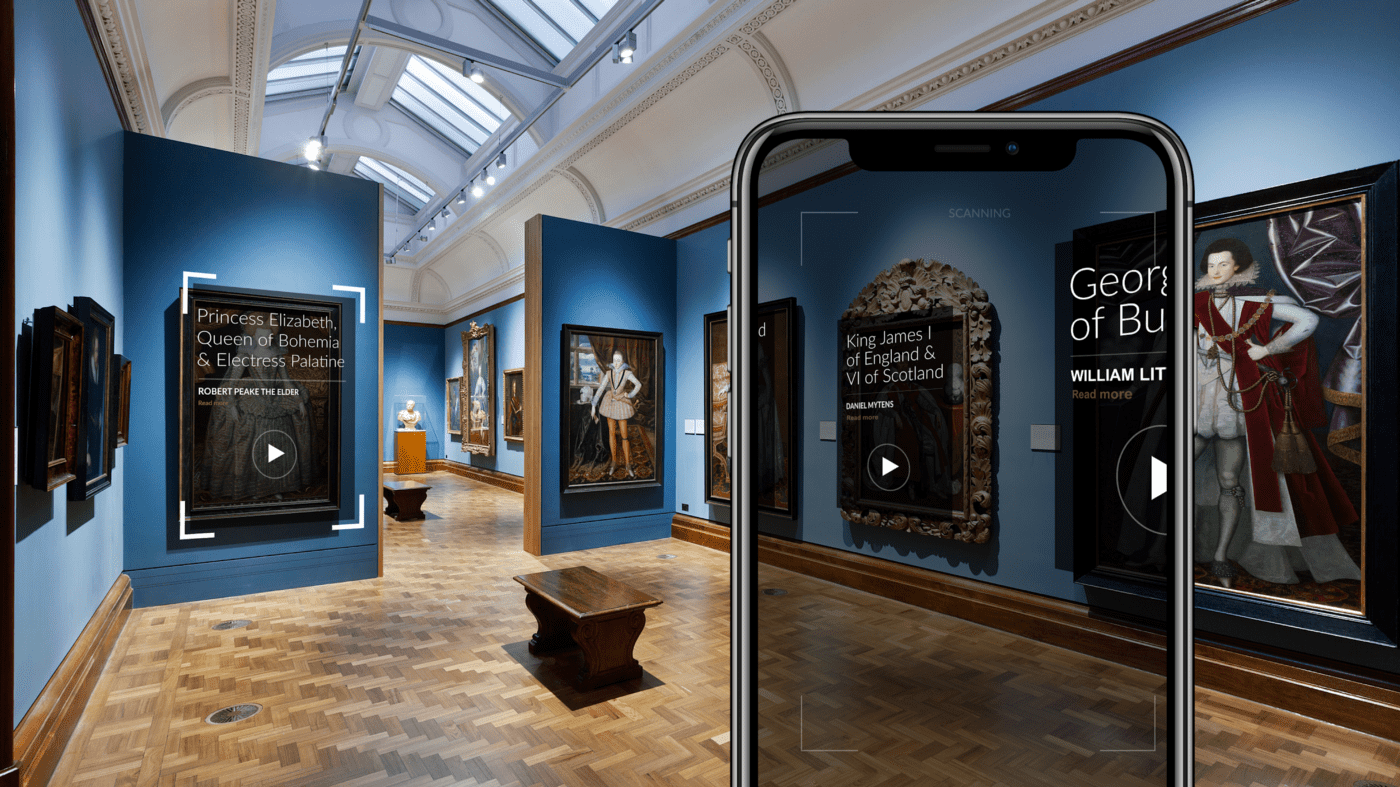
    Through the use of electronic devices, such as smartphones, tablets and wearables, it is possible for visitors to see, in addition to physical artworks, additional virtual artworks in the surrounding space of the art galleries and museums. Such pieces of art can be visualized in their real size, can be moved and manipulated freely (zooming, rotating, etc?). Augmented reality is destined to be increasingly exploited in the art world, not only as an alternative to a physical exhibition, but also in support of it.

    Ar in paintings

    By the end of 2022, according to Gartner’s The Future of Immersive Experiences research, 70% of art galleries will have experimented with immersive technologies to make the visitor experience unique.?

    Augmented reality painting

    With AR, even paintings come to life, acquiring three-dimensionality, becoming interactive with the user?s touch, transforming and moving, finally developing new surprises for the viewer with unseen and engaging virtual visual effects. Digital technology is opening up a new dimension of art and new ways of enjoying it, bringing the secrets of artistic language closer to an increasingly wide audience. Touching works of art, an action that is definitely not permitted in museums, has become the dominant experience of viewing paintings. It is indeed very common to find displays of varying sizes in museums and art galleries, however they often provide a very limited interactivity, that is also physically disconnected from the artwork itself.

    art galleries with augmented reality

    AR glasses allow several works to be viewed at the same time and to move them freely through space. The use of AR in art galleries brings numerous advantages both in setting up an exhibition and in a museum, let?s explore the most relevant ones.

    Create art galleries with augmented reality: what are the advantages?

    The advantages, in addition to return on investment (ROI), are many: augmented reality allows younger generations such as Millennials & Generation Z to be involved, and offers the possibility of retargeting operations, that is, personalized ads that intercept users based on their online behavior, as well as the attention of the public, conveying a sense of freshness and innovation and thus increasing perceived value.

    https://www.inglobetechnologies.com/ar-media/

    A cultural visit that is different, alternative and/or complementary to the traditional one, allowing the user to live a totally immersive experience and the art gallery to increase profits and earnings. 

    art galleries with augmented reality

    In addition, augmented reality allows for greater usability by reaching geographically dispersed audiences. It is an ideal tool where there is no possibility to visit a live art gallery. 

    All these different advantages allow the art gallery to attract an increasingly diverse audience, thus increasing engagement and interaction. Augmented reality is coming to generate a hybrid of dream and creation. An artist can decide to let us enter directly into his mind, into the way he perceives the world, involving us at 360 degrees. 

    Examples of art exhibitions in augmented reality:

    Augmented reality in the form of multimedia storytelling is becoming increasingly popular. Art galleries are offering visitors special glasses or inviting them to download an app on their smartphones that allows them to see additional virtual content such as images, videos, 3D models and listen to audio files in real time while simultaneously observing what they see. 

    – In Italy, more precisely in Palermo. 30 young creatives, including artists, designers, architects and graphic designers, during a Public Imagination Workshop “Call for (AR)tist”, hosted by Palermo’s Gallery of Modern Art, adopted 20 works of street art scattered throughout Palermo’s historic center and based on them created new digital animations usable in augmented reality.

    paintings

    – The initiative launched by the Art Gallery of Ontario was also very successful. The Toronto gallery used digital technology to animate the paintings in its rooms. Thanks to the support of their electronic devices, visitors were able to interact directly with the subjects depicted in the paintings. For each painting, there was not only an explanation, but also a character who came to life telling stories to the visitors.

    paintings

    – Lisson Gallery, with exhibition spaces in London, New York and Shanghai, has launched an augmented reality app that allows you to view the works inside your home, an online exhibition by artist Rodney Graham. The effect of augmented reality comes close to the real thing and can be viewed and edited.

    
paintings

    – The Looking Glass aims to transform some outdoor spaces into a large open-air museum, to be explored with your smartphone. To admire the works of art, all you have to do is download the appropriate app and place the device in front of the various QR codes scattered around the city. Once the simple operation has been completed, the seventeen works of art by KAWS, Olafur Eliasson, Tom?s Saraceno and the winner of the Frieze Artist Award 2021, Precious Okoyomon, will magically appear in the urban space. A myriad of impalpable and ephemeral “sculptures” to be visualized thanks to technology.

    art
  • AR in Educational Books: how to use it?

    AR in Educational Books: how to use it?

    Augmented Reality in education is considered today as an indispensable tool of the whole educational system, from the primary school to university. 

    The use of Augmented Reality in education allows the transition from the so-called “teaching-listening” to an active and participative method of study, in which children, class and teachers are involved in the learning process. They are no longer just observers, but protagonists. We talk about ‘augmented learning‘, which aims to stimulate students’ creative and communicative abilities. 

    Augmented reality applied to education actively involves students of all ages, giving them real learning experiences that improve their understanding of what they are studying and that foster interaction with the content, thus improving not only learning but also the level of attention, thanks to the effect of surprise and wonder. 

    AR in education is also an inclusive tool that allows teachers to integrate communication and to simplify it: from primary schools to higher education or university, extended realities can help teachers to explain complex concepts and visualise physical objects that are difficult to understand presented by the flattened and unrealistic images of books; thus allowing to study all subjects in an engaging way: from biology to art, from physics to chemistry up to computer science and languages.  

    Interactive content with Augmented Reality in Educational Books

    Is it really essential to make use of Augmented Reality in school books and teaching materials? The answer is yes. Numerous studies on the brain provide evidence that the best way to learn and therefore remember what you are studying for longer is to “do”. Studies have shown that, after two weeks, students remember only 10% of what they have read, but as much as 90% of what they have actively done. 

    Augmented Reality in education

    Augmented reality makes the learning experience immersive and therefore exciting, the more the material to be learned is linked to emotions the longer the memory retention will be, because it is designed to be relevant to the brain.

    What are the benefits of Augmented Reality for Education in school books?

    – Making connections and stimulating curiosity: augmented reality (AR) allows students and teachers to superimpose information, images and other content onto real-world scenes. This creates new contexts and effective connections that enhance learning and promote understanding. Teachers can use augmented reality apps in the classroom to turn it into a planetarium, making a science lesson more relevant;

    – Stimulate engagement through realistic explorations in motion; visualise and experiment during science or physics lessons; 

    Augmented Reality in educational books

    – Delving into hidden levels and systems based not only on theory but also on pratice part to become more familiar with the teaching material by allowing students to move and explore;

    – Enriching existing programmes with extra content in the form of video, audio, animation and immersive storytelling;

    – Carrying out large-scale projects and proposing challenges, the student will also stimulate problem solving skills and teamwork through the use of AR.

    New Ideas for STEM Subjects Lessons 

    You can imagine how many things can be done during STEM (science, technology, engineering and mathematics) lessons from the primary school to the university. During math lessons students can move between 3D shapes and graphs.

    In science classes, students can see the life cycle of an animal they are studying, study a live specimen in AR and explore its organs, systems and vocabulary as if they were looking at the animal in the flesh. 

    AR is used for learning during physics lessons, allowing students to experiment with atomic nuclei and the reactions in which they are involved. 

    STEM educational content with AR

    Use cases of Augmented Reality in education

    We have analysed some use cases where we believe augmented reality can have a strong impact on school books.

    Use case 1: Getting in touch with the studied content

    A software platform was designed to let students immerse themselves in the ecosystem of a river and explore how water interacts with animals, plants and human habitats. They could also discover what happens when the balance is altered. The learners came into contact with animals, discovered rivers, dams and ecosystems in other parts of the world. 

    Case study 2: The development of an educational video game.

    A video game platform was developed to engage its students and assign them ‘alternative’ tasks.

    By modifying even just the form of classic mathematical problems and inserting invented characters or simple stories, the students worked more enthusiastically and with better results. To find out how the story ended and what happened to the main characters, students had to solve the maths and physics problems they encounter each time. 

    Kid reading an education book with AR

    The Liquid Book. Updating existing materials with AR.

    In the effort of offering up to date and fresh educational content, most publishers release annual updates of their books and student, in turn, have to buy them even if they owned an older edition of the very same title. This need of continuously updating educational books may not be percieved positively from families that can’t pass the books of their first born to their second child.

    AR actually offers a solution to this problem by providing the updates, and even selling them, through a mobile app, in association with the book. Publishers can monetise on the updates only, without needing to produce a new edition altogether (with all its relevant costs) and the book enjoys an extended lifespan.

    No longer an enemy to fight, the second hand market becomes in fact an indirect ally for the circulation of the “cornerstone-book” upon which to build a new way of enjoying contents (with even vertical integration opportunities). Families attain significant savings. Think of a case where, instead of 50 euro for a brand new book, one can pay 25 euro for its second hand version plus 7 euro for the relevant updates: savings in the region of 35/40% are not unreasonable to imagine.

    Augmented Reality in education

    This hypothesis of “liquid book” would then resolve the false trade-off between publishers’ profits and unwarranted costs out the families’ pockets, while allowing a plunge in the digital era without leaving the reassuring presence of the physical book.

    But there is more. Employing augmented reality would open endless possibilities in terms of innovative contents, as well as offer a helpful tool for students with special needs – all stemming from the very same cornerstone: the good old schoolbook.

    Finally, there is a significant environment-related consideration to make: not only would the liquid book model reduce the waste of quickly dismissed books, but also the Co2 emissions linked to the production and distribution of the final product.

    A win for all, then? Well, not really, as it would appear. In the depicted scenario, the actual manufacturers of the books, that is, the printing companies, seem to be the ones losing out.

    Not so fast, though. This proposal does not threaten the book: it saves it.

    The most likely alternative scenario, in fact, is not the indefinite conservation of the status quo – clearly unrealistic – but a radical online shift instead: augmented reality can give paper a new life.

    In a such re-designed value chain, printing companies should in fact consider to include augmented reality within their products’ portfolio: by using ad-hoc platforms they can do so without developing in-house technical competences – hence without shifting their focus away from their core business – thus innovate in a planned and strategic manner, not in a panicky response to a sudden threat.

  • AR & VR for education helps students to learn more and better

    AR & VR for education helps students to learn more and better

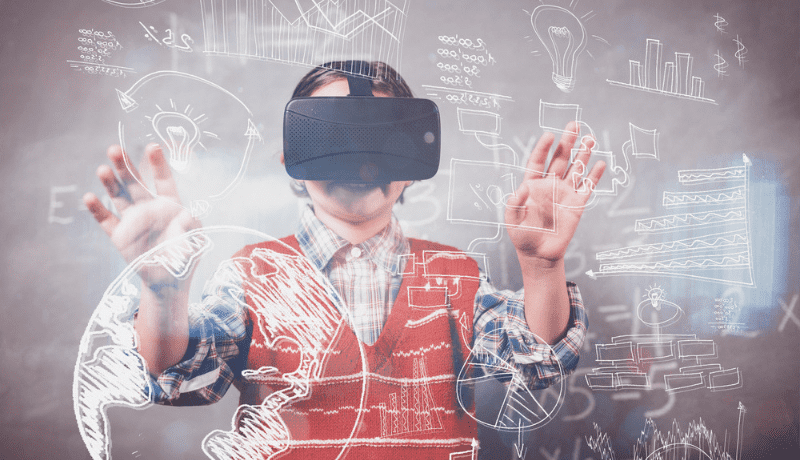
    Learning through AR & VR technologies can be a very effective educational methodology, able to engage the students and make content more attractive to them. The entire process can become more interactive and fun. In the field of education and training there are application tools that can help to improve the teaching-learning process by making it more connected with the surrounding environment; learning can become a more collaborative journey through the creation of interactive spaces that can encourage greater student involvement. 

    Through augmented reality, teachers can engage students by capturing their attention, making them have a great time: they will be able to remember the proposed topics more easily, even the most difficult ones will be more understandable. We believe that AR & VR for learning can become an essential component of the educational process, helping schools and teachers  to meet the needs and habits of the new generations.

    AR & VR for education help students to learn more and better

    For those who have kids in school age, the last couple of months have been quite a revelation.
    Used to kiss them goodbye in the morning and see them again only many hours later, whatever happened all day long inside the classroom was largely a guessing game, with the sole prop of clues that were either sporadic (the interaction with the teachers) or outright poor (the recounts of the usually reticent pupils).

    But when suddenly home-schooling became the new normal, it was as if the fourth wall collapsed, allowing us to take a glimpse at what happens routinely behind the scenes.
    A somewhat displacing experience, the one thing it did was giving us a better understanding of both the benefits and the limitations of digital and traditional means to deliver education.

    There is no doubt that a physical interaction with teachers and peers is crucial, not only for learning purposes, but also for a healthy social development; on the other hand, the increased adoption of communication technologies that are already part of the youngsters’ lives plays a role in engaging them more and better in the learning process.

    As such, we suddenly found ourselves at a crossroads where we must solve the dilemma and obtain the best of both worlds: by blending real world and digitally constructed contents, immersive technologies can be the answer.
    Let’s be clear about this: the pandemic did not raise the question from nowhere; it simply put it right at the top of the agenda. The case for mixed reality was already there well before the outbreak, and it rests on a set of reasons that we can schematically summarise as follows.

    The Benefits of Augmented Reality for Education

    Improve students’ engagement

    This is arguably the most powerful driver, as the interactive nature of  AR & VR for learning helps raise attention’s levels on any subject.
    Think about a maths lesson where pupils learn proportions by designing a building and then seeing it digitally erected: if their calculations are wrong, the result will be evidently disastrous! Not only that, but they will be extra-motivated to understand the theory better in order to improve the outcome. In addition, AR &VR enable students to study and learn more effectively, without distractions, they can improve their understanding of topics and have a better information retention over time.

    AR & VR for education help students to learn more and better

    Increase knowledge retention

    Research on the topic is extensive and unequivocal: by pulling contents through their own discovery, users recollect more memories – and more vividly – than they do when they are at the receiving end of a “passive” teaching approach.

    Augmented Reality is the perfect vehicle at this respect: one thing is to learn chemistry on a book; a totally different experience is to so by conducting experiments virtually, thus – by the way – without the need to equip an expensive lab.  Augmented and virtual reality are kinaesthetic learning, a system that helps students learn things better through direct practice instead of listening to lectures orally.

    Gamification of Learning with AR & VR

    How to apply the dynamics of video games to stimulate learning in schools?  

    Gamification is the use of game elements in contexts other than gaming, such as in education. Through challenges, exciting quizzes, based on the video games model, students are able to obtain a higher motivation as well as increased interest and creativity. 

    Learners will be more motivated and will eventually achieve better results. It is also motivating for teachers to be able to use innovative teaching strategies and tools in order to connect better with the new generations.

    AR & VR for education help students to learn more and better

    Seek cost-effectiveness in Education

    The “virtual lab” example has introduced the idea, but there is more to add in respect to costs saving.

    Sure, immersive technologies entail upfront investments that, especially in the case of public institutions, might initially be seen as a stumbling block.
    A couple of things however must be taken into account: first of all, applications of this kind increasingly run on hardware that is already in the students’ hands (their own mobile devices); and in the mid-run, the flexibility and the ease in updating the contents reduces the costs for designing and renewing the lessons.
    In short: while acquisition costs are decreasing, cost savings are getting more and more conspicuous.

    AR-Media included in the i-pear toolkit of educational AR & VR platforms

    The AR-Media platform has been selected to be featured on the iPear network (Inclusive Peer Learning with Augmented Reality Apps) project by the AETMA Lab of IHU University, Greece. The iPEAR project brings together the expertise of technology-enhanced learning researchers, computer scientists and educators to build a strategic partnership to optimize the adoption of Augmented Reality (AR) technology in education. The project will create innovative, accessible training resources for teachers that help implement and integrate active and collaborative learning pedagogical approaches supported by AR.

    Technological advances have influenced every aspect of our lifestyle: from communication, to the world of work, to social life. The school and educational context has also opened up to technology and digital teaching innovations to ensure that schools keep up with the times.  

    AR & VR for education help students to learn more and better

    AR-media believes in the importance of integrating education with Augmented and Virtual Reality by providing its users with diversified plans created to meet different needs. Recently we made available dedicated educations plans for Students, Teachers, Classrooms, Schools and even a custom Academy plan with more personalization options.

    We aim to offer the most competitive prices on the market, to let everyone work and study with Augmented Reality tools. AR-media for Education offers exclusive features such as the possibility to create tests and quizzes, send assignments to the Students and give them a feedback/mark and much more.

  • This Roman colony comes to life through Virtual & Augmented Reality

    This Roman colony comes to life through Virtual & Augmented Reality

    Enjoy the ancient Roman colony experience with augmented reality

    The ancient Roman colony Fregellae was an important Roman colony located on the Via Latina near the left branch of the Liri river. The city was probably founded by the Oscans and then occupied by the Volsci, before the destruction by the Samnites in 330 BC. In that year the people of Fabrateria Vetus (modern Ceccano) sought the help of Rome against the Samnites. In 328 BC a Latin colony was established near the site of the Volscian Fregellae. Not everybody knows that Fregellae faced the advance of Hannibal in 212 BC by destroying the bridge over the Liri river. During its existence Fregellae was a flourishing center in southern Lazio.

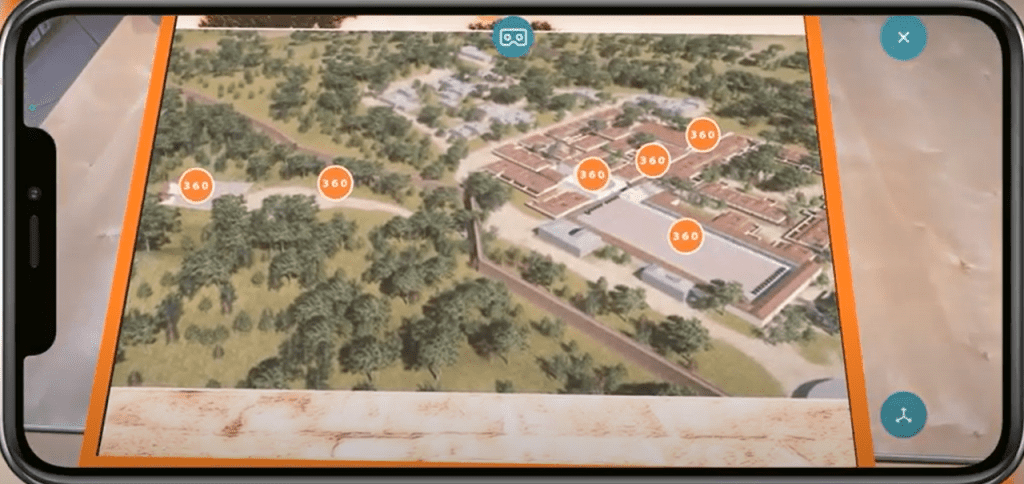
    The Fregellae experience with augmented reality offers an immersive and interactive reconstruction of the area of the archaeological excavations. It provides information about its history and meaning. Thanks to the 360° experience, users can navigate and interact with 3D reconstructions of the colony.

    Download the app and experience the ancient Roman colony with augmented reality for free

    Download the app and experience Ancient Roman colony with  augmented reality for free
    Download the app and experience Ancient Roman colony with  augmented reality for free

    Starting from a spatial visualization of the map, users can select the points of interest and enable an immersive visualization of 3D reconstructions based on the use of device sensors (gyroscope and accelerometer).

    How to experience Roman colony with augmented reality thanks to the AR-media Player app

    Created by AR-media “the Fregellae experience” is an immersive experience in the area of the archaeological excavations with the aim of innovating cultural heritage experiences through the power of emotions, opening the way to new audience segments with dynamism and interactivity to increase their involvement. Users see the life of the important Roman colony “Fregellae” flowing before their eyes through a more complete and varied view of history. They travel new roads, immerse themselves in the city’s lesser-known spaces and discover colonies, sanctuaries, underground passages and side streets.

    You can try this experience by downloading the free AR-media App for iOS or Android. Download the app and frame the QR Code using the button at the top right of the app. Click on the “save” button and then the “open” button, project the camera of your phone/tablet on the floor and begin to immerse yourself in this experience.  

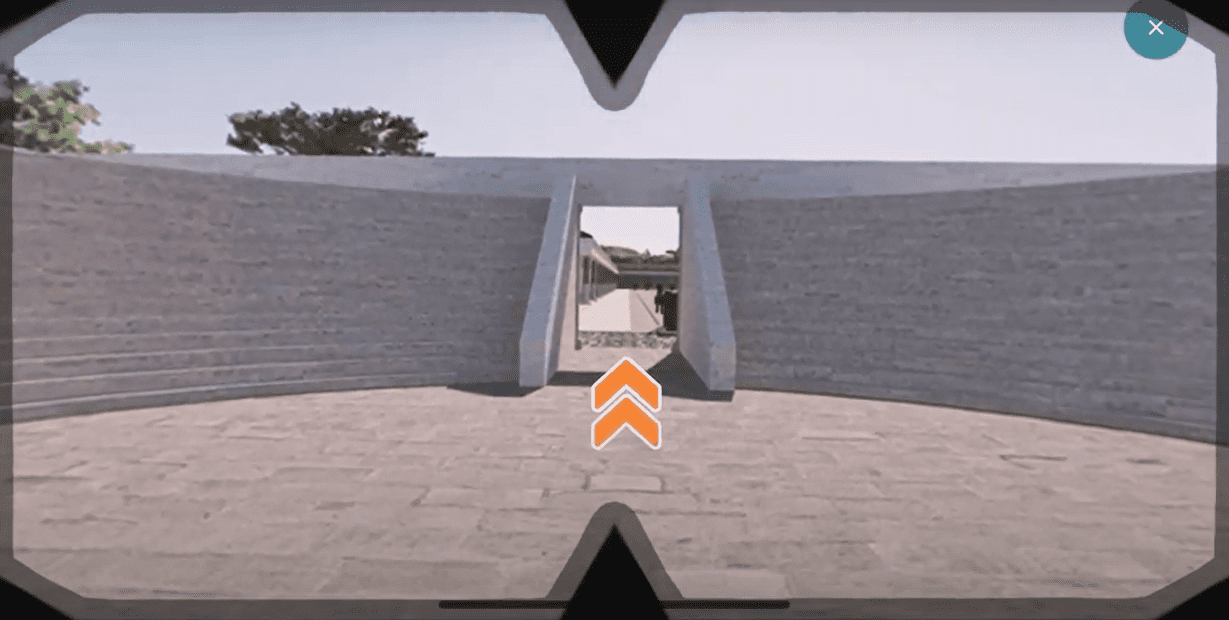
    Thanks to reconstructions made with attention, even to the smallest details, you go back to the past and get in touch with the architecture as it was; through the application the user can move freely by touching on specific arrows and travel in this virtual 360° world.

    To make this experience more immersive and evocative, it is possible to go inside each construction, giving the illusion of being physically where you are not. By pointing the phone at a building and tapping on the “i” button, the user can listen to audio explanations, information and other useful data.

    In this way the ancient Roman colony “Fregellae” comes back to life, upgrading and showcasing its beauty. The visitor is invited to perform a series of actions that will further engage the perceptual channels for a memorable experience. 

    How to experience Roman colony with augmented reality thanks to the AR-media Player app

    Build AR and VR experiences for archaeological areas with AR-media

    The relationship between AR-media and the archaeological sector represents a long process of digital evolution that is taking place in different archaeological areas. The choice of AR-media is to be able to give users a journey that is not only informative but also emotional. The AR-media application transforms the visit into a multisensory experience, involving the visitor, transforming her into a participating and active actor and expanding the journey with interactive content. By connecting from a smartphone or tablet the user is immersed in a unique virtual context with a high emotional impact. 

    AR-media’s augmented reality helps to connect history with the new digital reality and is particularly suited for:

    • Virtual tours both indoors and outdoors
    • Augmentation of ruins, helping the visitor to visualize the ancient beauty of the sites
    • Sites with visitors from many countries, thanks to the support for multi language projects
    • Increasing the sites’ revenues by providing a premium immersive experience alongside the more traditional visit experience

    Augmented and Virtual Reality make the cultural experience immersive and engages users before, during and after the visit.

  • Augmented Reality in Marketing and AR use cases

    Augmented Reality in Marketing and AR use cases

    Industry experts have long known that Augmented Reality is a powerful marketing tool, while in more recent times the Pokémon Go boom has made everyone understand the huge business impact of the technology.

    There have been many businesses that have ridden the wave exploiting PokeStop and Pokémon gyms in order to attract a greater number of customers, and getting some success.

    Pokémon Go, to be honest, is not the world’s most powerful implementation of Augmented Reality, although in its simplicity it was able to achieve unprecedented success.

    Application scenarios of Augmented Reality in marketing are numerous and require a dedicated study.

    AR for print products

    Although the digital revolution has dramatically changed the way we use information, still a relevant piece of information is conveyed through paper, such as newspapers, magazines, catalogs, flyers, books, etc …

    Despite having lost ground to digital, paper products are still a powerful means of communication and this is confirmed by the McKinsey Global Media Report 2015 which basically highlights two trends: the first concerns the maturity of the print media (+ 1.7% growth from 2014 to 2019); the second a steady growth of the digital (+ 9.5% in the same period).

    This suggests that these two seemingly distant worlds, can live well together, and indeed they can also cooperate. In fact, according to research by Digimarc, 75% of consumers think that digital media is a complement to paper, rather than a replacement.

    Marketers from all sectors can think of innovative ways for presenting their products and services, combining greater clarity of the offer to a greater customer engagement. It has been demonstrated, according to the claim made by Lisa Hu, that using Augmented Reality you can get a dwell time 2.5 times higher than that of traditional media (TV, radio and newspapers).

    To date, cases of successful Augmented Reality implementations in the publishing area relate to, among others, the creation of immersive catalogs, magazines and books with AR.

    Augmented Reality for events and trade shows

    The promotional environment for excellence, for many companies, is that of fairs and events in general. These are special occasions for companies to show off theirs strengths and to try to engage visitors in order to convert them into customers or at least into leads.

    In this context, companies focus a lot on entertainment, giving visitors the opportunity to try the products and to make the time spent at the stands a memorable experience.

    The use cases of marketing actions with the support of Augmented Reality in this area are diverse, ranging from brochures and catalogs with immersive 3D visualization of the product, to the organization of contests and gaming experiences to engage and amaze visitors giving them a concrete idea of the real potential of the product.

    AR for packaging

    A sub-set of paper products, to which more and more companies turn their attention to design marketing actions with Augmented Reality, is packaging.

    What better time to engage the customer and to provide additional information on the product except when she is face to face with the package?

    There are interesting use cases of interactive packaging that put people in a position to activate additional content or mini-games that come to life from a bottle of a soft drink, rather than from the foil of the chips of a fast food and so on.

    The result is an increase in brand reputation and customer loyalty, because when customers are faced with a similar product, they tend to pick the more exciting purchase experience.

    Augmented Reality for in-store experiences

    The natural ability of Augmented Reality to expand people’s vision makes it particularly suited to design in-store marketing experiences, allowing retail companies to offer additional layers of information to the visitors.

    This category of use cases includes indoor navigation to guide people in a particular area of the store, maybe to locate special deals; the display of products and information that is not physically present in the stores because of space limitations; the possibility to sort or read the data on the origin, understand the production process, watch a promotional video, etc …

    These experiences can be enriched by the gamification of the buying process with premium and retention mechanisms.

  • Experience NASA’s Mars Perseverance in Augmented Reality with AR-media

    Experience NASA’s Mars Perseverance in Augmented Reality with AR-media

    On February 18th 2021 the NASA’s Perseverance rover successfully landed on Mars and started its exploratory mission, consisting mainly in the collection of samples, images and sound of the red planet.

    The first images and sounds released by NASA have garnered a lot of media attention, so we decided to use the official Perseverance 3D model in order to create and publish an Augmented Reality experience of the rover in 1:1 scale.

    Thanks to this experience you’ll be able to enjoy the Rover anywhere in your surroundings and get projected on a multisensorial Mars environment as recorded by Perseverance. If you use a suitable AR/VR headset for smartphones you can select the new immersive visualization mode of AR-media to enjoy a truly Martian immersive experience and, in a way, feel like being there.

    How to enjoy the AR Mars Perseverance experience?

    If you want to play this Augmented Reality experience just download the AR-media Player app from your favourite app store (Google Play Store, Huawei App Gallery or Apple App Store), open the app and select the Mars Perseverance card from the list of available projects.

    Then just download the experience and follow the instructions: you will be asked to move your device to create a map of the surrounding environment and after that just tap on the display to place the 3D model of the Mars Perseverance rover where you want it to appear.

    How was the experience created?

    This Mars Perseverance experience was easily created using AR-media and creating a spatial project. We downloaded the 3D model and the 360 image from the NASA free resources and assembled them in a just few minutes.

    A guide on how to create spatial projects with AR-media can be found here: Learn how to use AR-media in under 3 minutes – YouTube

    Get a free AR-media account and start creating, you can rely on detailed tutorials and documentation available in the support section.

  • AR-media Plugin for Autodesk 3ds Max released

    AR-media Plugin for Autodesk 3ds Max released

    When the new generation of the AR-media platform was launched, we announced some major changes to the authoring workflow, including the way the AR-media plugins work within this new release.

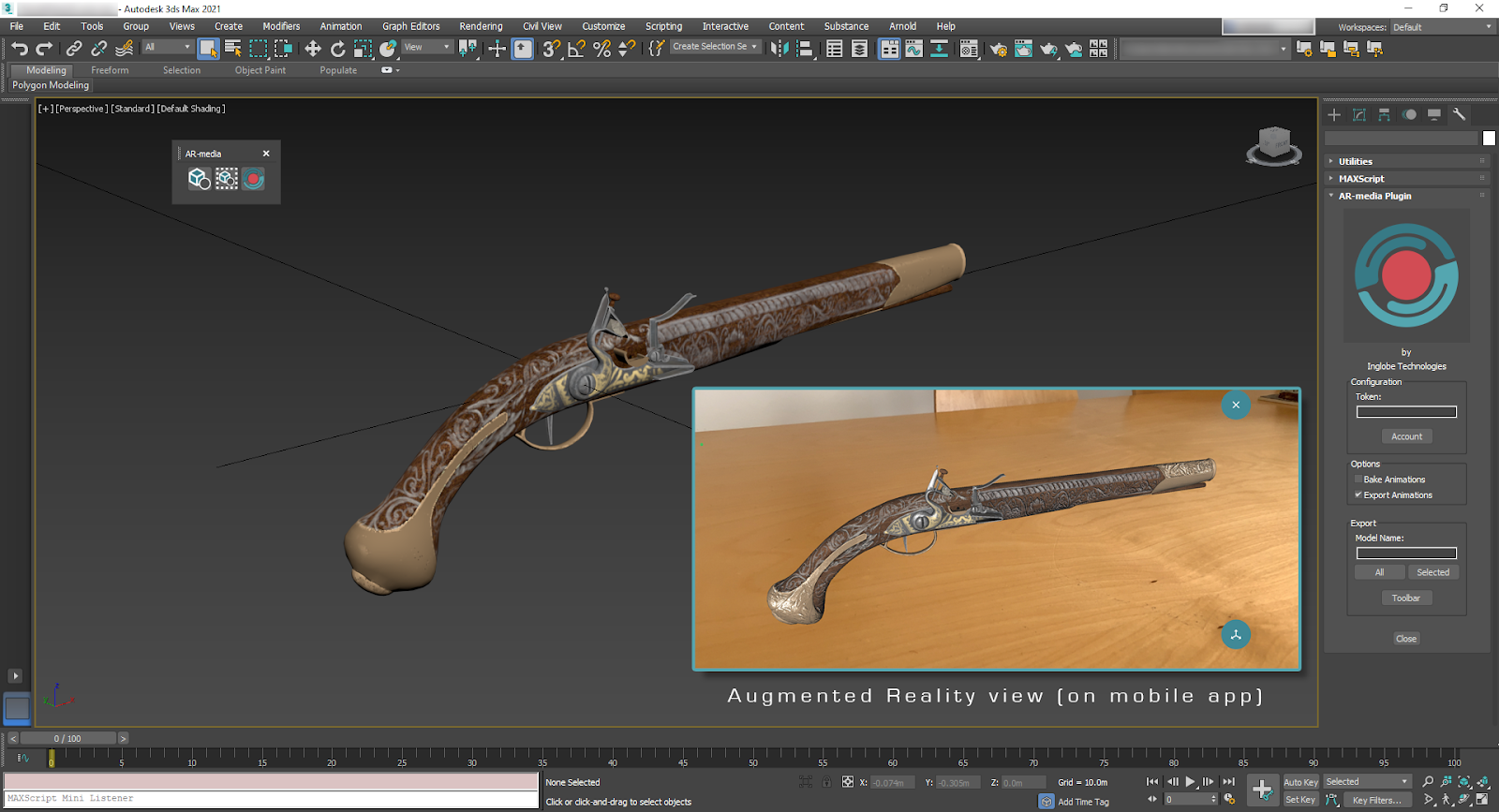
    In particular the authoring of Augmented Reality projects has been moved from the 3D modeling software to the web platform, while the plugins are now designed to just export your 3D projects in order to make them easily and readily available inside the AR-media Assets Manager.

    While AR-media allows you to easily export your models from nearly any 3D modeling software by following some simple guidelines, some users still prefer to have a dedicated export to do the job, and here is where the Autodesk 3ds Max plugin comes into play.

    AR-media Plugin for Autodesk 3ds Max Highlights

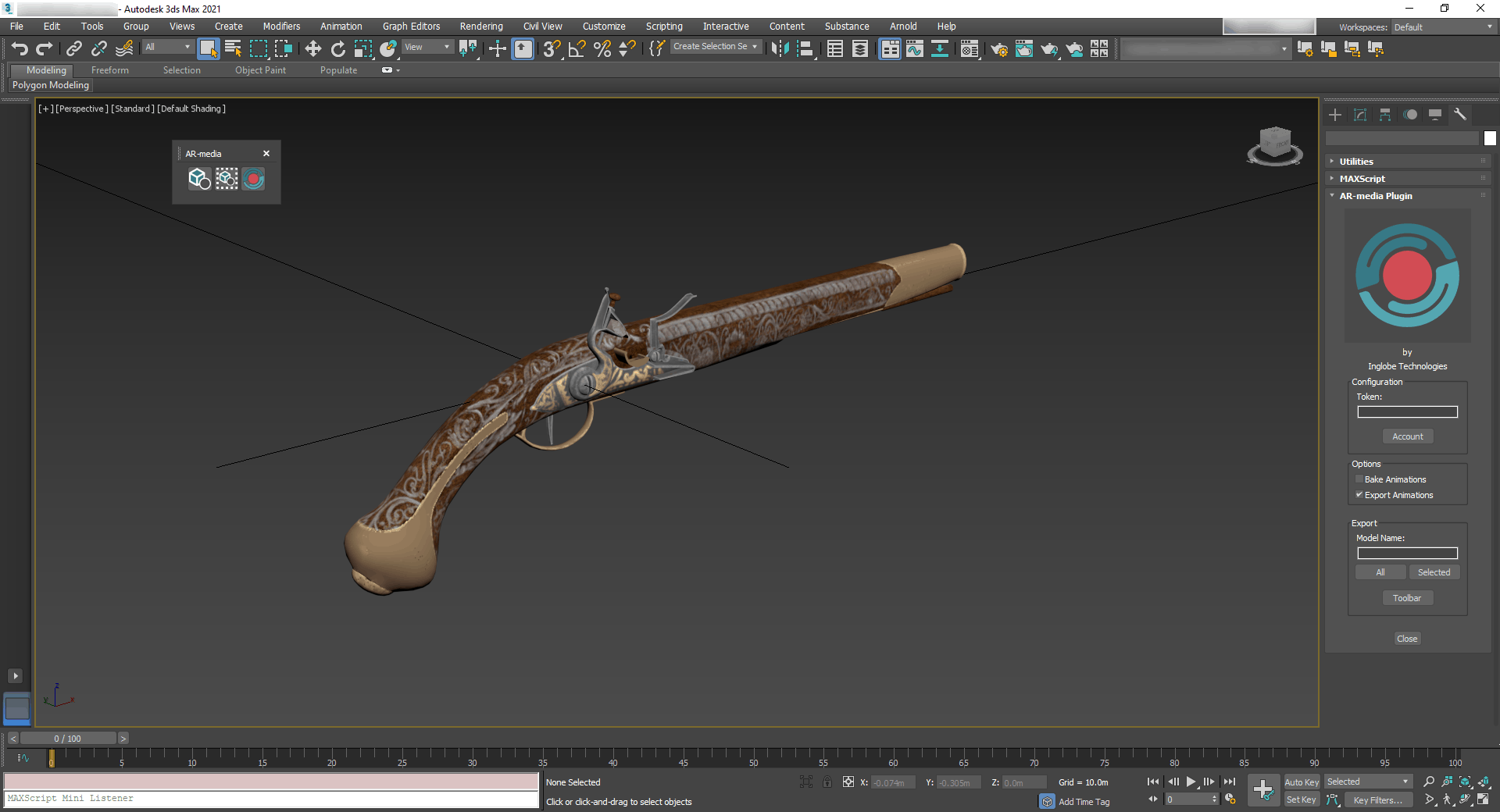
    After releasing the Trimble SketchUp plugin for AR-media, we are now releasing the Autodesk 3ds Max plugin to the community. It provides the ability to export 3D projects and upload them to AR-media directly from the software by means of a dedicated toolbar and sidebar.

    The plugin lets you:

    • Export the entire scene
    • Export the selection
    • Go to your AR-media Studio Account
    • Bake the animations
    • Export the animations
    The AR-media Plugin for Autodesk 3ds Max

    Download the AR-media 3ds Max Plugin from the Autodesk App Store and start creating. Also

    Get your free AR-media Plan

    AR-media is the ideal tool for users willing to create simple to advanced AR and VR projects for mobile devices without coding. The platform supports planar, spatial and location-based tracking, offering a wide range of possibilities in order to make your projects unique.

    Among the content types supported we have images (2D and 360), videos (2D, 360 and Alpha), audios, 3D models (static and animated), HTML5 packages, buttons and CTAs.

    You can get a free AR-media account and start creating, relying on detailed tutorials and documentation available in the support section.

  • Interacting with multiple objects in AR-media

    Interacting with multiple objects in AR-media

    In the recent weeks we released the long waited new version of the AR-media platform, a new generation Augmented Reality software targeted to end users, usually without coding skills, who need a quick and effective tool to create AR projects in various verticals, including Architecture, Engineering and Construction (AEC), Marketing and Publishing, Cultural Heritage and Museums, Medical, Education and more.

    This new generation of AR-media is made of the following components:

    • AR-media Studio:  Web based Experience Creation
    • AR-media Plugins: Optional exporters for the major 3D modeling software
    • AR-media Player: Mobile viewer app for iOS and Android 

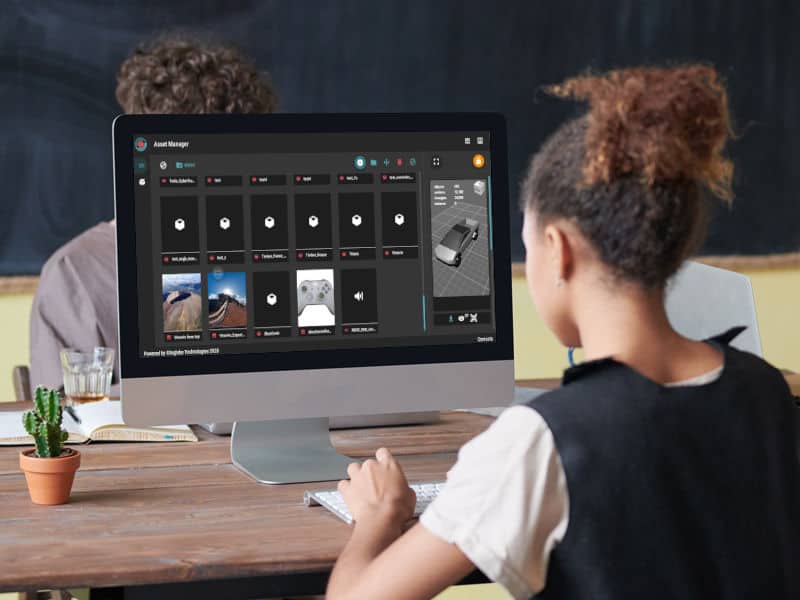
    AR-media Studio allows the user to upload her content into the platform’s Asset Manager, the area where multimedia files are stored and eventually organized in folders and subfolders. With respect to 3D models, such files can be exported from the major 3D modeling software, following specific guidelines.

    The next step is the project creation. Thanks to an intuitive 3D web editor, the user can add her content into so called “Augmented Reality scenes”, that is the combination of content and events created according to the final user experience on mobile devices.

    Finally the project can be made public, or shared privately, and enjoyed using the mobile application called AR-media Player, freely available on the app stores.

    Moving objects in the physical space

    Inglobe Technologies just released a feature update that includes the ability for users, using the AR-media Player, to select single items in an Augmented Reality scene and interact with it, other than with the entire scene including other objects.

    These new features also introduce the ability to pan objects and rearrange them in the physical space, finding the most suitable position according to the user intent.

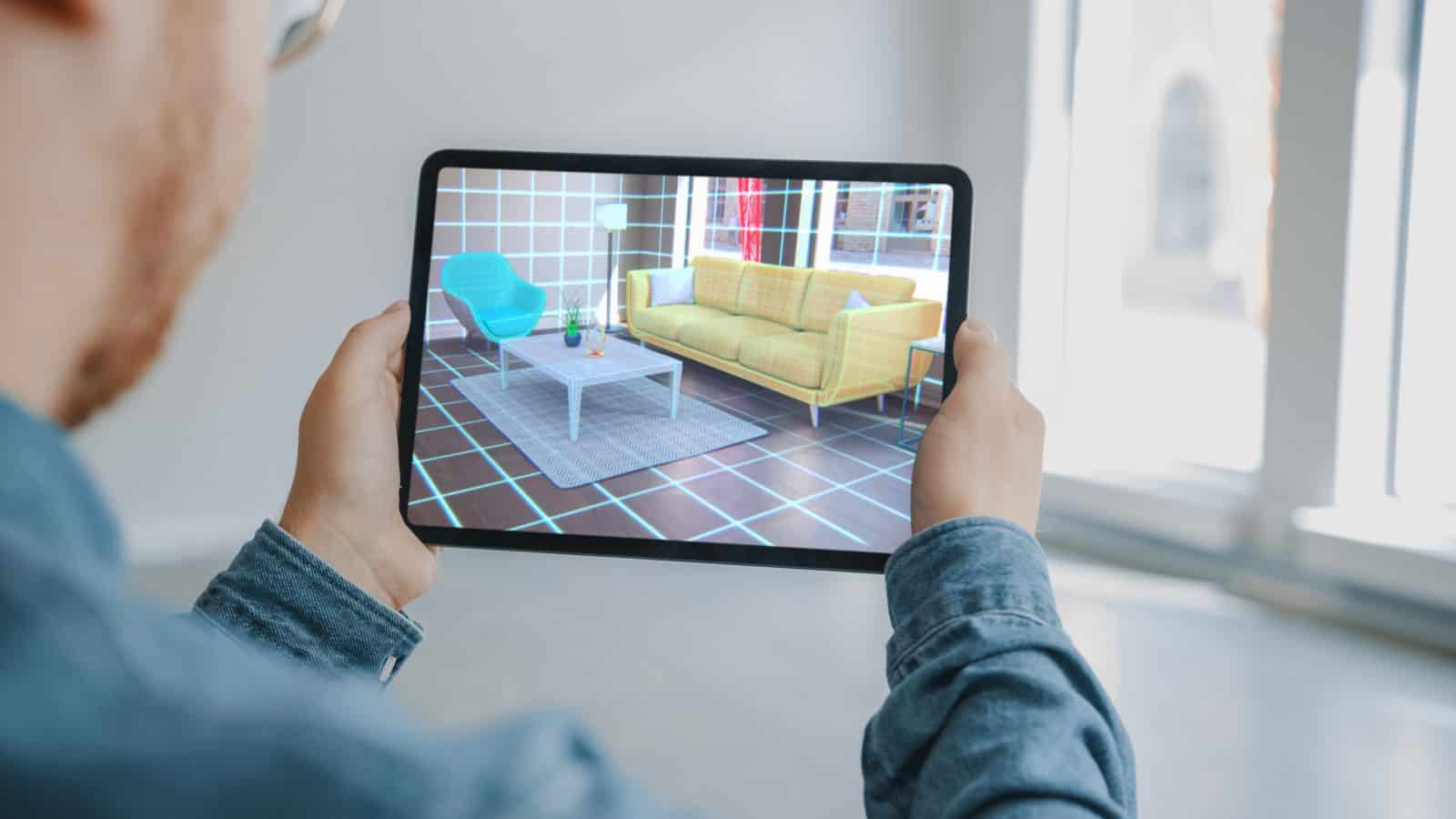
    The ability to rearrange objects’ position, size and orientation, makes AR-media a great tool for Augmented Reality in interior design, meaning a user can load her favourite pieces of furniture and accessories and visualize them instantly in the space, adjusting the combination and finding the perfect fit.

    How it works

    In order to use these functionalities, the user needs to download the free AR-media Player app from the stores (Android Play Store, iOS App Store and Huawei App Gallery) and browse through the list of the available categories, select a category and finally select the project she wants to download for Augmented Reality visualization.

    What the user has to do is just opening the AR-media Player on her mobile device, loading the project and visualizing it in the surrounding space, both indoors and outdoors. With a few easy gestures she can select the object she wants to move and then simply drag it to the desired position. Objects can also be rotated and zoomed.

    Switching content with AR-media

    Eventually, architectural projects and real-time interior design use cases, can be enriched by an additional feature AR-media offers, which is switching content by tapping on objects (or any other preferred user interaction) in order to visualize alternative design options.

    Suppose the user wants to decide which of the three sofas she is considering, fits best in her living room. Well with AR-media she can easily switch from one sofa to another and have an instant preview.

    Of course such a set of features can prove useful in many other application domains, like architectural design, project presentation, civil engineering and more.

  • The new generation of AR-media Plugins is coming

    The new generation of AR-media Plugins is coming

    Back in 2008 when the first generation of AR-media Plugins was released, Augmented Reality wasn’t the solid and promising technology it is today, but was probably more of a very risky bet.
    As Inglobe Technologies we have been among the pioneering companies worldwide to believe in AR and to invest in the development of products and solutions for Creators, Developers and Enterprises.

    Since then the AR-media Plugins have written an important page in the history of Augmented Reality, conquering the trust of over 50.000 registered users worldwide who have been creating immersive contents at an amazing pace over the years.

    Why have the AR-media Plugins been so successful?

    The reason for such a big success relies on the fact that Inglobe Technologies understood that there were so many Content Creators out there that were looking for innovative ways to present their work to their clients, colleagues or students, even if they had no coding skills. The plugins have been used with satisfaction by Designers, Architects, Engineers, Marketers, Publishers, Teachers and many more.

    The AR-media Plugins were designed starting from that intuition, providing 3D content creators with user-friendly coding-free tools that allowed for an easy authoring workflow starting from the 3D modeling software of choice. Among the supported products there were Sketchup; 3D Studio Max; Maya; Cinema 4D; Vectorworks and Scia Engineering.

    Users could easily prepare their Augmented Reality experiences and then visualize them by means of the AR-media Player.
    Back then Augmented Reality visualization wasn’t an all mobile and wearable thing, it was rather more frequent to view AR contents using a webcam connected to a personal computer, pointing to a previously printed marker.

    ar-media plugins 3D model autodesk maya

    The Smartphone changed… everything

    Exactly in 2008, when we were releasing the first generation of AR-media Plugins, Apple presented the first iPhone, paving the way for a revolution in the area of mobile devices that is still changing our lives as of today.
    The advent of the smartphone era is of vital importance for the affirmation of Augmented and Virtual Reality because it made it much easier to interact with AR contents and this trend kept growing over time as smartphones became more and more powerful.

    A more recent and inevitable revolution started with the advent of wearable devices as we know them today, as Google released the Google Glass in 2013. This type of device has not yet reached the maturity of smartphones, but it is changing the way AR and VR contents get enjoyed.

    Mobile and Wearable devices have changed so much our lives and brought at our fingertips an insane amount of technology and computational power for a relatively low price, opening the way for a major jump in the Augmented Reality market.
    For this reason we thought it was about time we totally redesigned our AR-media Plugins and platform in order to provide to the Content Creators a renewed and more powerful set of tools.

    What can you expect from the next generation of the AR-media Platform?

    We are actively working towards the release of the new generation of AR-media platform, currently testing some of the new exciting features that will be included in the new version.
    In the new version you will find a cloud based authoring tool, the AR-media Platform, where you will be able to easily create advanced AR and VR contents without any coding, as well as a set of exporters, the AR-media Plugins, that we’ll be releasing gradually for the major 3D modeling software (Trimble SketchUp, 3ds Max, etc…) and a companion mobile AR-media App.

    Note that the AR-media Plugins will be a support to export the contents properly from their native programs, but they won’t be mandatory, as you will be able to export any model following our guidelines and to upload them directly to the AR-media platform.

    The viewer for the previously created experiences will be the AR-media Player as usual, that will be made available for both iOS and Android from day 1.

    Among the new features we can already disclose the following will be included:

    • Cloud based Experience Creation (AR-media Studio)
    • Optional exporters for the major 3D modeling software (AR-media Plugins)
    • Mobile viewer app for iOS and Android (AR-media Player)
    • Spatial mapping to view your contents in the environment (indoor and outdoor) for a markerless experience
    • Many more to come…

    The new generation of AR-media platform will be made available in the coming weeks, please keep following our channels for more updates.

    Follow our Linkedin page
    Follow our Facebook page
    Subscribe to our YouTube Channel

  • Inglobe Technologies releases AR-media 3D SDK with Unique Object 3D Tracking Features

    Inglobe Technologies releases AR-media 3D SDK with Unique Object 3D Tracking Features

    The Development Lab of Inglobe Technologies announced the release of the AR-media 3D SDK and platform on the first day of Augmented World Expo in Santa Clara, CA. The AR-media 3D SDK v.1.0.0 features advanced 3D object tracking, a new 3D mapping and tracking approach that allows to create first of a class augmented reality (AR) applications capable of recognizing and tracking objects independently of their size and geometry.

    Inglobe Technologies first demonstrated the AR-media 3D Tracker prototype working on mobile devices in Santa Clara during Augmented World Expo 2013 catching the eye of many interested users. The new release will bring an enhanced version of the technology to the community of developers with extended support for multiple platforms and authoring environments, like for example Unity3D.

    With the AR-media 3D SDK users will be able to create applications and systems that link the digital and physical world in ways never experienced before. The AR-media SDK enables a new generation of applications that redefine the boundary of indoor and outdoor augmented reality in domains like industrial maintenance, interactive gaming, architectural visualization and cultural heritage, just to mention some.

    “While developing the AR-media 3D SDK we have tried to bridge the gap between what users and developers expect from augmented reality technology and what they actually have.” Said Graziano Terenzi, CEO at Inglobe Technologies. “Our 3D tracking technology adds a new form of intelligence to the environment and allows users to develop products and solutions never imagined before”.

    The AR-media 3D SDK allows to create a new generation of gaming applications on site thus allowing developers to add digital interaction to real world objects around us and create funny and engaging experiences. By using the AR-media 3D SDK technology users can populate a historical site with virtual characters, help represent and reconstruct the past, like for example a battle or even take part to a battle as an active player and try to change the course of events.

    The 3D object recognition and tracking technology of the AR-media 3D SDK does not just recognize planar images, but also complex 3D objects and is suitable for applications in the industry. This capability will address the growing need of different industries (like AEC, Aerospace, Automotive and Process Industry) to enhance their processes by means of the interaction of physical and digital information.