Tag: education

  • AR in Educational Books: how to use it?

    AR in Educational Books: how to use it?

    Augmented Reality in education is considered today as an indispensable tool of the whole educational system, from the primary school to university. 

    The use of Augmented Reality in education allows the transition from the so-called “teaching-listening” to an active and participative method of study, in which children, class and teachers are involved in the learning process. They are no longer just observers, but protagonists. We talk about ‘augmented learning‘, which aims to stimulate students’ creative and communicative abilities. 

    Augmented reality applied to education actively involves students of all ages, giving them real learning experiences that improve their understanding of what they are studying and that foster interaction with the content, thus improving not only learning but also the level of attention, thanks to the effect of surprise and wonder. 

    AR in education is also an inclusive tool that allows teachers to integrate communication and to simplify it: from primary schools to higher education or university, extended realities can help teachers to explain complex concepts and visualise physical objects that are difficult to understand presented by the flattened and unrealistic images of books; thus allowing to study all subjects in an engaging way: from biology to art, from physics to chemistry up to computer science and languages.  

    Interactive content with Augmented Reality in Educational Books

    Is it really essential to make use of Augmented Reality in school books and teaching materials? The answer is yes. Numerous studies on the brain provide evidence that the best way to learn and therefore remember what you are studying for longer is to “do”. Studies have shown that, after two weeks, students remember only 10% of what they have read, but as much as 90% of what they have actively done. 

    Augmented Reality in education

    Augmented reality makes the learning experience immersive and therefore exciting, the more the material to be learned is linked to emotions the longer the memory retention will be, because it is designed to be relevant to the brain.

    What are the benefits of Augmented Reality for Education in school books?

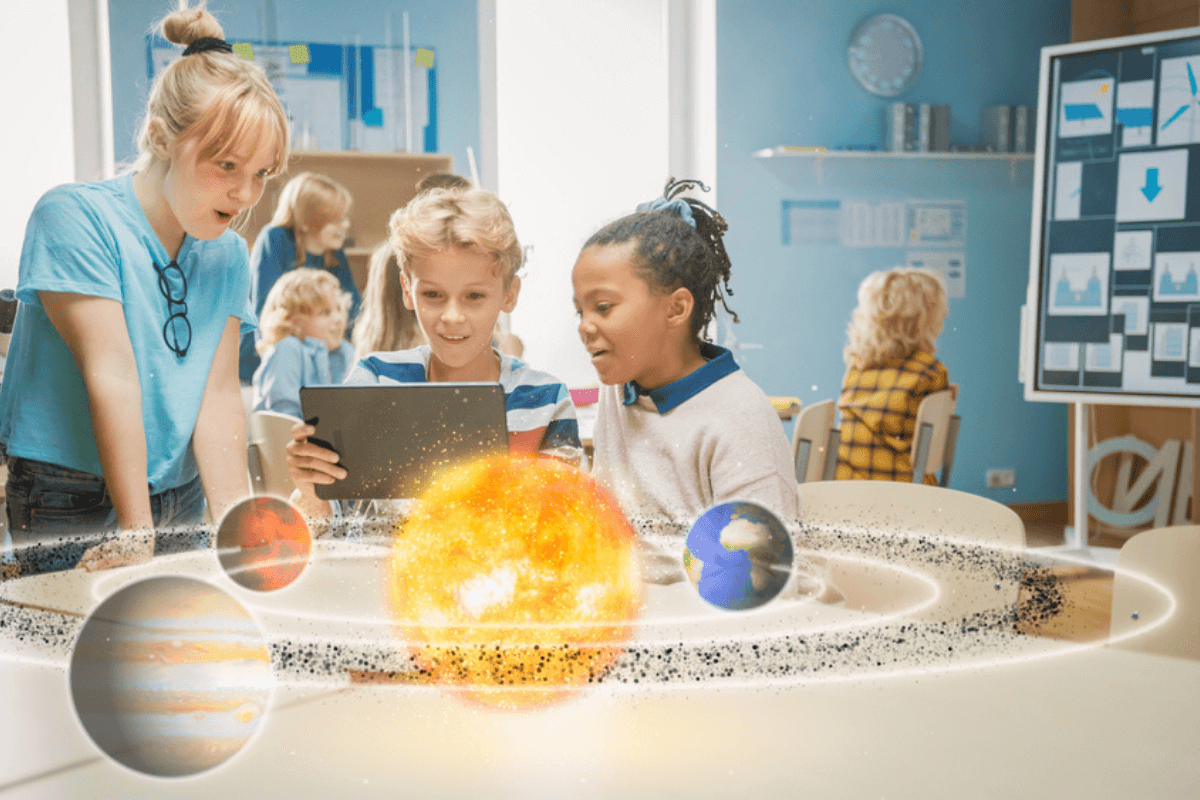
    – Making connections and stimulating curiosity: augmented reality (AR) allows students and teachers to superimpose information, images and other content onto real-world scenes. This creates new contexts and effective connections that enhance learning and promote understanding. Teachers can use augmented reality apps in the classroom to turn it into a planetarium, making a science lesson more relevant;

    – Stimulate engagement through realistic explorations in motion; visualise and experiment during science or physics lessons; 

    Augmented Reality in educational books

    – Delving into hidden levels and systems based not only on theory but also on pratice part to become more familiar with the teaching material by allowing students to move and explore;

    – Enriching existing programmes with extra content in the form of video, audio, animation and immersive storytelling;

    – Carrying out large-scale projects and proposing challenges, the student will also stimulate problem solving skills and teamwork through the use of AR.

    New Ideas for STEM Subjects Lessons 

    You can imagine how many things can be done during STEM (science, technology, engineering and mathematics) lessons from the primary school to the university. During math lessons students can move between 3D shapes and graphs.

    In science classes, students can see the life cycle of an animal they are studying, study a live specimen in AR and explore its organs, systems and vocabulary as if they were looking at the animal in the flesh. 

    AR is used for learning during physics lessons, allowing students to experiment with atomic nuclei and the reactions in which they are involved. 

    STEM educational content with AR

    Use cases of Augmented Reality in education

    We have analysed some use cases where we believe augmented reality can have a strong impact on school books.

    Use case 1: Getting in touch with the studied content

    A software platform was designed to let students immerse themselves in the ecosystem of a river and explore how water interacts with animals, plants and human habitats. They could also discover what happens when the balance is altered. The learners came into contact with animals, discovered rivers, dams and ecosystems in other parts of the world. 

    Case study 2: The development of an educational video game.

    A video game platform was developed to engage its students and assign them ‘alternative’ tasks.

    By modifying even just the form of classic mathematical problems and inserting invented characters or simple stories, the students worked more enthusiastically and with better results. To find out how the story ended and what happened to the main characters, students had to solve the maths and physics problems they encounter each time. 

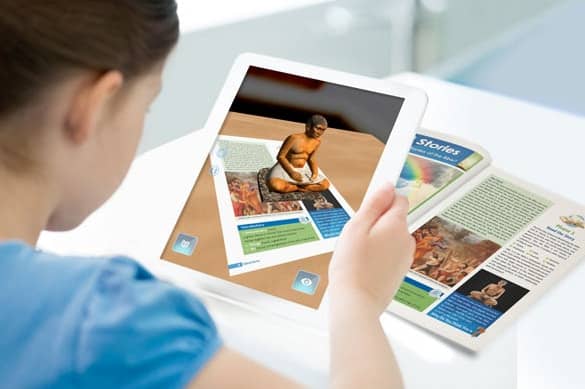
    Kid reading an education book with AR

    The Liquid Book. Updating existing materials with AR.

    In the effort of offering up to date and fresh educational content, most publishers release annual updates of their books and student, in turn, have to buy them even if they owned an older edition of the very same title. This need of continuously updating educational books may not be percieved positively from families that can’t pass the books of their first born to their second child.

    AR actually offers a solution to this problem by providing the updates, and even selling them, through a mobile app, in association with the book. Publishers can monetise on the updates only, without needing to produce a new edition altogether (with all its relevant costs) and the book enjoys an extended lifespan.

    No longer an enemy to fight, the second hand market becomes in fact an indirect ally for the circulation of the “cornerstone-book” upon which to build a new way of enjoying contents (with even vertical integration opportunities). Families attain significant savings. Think of a case where, instead of 50 euro for a brand new book, one can pay 25 euro for its second hand version plus 7 euro for the relevant updates: savings in the region of 35/40% are not unreasonable to imagine.

    Augmented Reality in education

    This hypothesis of “liquid book” would then resolve the false trade-off between publishers’ profits and unwarranted costs out the families’ pockets, while allowing a plunge in the digital era without leaving the reassuring presence of the physical book.

    But there is more. Employing augmented reality would open endless possibilities in terms of innovative contents, as well as offer a helpful tool for students with special needs – all stemming from the very same cornerstone: the good old schoolbook.

    Finally, there is a significant environment-related consideration to make: not only would the liquid book model reduce the waste of quickly dismissed books, but also the Co2 emissions linked to the production and distribution of the final product.

    A win for all, then? Well, not really, as it would appear. In the depicted scenario, the actual manufacturers of the books, that is, the printing companies, seem to be the ones losing out.

    Not so fast, though. This proposal does not threaten the book: it saves it.

    The most likely alternative scenario, in fact, is not the indefinite conservation of the status quo – clearly unrealistic – but a radical online shift instead: augmented reality can give paper a new life.

    In a such re-designed value chain, printing companies should in fact consider to include augmented reality within their products’ portfolio: by using ad-hoc platforms they can do so without developing in-house technical competences – hence without shifting their focus away from their core business – thus innovate in a planned and strategic manner, not in a panicky response to a sudden threat.
  • AR & VR for education helps students to learn more and better

    AR & VR for education helps students to learn more and better

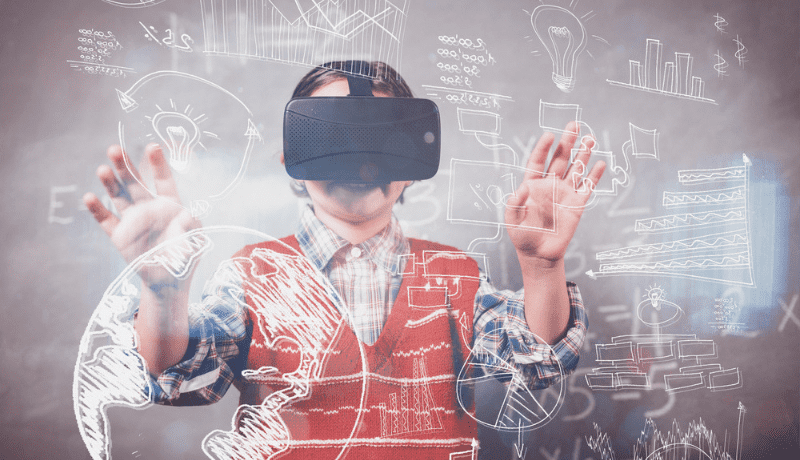
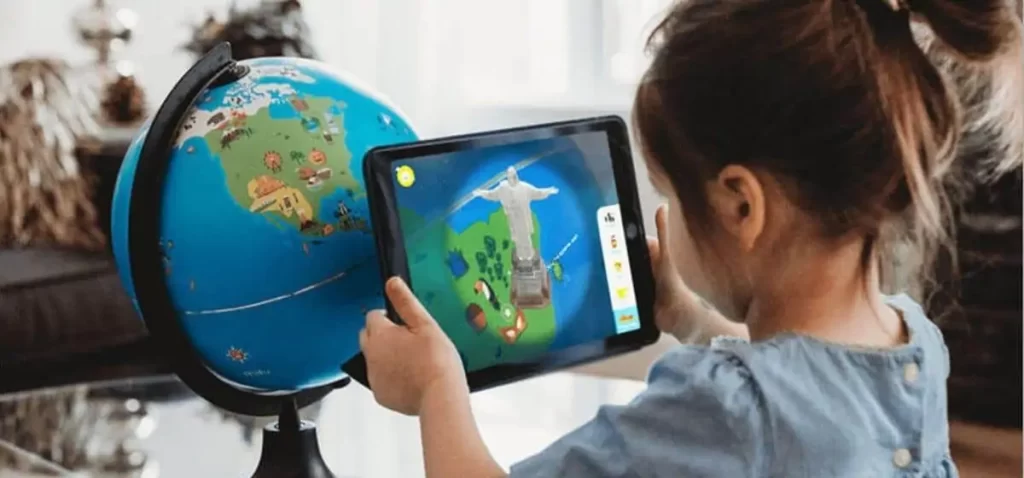
    Learning through AR & VR technologies can be a very effective educational methodology, able to engage the students and make content more attractive to them. The entire process can become more interactive and fun. In the field of education and training there are application tools that can help to improve the teaching-learning process by making it more connected with the surrounding environment; learning can become a more collaborative journey through the creation of interactive spaces that can encourage greater student involvement. 

    Through augmented reality, teachers can engage students by capturing their attention, making them have a great time: they will be able to remember the proposed topics more easily, even the most difficult ones will be more understandable. We believe that AR & VR for learning can become an essential component of the educational process, helping schools and teachers  to meet the needs and habits of the new generations.

    AR & VR for education help students to learn more and better

    For those who have kids in school age, the last couple of months have been quite a revelation.
    Used to kiss them goodbye in the morning and see them again only many hours later, whatever happened all day long inside the classroom was largely a guessing game, with the sole prop of clues that were either sporadic (the interaction with the teachers) or outright poor (the recounts of the usually reticent pupils).

    But when suddenly home-schooling became the new normal, it was as if the fourth wall collapsed, allowing us to take a glimpse at what happens routinely behind the scenes.
    A somewhat displacing experience, the one thing it did was giving us a better understanding of both the benefits and the limitations of digital and traditional means to deliver education.

    There is no doubt that a physical interaction with teachers and peers is crucial, not only for learning purposes, but also for a healthy social development; on the other hand, the increased adoption of communication technologies that are already part of the youngsters’ lives plays a role in engaging them more and better in the learning process.

    As such, we suddenly found ourselves at a crossroads where we must solve the dilemma and obtain the best of both worlds: by blending real world and digitally constructed contents, immersive technologies can be the answer.
    Let’s be clear about this: the pandemic did not raise the question from nowhere; it simply put it right at the top of the agenda. The case for mixed reality was already there well before the outbreak, and it rests on a set of reasons that we can schematically summarise as follows.

    The Benefits of Augmented Reality for Education

    Improve students’ engagement

    This is arguably the most powerful driver, as the interactive nature of  AR & VR for learning helps raise attention’s levels on any subject.
    Think about a maths lesson where pupils learn proportions by designing a building and then seeing it digitally erected: if their calculations are wrong, the result will be evidently disastrous! Not only that, but they will be extra-motivated to understand the theory better in order to improve the outcome. In addition, AR &VR enable students to study and learn more effectively, without distractions, they can improve their understanding of topics and have a better information retention over time.

    AR & VR for education help students to learn more and better

    Increase knowledge retention

    Research on the topic is extensive and unequivocal: by pulling contents through their own discovery, users recollect more memories – and more vividly – than they do when they are at the receiving end of a “passive” teaching approach.

    Augmented Reality is the perfect vehicle at this respect: one thing is to learn chemistry on a book; a totally different experience is to so by conducting experiments virtually, thus – by the way – without the need to equip an expensive lab.  Augmented and virtual reality are kinaesthetic learning, a system that helps students learn things better through direct practice instead of listening to lectures orally.

    Gamification of Learning with AR & VR

    How to apply the dynamics of video games to stimulate learning in schools?  

    Gamification is the use of game elements in contexts other than gaming, such as in education. Through challenges, exciting quizzes, based on the video games model, students are able to obtain a higher motivation as well as increased interest and creativity. 

    Learners will be more motivated and will eventually achieve better results. It is also motivating for teachers to be able to use innovative teaching strategies and tools in order to connect better with the new generations.

    AR & VR for education help students to learn more and better

    Seek cost-effectiveness in Education

    The “virtual lab” example has introduced the idea, but there is more to add in respect to costs saving.

    Sure, immersive technologies entail upfront investments that, especially in the case of public institutions, might initially be seen as a stumbling block.
    A couple of things however must be taken into account: first of all, applications of this kind increasingly run on hardware that is already in the students’ hands (their own mobile devices); and in the mid-run, the flexibility and the ease in updating the contents reduces the costs for designing and renewing the lessons.
    In short: while acquisition costs are decreasing, cost savings are getting more and more conspicuous.

    AR-Media included in the i-pear toolkit of educational AR & VR platforms

    The AR-Media platform has been selected to be featured on the iPear network (Inclusive Peer Learning with Augmented Reality Apps) project by the AETMA Lab of IHU University, Greece. The iPEAR project brings together the expertise of technology-enhanced learning researchers, computer scientists and educators to build a strategic partnership to optimize the adoption of Augmented Reality (AR) technology in education. The project will create innovative, accessible training resources for teachers that help implement and integrate active and collaborative learning pedagogical approaches supported by AR.

    Technological advances have influenced every aspect of our lifestyle: from communication, to the world of work, to social life. The school and educational context has also opened up to technology and digital teaching innovations to ensure that schools keep up with the times.  

    AR & VR for education help students to learn more and better

    AR-media believes in the importance of integrating education with Augmented and Virtual Reality by providing its users with diversified plans created to meet different needs. Recently we made available dedicated educations plans for Students, Teachers, Classrooms, Schools and even a custom Academy plan with more personalization options.

    We aim to offer the most competitive prices on the market, to let everyone work and study with Augmented Reality tools. AR-media for Education offers exclusive features such as the possibility to create tests and quizzes, send assignments to the Students and give them a feedback/mark and much more.

  • AR-media Educational Plans now available

    AR-media Educational Plans now available

    The last two years have been very critical for Education worldwide with a pandemic disrupting the relationship between teachers and students, since for many it’s been impossible to stay in class.

    These challenges led to the emergence of alternative teaching methods, with digital tools helping the transition to a virtual classroom model and distance learning gaining ground quickly.

    In many occasions we have talked about the importance of activating a true digitization of the learning process and materials in order to empower both students and teachers with modern technologies, this is why at some point we decided to offer an easy to use, yet very effective platform to the educational users.

    Starting today, we are finally introducing the AR-media Educational plans to our community.

    Taking into account several different educational use cases we made available 4 plans: one for Students; one for Teachers; one for Classrooms and one for Schools. In addition, we have another plan named “Academy” that can be customized according to the number of classrooms and students.

    As with the existing plans for Individuals and Companies, we aim to offer the most competitive prices in the market, since we believe everybody should have access to Augmented Reality authoring tools.

    The users who will undertake the purchase process will be asked a proof of enrollment if they are students or a school certificate if they are a teacher or an educational institution.

    AR for students, teachers and educational institutions

    Whether you are a college student building your AR project for your thesis or a teacher exploring new ways to make lessons more interactive and engaging, AR-media Educational plans offer you the features you need at a very competitive pricing.

    For classrooms and schools, when teachers need to involve dozens of students, AR-media offers dedicated plans with exclusive features, such as the possibility to create assignments, give marks and provide feedback to the students. This is a great way of using the platform as a true collaborative environment. Students can even work as a team on the same project!

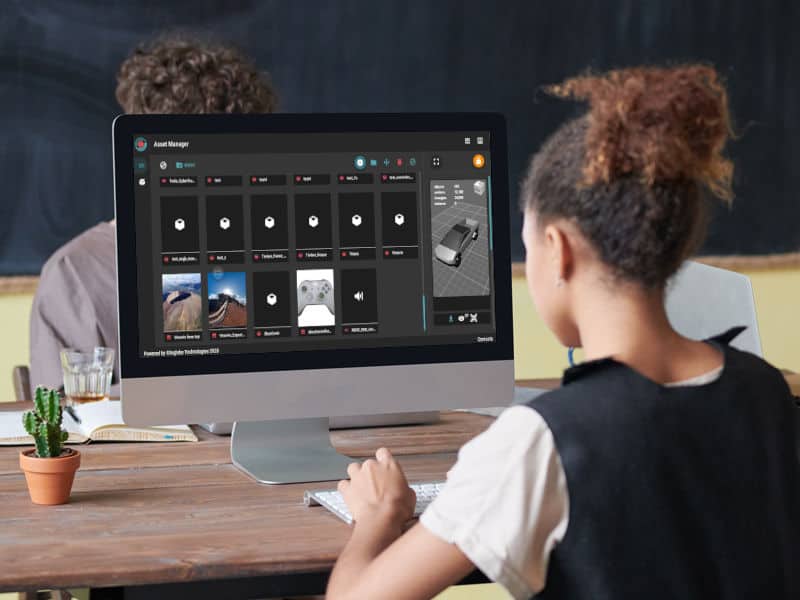
    Evaluating a student’s project on AR-media Studio

    Get a free AR-media account and start creating your educational project, you can rely on detailed tutorials and documentation available in the support section.